
Blog
58% of SMBs Now Use AI. 91% Report Revenue. Here’s What That Actually Means for South Florida.
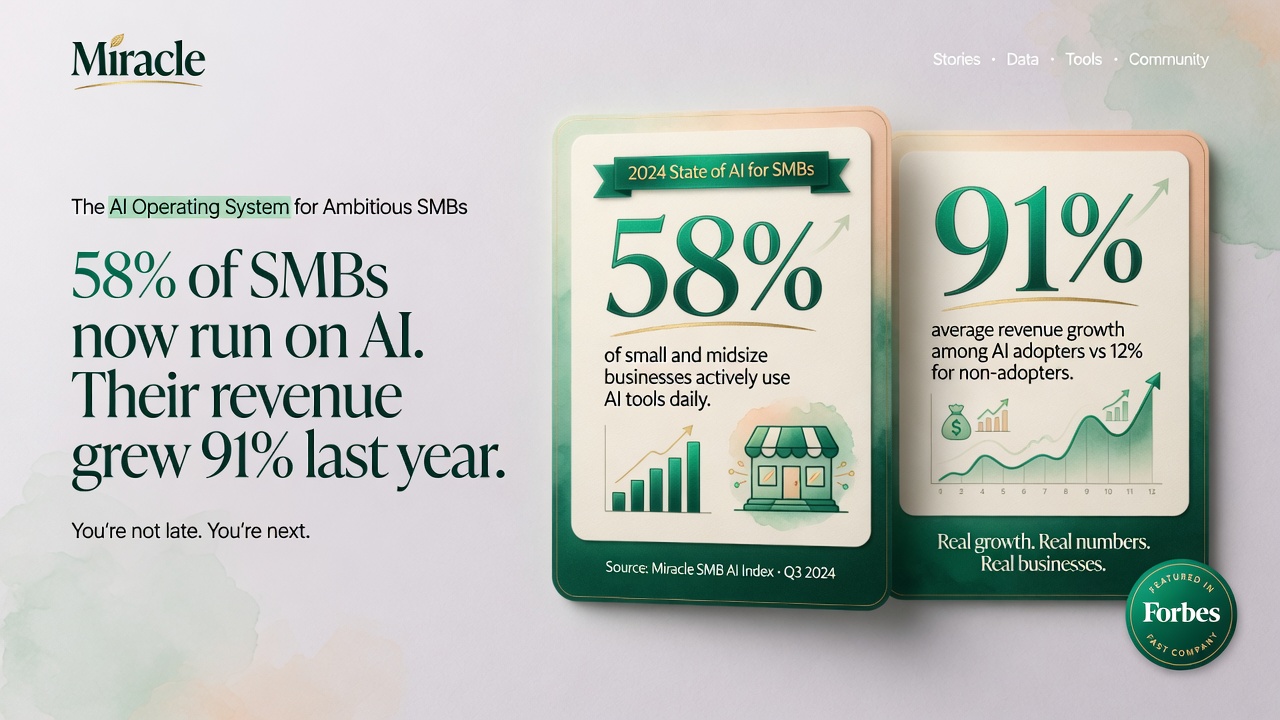
Let me be direct about what the data actually says.
The U.S. Chamber of Commerce reports that 58% of small businesses now use generative AI , up from 40% in 2024, more than double the rate from 2023. Salesforce’s latest SMB Trends Report finds that 91% of those businesses report a revenue boost from AI. The Small Business Administration tracks that the adoption gap between small and large businesses shrank from 1.8x to 1.2x in 18 months , the fastest technology adoption cycle in modern business history.
Those numbers are real. They come from 34,000 businesses surveyed in the Forbes/QuickBooks AI Impact Report published May 29, 2026. But here is what the data also says, because Forbes asked a different question: 50% of AI-adopting businesses could not name a single metric they track. They reported a “general feeling” that their business was better.
That is the gap this article exists to close.
The South Florida story within the national story
Miami-Dade County has an official AI Vision for 2026. The Miami metro ranked 20th globally in the Global Tech Ecosystem Index. The South Florida Business Journal reported in May 2026 that 54% of South Florida businesses believe AI adoption will increase their workforce over the next 12 to 18 months , not shrink it.
South Florida has conditions that make AI adoption compound faster than most markets. About 73% of Miami-Dade County speaks a language other than English at home, primarily Spanish. Miami businesses serve Cuban American, Venezuelan, Colombian, and Brazilian communities daily. An AI tool that only works in English is not a tool for Miami. One that handles bilingual lead response, WhatsApp conversations, and dialect variation is a competitive weapon.
A boutique hotel in Brickell deployed a bilingual AI voice agent in late 2025. Phone reservation capture went from 64% to 91% in eight weeks. The revenue impact was roughly $34,000 per month from reservations that previously rolled over to competitors. That is not an outlier. That is what targeted deployment looks like.
What the 91% revenue figure actually means
The common read of the Salesforce data is “AI works, buy it.” That is wrong.
The Salesforce report also says that 83% of growing SMBs have adopted AI, compared to 55% of declining businesses. And 78% of growing SMBs plan to increase AI investment, compared to 55% of declining peers. The difference between the two groups is not which tool they bought. It is whether they built a system.
The businesses reporting revenue growth did not install a chatbot. They defined a workflow, automated one step, measured the change, and repeated. The 55% of declining businesses that adopted AI bought a tool without a process.
The Forbes/QuickBooks report makes this explicit. Surveying 34,000 businesses with the University of Chicago, it found that 77% use AI at least regularly, 41% report revenue increases, and 74% report productivity improvements. But when researchers asked how businesses measured those improvements, answers became “vague.” More than half of respondents stated a general feeling that their business was better. Less than half tracked specific metrics.
This is not an argument against AI. It is an argument for deploying with intention.
What an AI operating system looks like for a South Florida SMB
At Startup Miracle, we use the term “AI Operating System” to describe something specific. It is not a chatbot on your website. It is not a ChatGPT subscription. It is a centralized knowledge layer that connects every part of your business.
Here is what that means in practice.
A roofing company in Pembroke Pines gets 40 inbound calls a day. Before an operating system, those calls hit a front desk person who takes a message, emails the estimator, and hopes the callback happens within four hours. Speed-to-lead benchmarks show that businesses without formal response processes have a 29.5% chance of responding within 15 minutes.
With an operating system, those calls are answered by an AI voice agent that qualifies the lead, checks the calendar, books the estimate, and adds the appointment to the CRM , in both English and Spanish. The estimator wakes up to a fully scheduled day of confirmed appointments instead of a voicemail transcript. The lead that called at 9 PM does not call a competitor at 9:05.
The architecture: Claude Code designs the workflow strategy. Codex runs the execution layer. Hermes Agents handle the always-on orchestration. The system learns the roofing company’s pricing, service area, warranty terms, and common customer objections. Teach it once, it runs forever.
The cost question every owner asks
A full AI operations setup for a 10-50 employee business runs $1,500 to $4,000 per month, including implementation, tuning, and ongoing management. That is the boutique implementation tier that the Mi Assist Miami market analysis identifies as the highest-ROI investment for mid-market South Florida businesses.
Compare that to what a full-time operations person costs in South Florida , $4,000 to $8,000 per month before benefits, payroll tax, and the 2-3 month ramp time. And that person works 9 to 5. The AI system works 24/7, speaks two languages, and never calls in sick.
The 5.8x average ROI that Versalence documented in their 2026 small business AI study is not hypothetical. When the Brickell hotel I mentioned earlier captures $34,000 more per month in reservations for roughly $3,000 in AI costs, that is 11x. In the first month.
How to start without wasting money
The businesses that succeed with AI do not start with a grand strategy. They start with one specific, measurable pain point. Here is the framework we use with every client.
Pick one workflow where a delay or a dropped ball costs you money. The most common starting point for South Florida SMBs is the lead response gap , calls that go to voicemail, texts that sit unanswered for hours, website forms that disappear into email inboxes. Speed-to-lead is the single highest-leverage fix because the data is immediate and measurable.
Deploy one solution for that one workflow. Not three. Not a suite. One. Measure the response time before and after. Measure the conversion rate before and after. If the numbers move, you have evidence to expand. If they do not, you pivot without having burned six months and a tool budget.
The SBA data shows that the adoption gap closed faster than any previous technology cycle because the cost of trying is low. A targeted AI deployment today costs roughly the same as one month of PPC ad spend or one half-page Yellow Pages ad from 2015.
What changes when Claude changes its pricing
June 2026 is a relevant date for anyone following this space. Claude shifted its credit model recently, and the cost of my own system , the one running Startup Miracle , went up roughly 3x. That matters to me as an operator. It should matter to anyone evaluating AI for their business.
But here is why the math still works. The system I run outputs 10x more value than it did before the pricing change. It publishes a daily blog post across two blogs, produces three X posts and a carousel, manages lead qualification, CRM updates, and client delivery tracking. That is $150 per month in AI operating system cost replacing work that would require at least one full-time content and operations person.
When I evaluate tools for SM clients, pricing predictability is a factor. But the right question is not “will the price go up.” It is “am I getting 10x the value from what I am paying.” If the answer is yes, a price adjustment does not break the model.
The move
The window is not theoretical. 58% of small businesses already use AI. That means 42% have not started. The 1.8x to 1.2x gap compression means those who move now do not face a technology disadvantage against larger competitors. The education gap is the real barrier , 82% of businesses with fewer than five employees still believe AI is not applicable to their operation. That is a perception problem, not a technology problem.
The 91% revenue figure from Salesforce is a useful headline. The question it should provoke is: what did the 91% do that the 9% did not? The answer is consistent across every data set. They built a system. They measured the output. They kept going.
South Florida businesses have an advantage in this moment. The market is bilingual, service-intensive, and relationship-driven. Those are exactly the conditions where targeted AI deployment shows outsized returns. A lead captured in Spanish at 10 PM is worth the same as a lead captured in English at 10 AM. The tools that make that possible exist today, they are affordable, and the implementation path is shorter than most owners expect.
Book an AI Assessment. We will measure your current response time, identify the highest-leverage automation point, and give you a working system in under two weeks. The 30-minute call is an investment analysis, not a sales pitch.
FAQ
What percentage of small businesses actually use AI in 2026?
58% of U.S. small businesses use generative AI as of 2025-2026, according to the U.S. Chamber of Commerce’s Empowering Small Business report. That is up from 40% in 2024 and more than double the rate in 2023.
Does AI really increase revenue for small businesses?
The Salesforce SMB Trends Report shows that 91% of SMBs using AI report a revenue boost. The Forbes/QuickBooks AI Impact Report surveying 34,000 businesses found that 41% directly attributed revenue increases to AI use, and 74% reported productivity improvements.
How much does a practical AI setup cost for a South Florida business?
A targeted deployment for a 10-50 employee business runs $1,500 to $4,000 per month including implementation and tuning. That is the tier consistently showing the highest return on investment for South Florida mid-market businesses, per market analysis from Mi Assist and Versalence.
Can AI handle Spanish-language customers for a Miami business?
Yes. Bilingual AI voice agents and messaging systems are the highest-ROI deployment for Miami-area hospitality, real estate, and professional services businesses. A Brickell hotel using bilingual AI captured $34,000 per month in additional reservations by handling Spanish and English calls equally well.
What is the difference between businesses that succeed with AI and those that do not?
The data is clear: 83% of growing SMBs have adopted AI versus 55% of declining businesses. The difference is process, not tool selection. Growing businesses deploy AI into specific measurable workflows. Declining businesses buy AI tools without defining success metrics first.