
Blog
Your AI Bill Just Became a Budget Line
Your AI Bill Just Became a Budget Line
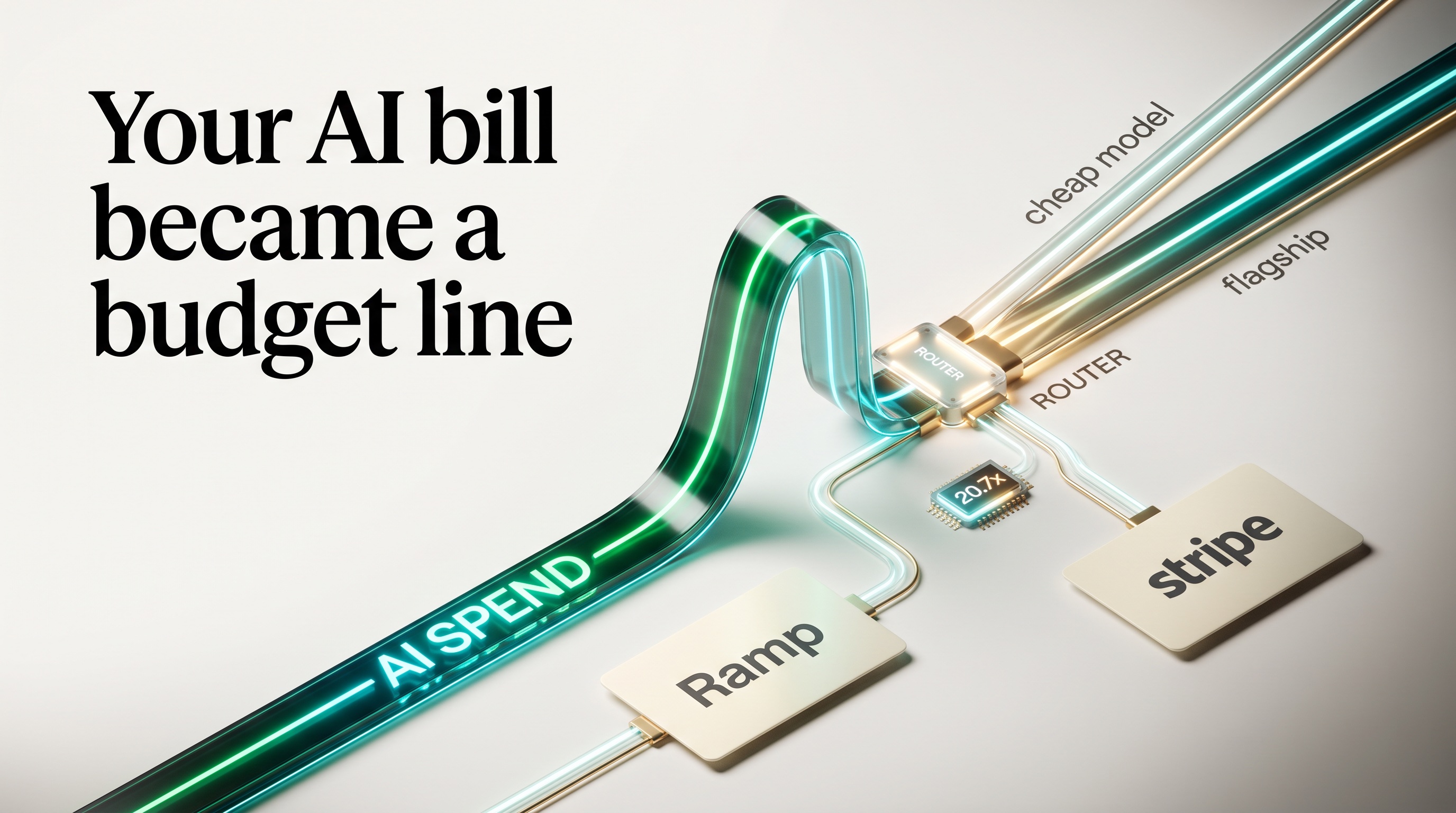
This week the two companies that already see where businesses spend money both moved on AI routing. Inference is no longer a seat you buy once. It is a budget line that grows with every job.
If you run a shop, that is the so-what. Do not marry one lab. See the spend the way you see payroll. Put the cheap work on a cheap model and keep the hard work on the expensive one.
Two moves, same week
Ramp launched Router.com on August 19, 2026. One endpoint. Many models. Customers already on it cut inference costs about 40% on average. Routing is free through 2026. New users get $26 in credits and pay list price for tokens.
Stripe agreed to acquire OpenRouter. Stripe's newsroom names a gateway across 400-plus models from more than 80 providers. Stripe did not publish a price. Bloomberg, via Decrypt, says the deal finalized August 16, 2026 at more than $7 billion, months after a reported $1.3 billion May valuation. That is about 5.4 times on reported figures. It is arithmetic, not a Stripe number.
Ramp sees the card. Stripe sees the invoice. Both just bet that the layer that matters is routing, not one logo.
The median shop is still on a seat. The top shops are not.
The Ramp AI Index (June 26, 2026) is the local number I trust for this. The median firm spends $11.38 per employee per month on AI. The top 10% spend $611. The top 1% spend $7,449.
The median is still a ChatGPT seat. The shops at the top are already on a different bill.
Ramp's August 19 PR says AI spend has grown 20.7 times since June 2025. Token spend scales with usage. A seat does not.
If you are still shopping for one lab, the bill is already deciding for you.
I sit with owners who bought a chat tab in 2025 and still think they are "on AI." They are on a seat. The shops spending $7,449 per employee are on jobs. Follow-up. Intake. Quotes. Content. The token meter is the payroll they forgot to watch.
A contractor locked the first model they tried
You tried one flagship. It wrote a decent follow-up. You left it on.
A cheaper model would do that job. You keep paying flagship prices.
Going direct ties the shop to one provider price and one release cycle. The lab ships on Friday. You should not rebuild the shop on Friday.
One endpoint is the point. The first AI employee can change labs without you changing the shop. You keep the quality bar.
That is the bet. Not a cheaper chatbot. A hire that can move when the price moves.
A plant office cannot see which job burned the tokens
The leak is quiet. It sits in a provider dashboard finance cannot read.
Ramp built Router on its own production load and cut its own inference costs about 30% for the same output. A July 16 Ramp briefing found AngelList had been losing $10,000 a month on prompt caching. The controller said the fix shipped the same day. One in three businesses using the tool found work they could shift off frontier models.
Token spend is now a plant cost, not a surprise invoice. Treat it like a vendor you can fire.
Wake up to a review list. Which job. Which model. Then approve the cut.
One lab will not stay cheapest
The owner who thinks one name stays the smartest and the cheapest just watched a payments company buy the booth in front of 400 models.
Plan the shop so GTM, SEO and AEO, sales, and the software you already run can move. Agents in Slack, WhatsApp, and iMessage should not need a rebuild when the price moves.
Prepaid and committed tokens start to make sense once you can see the line. Not before.
If you commit before you can name the job, you bought a bigger leak.
Three moves before you lock a lab
Startup Miracle is not marrying a lab for you. We map the spend, then we install the hire that can move.
1. Do not lock the first model.
Name the job. Follow-up. Intake. Quote review. A flagship for the hard turn. A cheaper model for the draft. One endpoint so you can switch without tearing out the shop.
2. See the dollar the way you see payroll.
Tokens, seats, and which job used which model. In one place. If finance cannot read the dashboard, you do not have a budget line. You have a leak.
3. Plan the channels before you buy more tokens.
SEO and AEO. GTM. Sales. The tools the crew already opens. Slack. WhatsApp. iMessage. If the agent cannot live there, you will rebuild every time a lab ships.
Do not start with four jobs. Start with the one that already has a meter. Then make sure the next job can sit in the same doorway.
You keep the judgment. The hire holds the list. That is the AI ops Startup Miracle already runs.
FAQ
What is an LLM router?
An LLM router is one doorway that sends each job to the model that fits the work, the price, and the speed. You do not rebuild the shop when a lab ships or cuts a rate.
How much are businesses spending on AI?
Ramp says AI spend is up 20.7 times since June 2025. The median firm still spends $11.38 per employee per month. The top 1% spend $7,449.
How should an SMB plan AI spend?
Treat inference like a vendor invoice, not a seat. See spend by job, keep the shop able to change labs, and only then commit tokens. If you cannot name the job, you are not ready to lock a price.
If you want the long version of how we think about readiness, Start with a FREE quiz and Get Your AI Score.