
Blog
One Blog Post Becomes 7 Social Assets Without a Social Media Manager. Here’s the Distribution Stack We Actually Run.
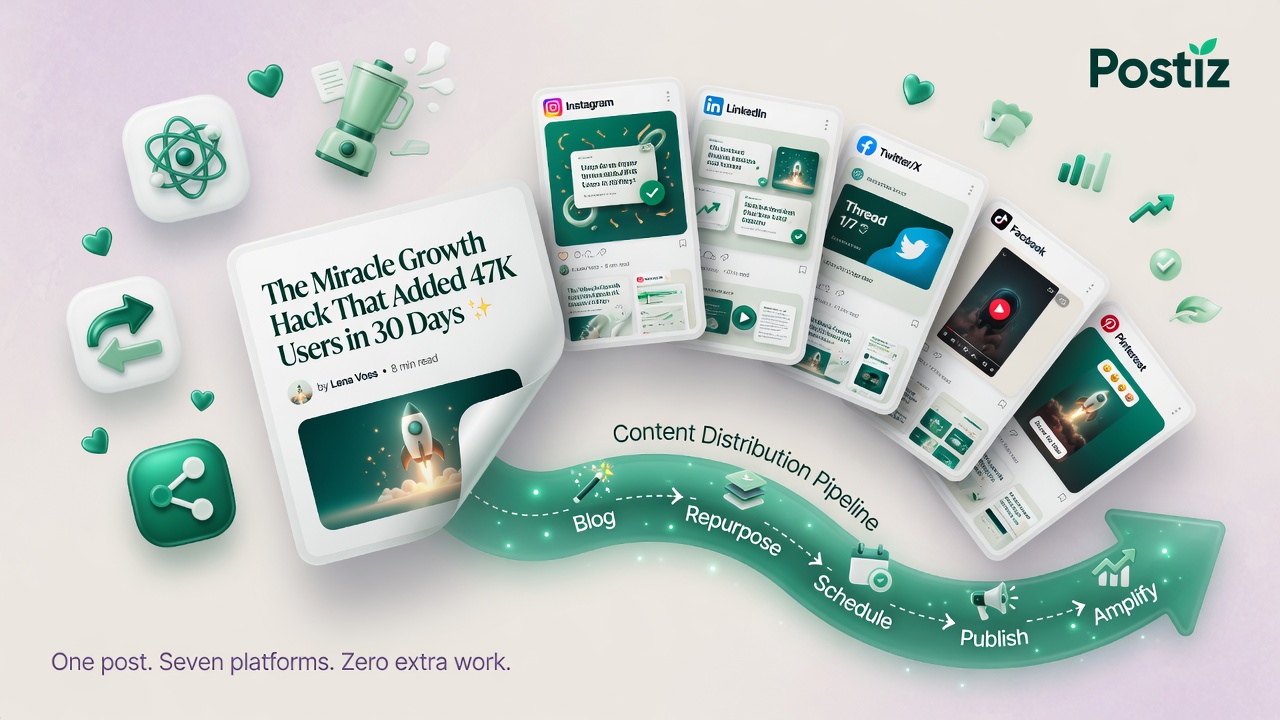
Most content advice starts with "write better." Ours starts with "distribute smarter."
We publish one blog post per day. That post becomes 7 distinct social assets across 4 platforms. No social media manager. No copy-paste. No one spends the afternoon reformatting paragraphs.
Here is the exact stack we run, what each piece does, and what still needs a human.
The Cascade Problem
When you publish one blog post, the natural instinct is to share the same link on every platform. X gets the headline. LinkedIn gets the same headline. Everyone sees the same thing.
This is bad for two reasons:
- Each platform rewards native content. X wants short, punchy takes. LinkedIn wants narrative threads. Reddit wants community value. Medium wants depth. Posting the same link everywhere tells each platform’s algorithm you are not playing their game.
- Duplicate content kills reach. When LinkedIn detects the same text from your X post, it suppresses the reach. The platforms have gotten good at detecting cross-posting.
The fix is not more work. It is a system.
The Cascade Rule
We follow one rule that makes distribution work without a team:
> Every platform gets a distinct angle. Never copy-paste.
If the blog post is about content distribution, the X thread leads with the cost breakdown. The LinkedIn post leads with the founder story. The Reddit post leads with the technical architecture. The Medium article leads with the full system design.
Same source material. Four different entry points. Four different audiences. One blog post.
The Stack
Here is what we actually run:
1. Hermes Agent (Trend Radar + Publisher)
Hermes Agent is our AI operations platform. It runs three cron jobs that form a dependency chain:
- Trend Radar (06:00 UTC daily): Researches 10 ranked topic candidates from industry news, client conversations, and our own Granola meeting notes. Writes to disk.
- Weekly Calendar (Monday 08:00 UTC): Plans the full 7-day production schedule with pillar rotation (P1 AI-OS, P2 Tools of the Trade, P3 Speed-to-Lead, P4 Behind the AI Office).
- Publisher (12:30 UTC daily): Takes the calendar’s topic for today, researches it, drafts the full article, generates hero/OG images via AI, uploads to Cloudinary, writes to Supabase, and verifies the live page renders correctly.
The key insight: each job produces output that the next job consumes. The Trend Radar feeds the Publisher. The Calendar feeds the entire week. No one writes a topic brief.
2. Postiz (Distribution Engine)
Postiz is our self-hosted distribution layer. Once the blog is live, we schedule the cascade through Postiz:
- X (@javyautomation): The X thread goes live immediately. 5-7 posts with outcome-first hooks, last post links the blog. Postiz handles the schedule.
- LinkedIn: Draft saved for the founder’s narrative thread. LinkedIn’s API approval is pending for our Community Management app, so we produce drafts now and publish when the connection is live.
- Reddit: Draft saved to disk. Reddit is never auto-posted per policy. Every Reddit post gets human review before it goes live.
- Medium: Extended version, distinct angle. Medium’s API is closed, so this is a manual copy-paste until the posting layer is complete.
Postiz handles the X scheduling, media uploads, and unified calendar. It has a 90-request/hour rate limit which is generous for daily publishing.
3. The Cascade Script
Each distribution draft is saved to `~/.hermes/cron/distribution/{slug}/` as separate markdown files. The structure:
- `x-thread.md` — 5-7 posts with Javier’s voice, outcome-first hooks, last post links the blog
- `linkedin.md` — Problem → Story → Solution, transparent build-in-public framing
- `reddit.md` — Neutral, community-native, value-first. Never auto-posted.
- `medium.md` — Extended version with a distinct angle from the blog
Each file is a different piece of content. Same data. Different angle. That is the rule.
What Postiz Handles Well
We have been running Postiz for about two weeks. Here is what works:
- X scheduling is reliable. Threads post in order, media attachments work, the unified calendar shows everything in one view.
- Media uploads work. We generate images via Higgsfield CLI (GPT Image 2 for heroes, Seedream for body visuals), upload to Postiz via API, and attach to posts. The pipeline is clean.
- The API is straightforward. Create-post shape: `{type: now|schedule|draft, date, posts: [{integration, value, settings}]}`. Easy to script.
What Is Still Manual
- LinkedIn posting: LinkedIn’s API approval for Community Management apps is pending. We produce drafts. Publishing is manual until the approval comes through.
- Reddit posting: Policy decision. Reddit content works best when it participates in a community conversation, not when it broadcasts. Human review is the right call.
- Medium publishing: Medium’s API is closed to third-party apps. Copy-paste from the blog to Medium is the only option.
The Cost
Our distribution stack costs $150/month total:
| Component | Cost |
|---|---|
| Hermes Agent (self-hosted) | $0 (infrastructure on existing VPS) |
| Postiz (self-hosted) | $0 (open-source, Docker) |
| AI image generation (Higgsfield) | ~$50/month (861 credits on Plus plan) |
| Cloudinary (image hosting) | $0 (free tier) |
| Supabase (database) | $0 (free tier) |
| Domain + DNS | ~$100/year |
Total: $150/month for a system that publishes daily and distributes to 5 platforms.
Compare that to a social media manager at $3,000-$5,000/month. Or a content agency at $5,000-$10,000/month. The math is not close.
What This Means for Your Business
You do not need a bigger team to publish more content. You need a system that does the distribution work automatically.
The hard part is not the tooling. It is the cascade rule: never copy-paste, each platform gets a distinct angle. That takes thinking, not writing. And the thinking happens once, when you define the angle per platform. After that, the system runs.
For South Florida businesses serving local customers, this matters because local search rewards fresh, consistent content. Google’s local ranking algorithm favors businesses that publish regularly across multiple channels. A $150/month distribution system that produces 7 assets per day beats a $5,000/month agency that produces one polished post per week.
Getting Started
If you want to build this yourself:
- Set up a publishing cron chain. Blog → Trend Radar → Publisher. One blog post per day, no exceptions.
- Define your cascade rule. Write down what each platform gets. X gets threads. LinkedIn gets stories. Reddit gets value. Medium gets depth.
- Pick a distribution tool. Postiz (self-hosted, open-source) or Buffer/Hootsuite if you want managed. The tool matters less than the cascade rule.
- Write the cascade once. The first time you define the angle per platform for a blog post, you are building the template. The 100th time, you are just filling in the blanks.
Or book an AI Assessment and we build it for you.
Frequently Asked Questions
How much time does the distribution cascade take per day?
About 15 minutes. The Publisher writes the blog. The cascade script generates the platform drafts. A human reviews the Reddit and LinkedIn drafts and approves or edits. The X thread auto-posts. Total daily human time: 15 minutes.
Is Postiz better than Buffer or Hootsuite?
Postiz is self-hosted and open-source, which means you control the data and the API. Buffer and Hootsuite are managed services with higher price points and rate limits. For a small team publishing daily, Postiz is the better value. For a larger team needing multi-role approval workflows, Hootsuite might be worth the premium.
Can you automate LinkedIn posting?
LinkedIn’s API allows scheduled posting, but the approval process for Community Management apps has been slow. We have applied and are waiting. For now, we produce LinkedIn drafts and the founder posts them manually. It takes 2 minutes.
What about Instagram and TikTok?
We focus on text-first platforms (X, LinkedIn, Reddit, Medium) because one blog post naturally repurposes into text across those channels. Instagram and TikTok require video or image-first content, which is a different production pipeline. We are testing HeyGen avatar videos for Instagram, but the text-to-video pipeline is not at the same maturity level as the blog-to-text pipeline.
Does this work for non-AI businesses?
The stack is tech-agnostic. The cascade rule (distinct angle per platform) works for any business that publishes content. Postiz supports any platform with an API. The only AI-specific part is the Hermes cron chain, which you can replace with a manual editorial calendar if you have a writer. The distribution system works the same way.
We publish daily, distribute to 5 platforms, and track performance — with one operator and a stack that costs $150/month. Book an AI Assessment and let’s build your content machine.