
Blog
Claude Code + Hermes AI Agent: The AI Operating System That Scales Your Business 10X
Claude Code + Hermes AI Agent: The AI Operating System That Scales Your Business 10X
Every business runs on knowledge.
Your pricing. Your procedures. Your distribution channels. How your customers talk and when they buy. Your culture. The way you treat a client when something goes wrong. How you want to grow next year, and the year after that.
That knowledge lives in your head. In key team members' heads. Tucked inside email threads, Google Docs, Slack messages, and that one notebook you keep meaning to digitize.
Every time you hire, you retrain that knowledge from scratch. Every time you step away, throughput slows down. Every time a key person leaves, a piece of your business walks out the door.
And the tools you've tried to fix this — they don't work together. The CRM that nobody updates. The chatbot that gives wrong answers. The automation that broke after three weeks. Another dashboard you don't check.
The problem isn't the tools. The problem is that none of them know your business.
What if you could encode everything — your way of operating — into an AI Operating System that runs alongside your company 24 hours a day?
That OS exists. It runs on two agents. It costs $150/month. And it scales to your whole team.
What is an AI Operating System
An AI Operating System is not a chatbot. It's not a workflow automation tool. It's not a CRM with AI bolted on.
It's a centralized knowledge and execution layer that sits above every tool you already use. It learns:
- Your business — what you sell, who you sell to, how you win deals
- Your customers — how they talk, what they need, when they buy
- Your procedures — intake, qualification, delivery, follow-up
- Your pricing — what you charge, when you discount, where you have margin
- Your distribution — where leads come from, which channels perform
- Your culture — how your team operates, what matters to you
- Your voice and tone — how you communicate, what feels like you vs what doesn't
- How you treat customers — your service standards, your escalation path, your "this is how we handle it" playbook
- How you want to grow — your targets, your bottlenecks, your next move
Then it executes on that knowledge 24 hours a day, while your team focuses on work only humans can do.
The result: the same team, with the same hires, produces 10X the output and throughput — because the AI OS handles the gaps, the handoffs, the follow-ups, the reporting, and the institutional recall that normally slows everyone down.
The two agents that power it
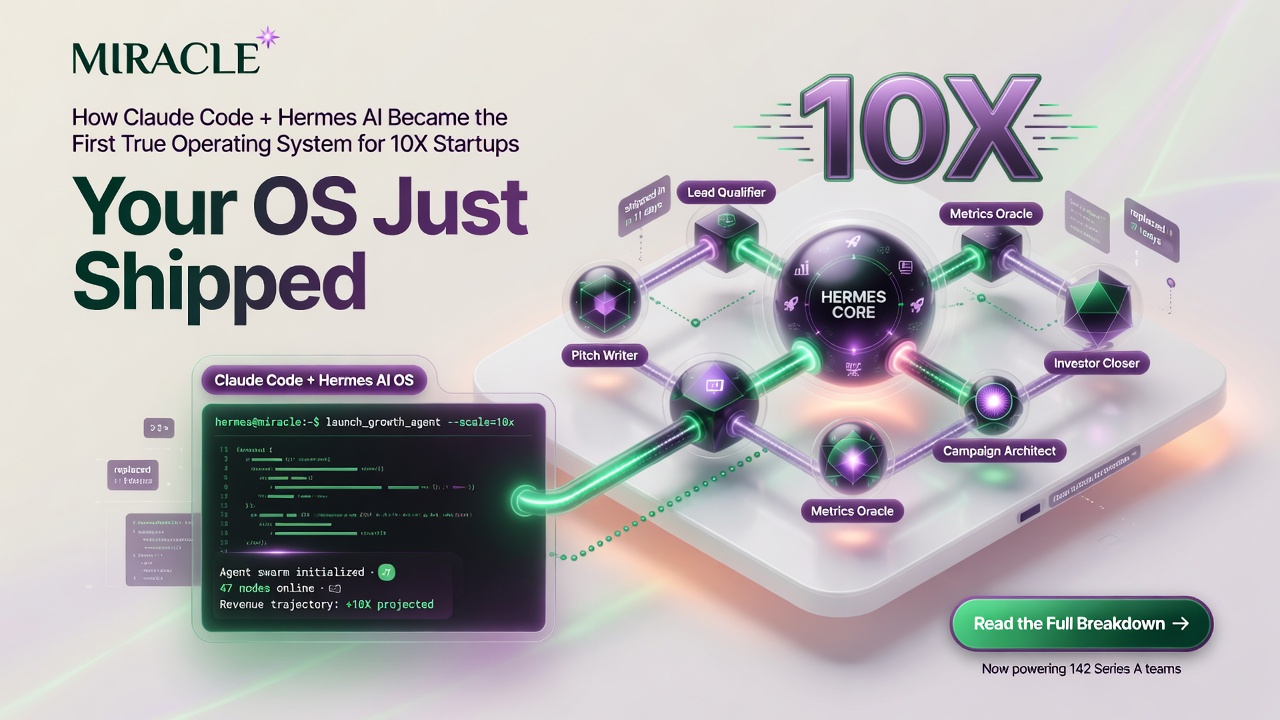
The OS runs on two AI agents that work as a brain trust. Both learn your business. Both share context. Both get smarter the longer they work for you.
Claude Code is my major advisor, strategist, and CTO. It learns your business deeply — reads your documents, understands your pricing and procedures, studies your voice and tone, maps your distribution channels. It designs the playbooks your business runs on: sales sequences, lead scoring, content strategy, operational workflows. Claude runs on my Mac Mini, in the browser, and on my iPhone.
Hermes is the autonomous executor, always on 24/7 via Telegram. It takes Claude's playbooks and runs them constantly — without clocking out, without forgetting context, without dropping balls. It follows up with leads, generates content, runs BI dashboards, monitors your pipeline, and knows when to escalate to your team. Hermes lives on a VPS in Microsoft Azure and uses the latest Codex model via OpenAI OAuth, with DeepSeek via OpenRouter as the fallback when I hit API rate limits.
Claude and Hermes share the same knowledge base. What Claude learns about your business, Hermes uses. What Hermes discovers in execution, Claude builds on. The system compounds.
You interface with Hermes through Telegram — text it like a team member. "Run today's lead report." "Draft the onboarding sequence in our voice." "What's our conversion rate this month?" It answers and acts.
How they collaborate in practice
The three agents — Claude, Hermes, and Codex — share a collaborative space on GitHub. When one produces work, it lives in a repository the others can read and build on. No context lost. No manual handoffs.
When I'm working with clients, I add Linear workspaces to hand off project management. Clients get dedicated dashboards where they can see progress, open tickets, and track delivery without needing to understand the agent architecture underneath.
And when I'm in meetings, Granola takes the notes. Those notes feed directly into the OS — action items become Hermes tasks, decisions update Claude's context, no one has to transcribe or summarize. The system stays current without anyone doing data entry.
The workflow is simple:
- I brief Claude on strategy → Claude produces specs
- Claude delegates to Hermes → Hermes executes
- Hermes logs results to GitHub → Claude reviews
- I ship to client through Linear → client sees dashboard
It's a loop. Everyone stays synced. No meetings needed to answer "where are we on this?"
What this costs vs what it replaces
| Service | Role in the OS | Monthly cost |
|---|---|---|
| ChatGPT (Codex) | Primary operations engine | $20 |
| Claude Max | Strategy, deep learning of your business | $100 |
| OpenRouter | Fallback for peak demand | $30 |
| Total | AI Operating System | $150/month |
That's $1,800 per year for an institutional knowledge and execution layer that produces the output and throughput of multiple full-time hires.
Compare that to adding one mid-level operations person in South Florida: $50k–$65k/year before benefits. They work 40 hours. They take weekends. They need onboarding. They leave after 18 months and take their knowledge with them.
The OS doesn't leave. It doesn't forget. And every month it knows your business better than the month before.
By having Codex OAuth and DeepSeek via API, you get monthly cost predictability across your entire AI squad inference budget: ChatGPT at $20, Claude at $100, OpenRouter at $30, for roughly $150 total. The math is $1.8k/year vs $1.2 million/year in equivalent staff output.
Cost predictability (June 2026 Claude changes)
Starting June 15, 2026, Anthropic is separating headless Claude Code usage from interactive usage. Automation draws from a separate monthly credit instead of your plan's usage pool.
Interactive Claude (terminal, IDE, web, desktop) stays unchanged. Headless Claude (automation, scripts, cron jobs) gets a separate credit per plan:
- Pro: $20/month
- Max 5x: $100/month
- Max 20x: $200/month
- Team/Enterprise: varies by seat type
The credit drains first. When it runs out, usage either flows to API billing or stops until the credit refreshes.
My stack includes an OpenRouter fallback that kicks in during API peaks. The system never goes down because of rate limits or credit depletion. Predictable ceiling. Continuous uptime.
Please protect your Claude account and don't bend their Terms of Use. OAuth usage is moving to API billing. The monthly credit is real, but treat it as a bridge, not a permanent solution for high-volume automation.
Scale to your team, not just your desk
This is not a founder-only setup. It's designed to be shared.
Add your operations lead, your sales manager, your marketing person — they all interact with the same AI OS. It knows the same knowledge. It speaks in the same voice. It follows the same procedures.
New hire joins and needs to learn your pricing and follow-up process? The OS has it. Your salesperson is out sick and a lead calls? The OS knows how to handle it. Your operations lead wants a weekly report on throughput? The OS runs it automatically.
That's the difference between a tool and an operating system. A tool helps one person do one thing faster. An OS gives every person on your team leverage.
When I add a VoiceAI layer — calls get answered in your voice, with your pricing, following your qualification process, even when nobody on the team is available — that's the OS extending your business's reach beyond your working hours.
When Generative AI produces content, drafts sequences, and handles intake in your specific voice and tone — that's the OS scaling your team's output without scaling headcount.
When your BI dashboards update automatically because the OS feeds them — that's the OS giving every team member the same picture of the business, without anyone needing to pull reports.
And for credentials and API keys — use Bitwarden Secret Manager. It's a gated, secure vault available 24/7 to your Hermes instance. When a cron job needs a Supabase key or a Mailgun token, Hermes pulls it from Bitwarden at runtime. Never hardcode secrets. Never store API keys in plaintext on the VPS. A compromised VPS with plaintext secrets wipes out months of automation.
How the system learns your business
The OS doesn't ship with generic templates. It learns your specific operation.
The process is straightforward:
- Claude reads your material — pricing sheets, process docs, client emails, content you've published, your CRM notes
- You teach it your voice — "We don't say X, we say Y." "Our follow-up cadence is 30 minutes, not 24 hours."
- Claude designs playbooks — exactly how you want leads handled, content produced, reports built
- Hermes executes — runs the playbooks, learns from outcomes, feeds data back
- The system compounds — more data = better execution = better results
This is not "set it and forget it." It's "teach it once, and it runs forever."
And when something breaks, Claude is your Hermes doctor. Claude Code can SSH into your VPS, inspect the Hermes config, check the logs, find the root cause, and fix it — all without you touching a terminal. Claude Code v2.x reads files, writes code, runs shell commands, spawns subagents, and manages git workflows autonomously. It's a remote sysadmin that understands the full stack.
Getting started — the honest version
This setup delivers massive leverage. It also requires technical moving parts: a VPS, GitHub authentication, API keys, terminal access, provider configuration, environment variables, cron job scheduling. For someone who lives in this stack, it's 30 minutes. For someone who doesn't, it's a frustrating weekend of debugging error messages.
The two resources below will get you there if you're technically inclined:
- Hermes Quickstart Guide — install to a working agent, provider setup, chat verification, troubleshooting
- Hermes → Claude Code delegation — wire the full brain-and-executor architecture
But GitHub, the terminal, API keys, and a VPS are a scary territory for a non-technical business owner — and rightfully so. The first time setup has too many failure points for a DIY approach to be a real solution.
Curious where AI actually fits your business?
Everything above is the developer's-eye view. But the real question for a business owner isn't how to wire Claude Code and Hermes together — it's where an AI operating system would make you money first: the missed calls, the slow follow-up, the hours lost to admin every week.
That's exactly what our free AI Readiness quiz tells you. Ten questions, two minutes, and you get a personalized score showing where AI belongs in your operation — prioritized by ROI, not hype.
If your score says you're ready, the next step is a $1,500 AI Assessment: we map your two or three highest-return automations and hand you a step-by-step plan your team can actually run.
👉 Take the free AI Readiness quiz — see your score, then decide.
— Javier Aguilera, Founder, Startup Miracle