
Blog
AI Patient Scheduling Cuts No-Shows 30-40% — Every Clinic in South Florida Should Know This
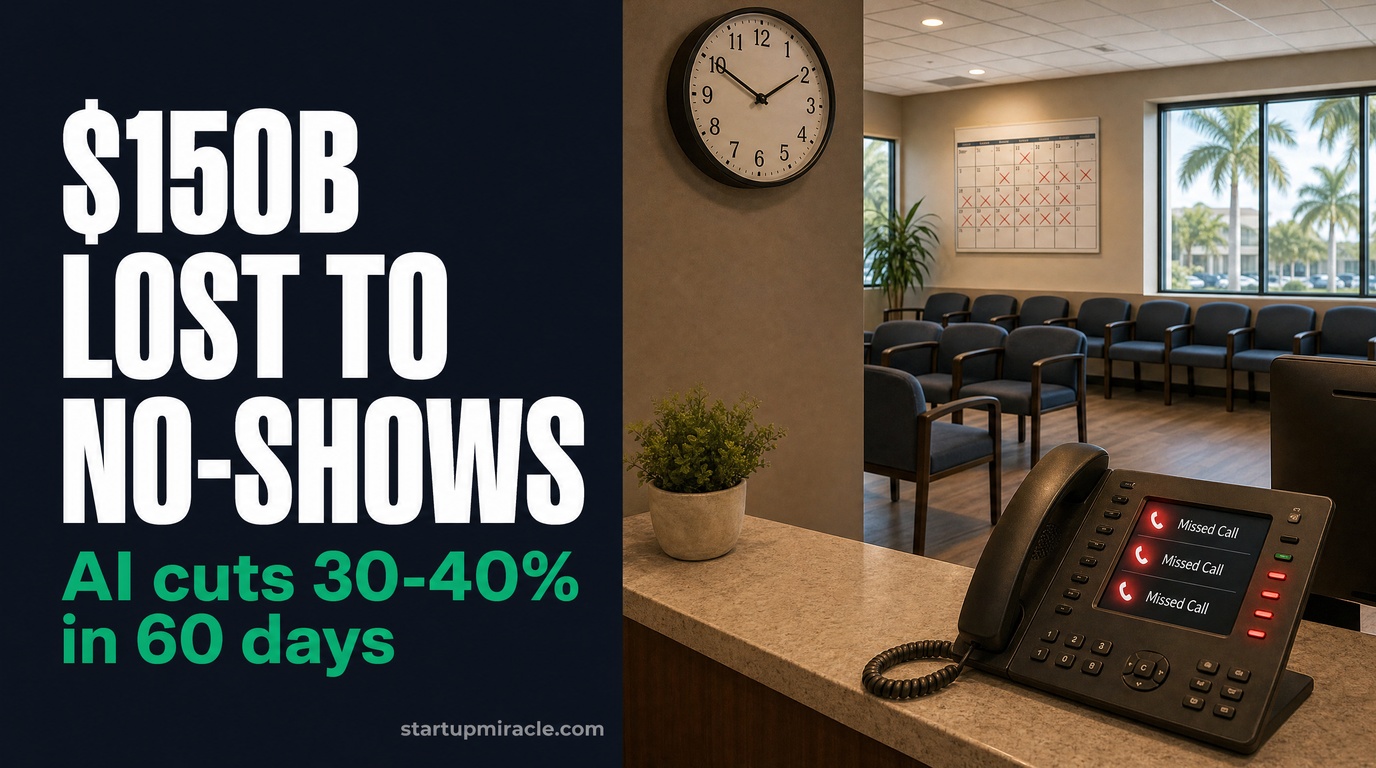
Patient no-shows are not a minor inconvenience. They are a $150 billion leak in the US healthcare system. For a single physician, each missed appointment costs roughly $200 in lost revenue. And in South Florida, where clinics serve a heavily bilingual population, the problem has an extra layer: language gaps that make standard reminder systems less effective.
The good news? Artificial Intelligence (AI) scheduling systems are cutting no-shows by 30-40% in under 60 days. Clinics that deploy them are recovering five figures in lost revenue per month without adding a single staff member.
Here is how it works and why every clinic in Miami, Hialeah, Pembroke Pines, and Fort Lauderdale should be paying attention.
The Real Cost of No-Shows
The national average no-show rate across all medical specialties is 6.8%, according to the Medical Group Management Association (MGMA). But that average hides wide variation. Outpatient settings can hit 23-33%. Sleep clinics see 39%. Pediatrics and dermatology run around 30%. Primary care sits at 19%.
For a clinic scheduling 2,000 appointments per month with a 15% no-show rate, that is 300 empty slots. At $200 per slot, that is $60,000 in direct lost revenue every month. Not including the wasted staff time, the empty exam rooms, and the provider capacity that cannot be recovered.
The Prosper AI 2026 guide on no-show costs breaks it down: clinics lose an average of $97,000 per year from unanswered calls alone. Each missed call represents roughly $200 in lost revenue. And 34% of patients abandon the booking process entirely when they cannot get through on the phone.
Why Patients No-Show
The reasons are predictable and mostly preventable:
- Forgotten appointments. A patient who books six weeks out has six weeks to forget or run into a conflict. Without a reminder sequence, the no-show risk climbs with every passing day.
- Transportation and scheduling conflicts. Work, childcare, unreliable transit. These are life realities, not patient negligence.
- Copay and coverage anxiety. Uncertain about costs? Many patients quietly disengage rather than ask.
- Long lead times. The further out the appointment, the higher the probability of a no-show.
The common thread: most of these are addressable with better communication. But manual reminder calls are expensive, inconsistent, and rarely happen in Spanish.
What Most Clinics Do Wrong
The standard approach is a single automated reminder call or text 24 hours before the appointment. One-way. No confirmation requested. No rescheduling option. No follow-up if the patient does not respond.
This is better than nothing, but barely. One-way reminders reduce no-shows by only 8-20%. They do not confirm intent. They do not catch patients who changed their mind. They do not fill the slot if someone cancels.
The other common mistake: treating no-shows as a policy problem instead of a communication problem. Charging fees, threatening discharge, requiring credit cards. These approaches create friction with the patients who do show up and rarely recover the lost revenue.
The AI Solution: Three Systems Working Together
AI scheduling is not a single feature. It is three interconnected systems that handle the full appointment lifecycle.
1. Predictive No-Show Detection
AI analyzes patient history, appointment lead time, time of day, and behavioral patterns to identify high-risk appointments before they happen. A patient who has no-showed twice before, booked six weeks out, for a Friday afternoon slot? The AI flags that appointment and triggers extra interventions: an additional reminder at 72 hours, a two-way confirmation request, and a strategic overbooking slot held in reserve.
Clinics using predictive detection see 30-40% fewer no-shows, according to studies from Prosper AI, Neuwark, and the PMC National Library of Medicine.
2. Two-Way Automated Communication
Instead of a one-way text blast, AI systems send a timed sequence of interactive messages:
- 72 hours out: "Your appointment is Tuesday at 2 PM. Reply CONFIRM or RESCHEDULE."
- 24 hours out: Follow-up for non-responders. Voice call if text was ignored.
- Same morning: Final confirmation with directions and check-in instructions.
Two-way interactive reminders increase confirmation rates by 45% compared to one-way messages. And SMS has a 97% open rate, most within three minutes.
For South Florida clinics, the language layer is critical. AI voice agents that detect Spanish from the first sentence and switch seamlessly are not a nice-to-have. They are a requirement. 73% of Miami-Dade County speaks a language other than English at home. A reminder system that only works in English is missing a third of your patients.
3. Intelligent Waitlist Management
When a cancellation happens, the AI instantly contacts waitlisted patients via text or automated call. No staff time required. The result: 95% of canceled slots get rebooked, compared to 15% with manual waitlist management. And it happens in under five minutes.
Frederick Foot and Ankle, a real-world example, filled 40% of same-day cancellations using automated waitlist AI.
The ROI Is Not Theoretical
The numbers are concrete:
- $200 recovered per no-show slot that gets filled
- $97,000/year in lost revenue from unanswered calls alone
- 35x return on investment from backfilling last-minute cancellations (Prosper AI)
- 25% increase in patient volume without adding staff (Penn Medicine)
- 89% drop in call abandonment when AI answers the phone instantly
UCHealth added $8 million in value from higher throughput using AI scheduling optimization. The technology pays for itself in months, not years.
Why South Florida Clinics Have an Extra Advantage
South Florida's patient population is uniquely suited for AI scheduling because the technology handles what manual systems cannot: bilingual communication at scale.
A clinic in Hialeah serving Cuban American and Venezuelan patients needs reminders in Spanish. A clinic in Pembroke Pines with a mixed English-Spanish patient base needs language detection that works on the first interaction. A clinic in Fort Lauderdale serving a diverse population needs both.
AI voice agents that detect language from the first sentence, handle dialect nuances, and switch between English and Spanish mid-conversation are not futuristic. They are available now through platforms like the ones Startup Miracle deploys for South Florida clinics.
Implementation: What It Actually Takes
Deploying AI scheduling does not require an IT overhaul. Modern platforms integrate with 80+ Electronic Health Record (EHR) systems and go live in weeks, not months.
The implementation path:
- Audit your current no-show rate and revenue loss. Most clinics do not have a precise number. Measure it.
- Deploy automated two-way reminders. Start with the 72/24/same-morning sequence. Measure the change.
- Add predictive no-show detection. Let the AI flag high-risk appointments and trigger extra interventions.
- Activate intelligent waitlist management. Fill cancellations automatically.
- Add bilingual voice AI. Deploy Spanish-language voice agents for reminder calls and after-hours scheduling.
Each step compounds the ROI. Most clinics see a measurable reduction in no-shows within the first 30 days.
The Bottom Line
Patient no-shows are not a fixed cost of doing business. They are a solvable operational problem. AI scheduling systems that combine predictive detection, two-way communication, and intelligent waitlist management cut no-shows by 30-40% in under 60 days.
For a South Florida clinic losing $60,000 per month to no-shows, that is $18,000 to $24,000 recovered per month. Without adding staff. Without changing your clinical workflow. Without charging your patients more.
The technology exists. The ROI is proven. The only question is whether your clinic will deploy it before your competitors do.
Frequently Asked Questions
How quickly can AI scheduling reduce no-shows?
Most clinics see measurable improvement within 30 days and full 30-40% reduction within 60 days of deployment. The reminder sequence starts working immediately; predictive detection improves as the AI learns your patient patterns.
Is AI scheduling compliant with HIPAA (Health Insurance Portability and Accountability Act)?
Yes. Reputable AI scheduling vendors provide Business Associate Agreements (BAAs), end-to-end encryption, and SOC 2 Type II audits. Appointment reminders are considered administrative communications and do not require FDA clearance.
Will AI scheduling replace my front desk staff?
No. It automates repetitive tasks like reminder calls, confirmation collection, and waitlist management. This frees your staff to handle complex patient needs, insurance verification, and in-person interactions. Most clinics find their front desk team becomes more effective, not redundant.
Can AI scheduling handle Spanish-speaking patients?
Yes. Modern AI voice agents detect language from the first sentence and switch between English and Spanish seamlessly. For South Florida clinics serving Cuban American, Venezuelan, and Colombian communities, this is a critical feature.
What if a patient does not have a smartphone?
AI scheduling works across channels: SMS text, voice calls, and web. Patients without smartphones can still receive automated voice calls and confirm appointments by pressing a key or speaking. No app download required.
How much does AI scheduling cost?
Pricing varies by platform and patient volume, but most clinics see a positive return on investment within 2-4 months. The technology typically costs a fraction of what a single no-show costs per day.
Does AI scheduling integrate with my existing Electronic Health Record (EHR) system?
Most modern AI scheduling platforms integrate with 80+ EHR systems, including Epic, Cerner, Athenahealth, and Practice Fusion. Two-way sync eliminates double bookings and manual data entry.