
Blog
Your 5 AI Tools Don't Talk to Each Other. That's Not a Workflow Problem — It's a Runtime Problem.
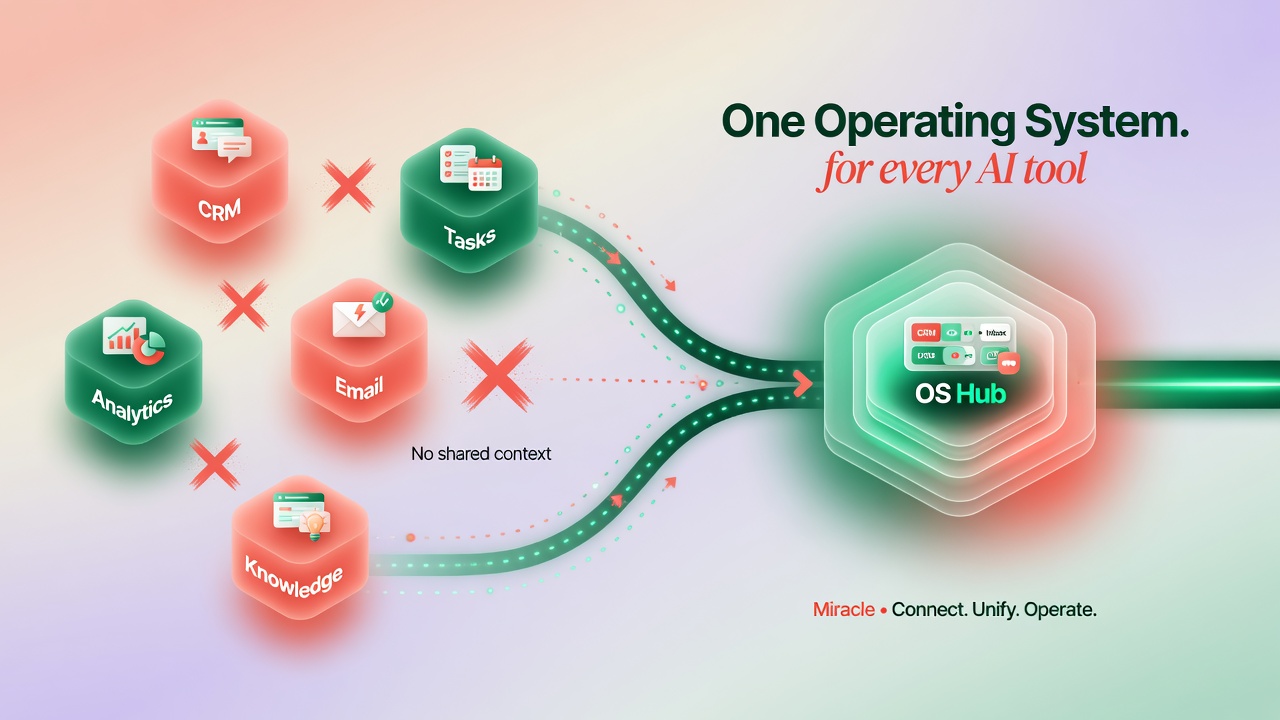
You bought the tool. Then another one. Then three more.
A chatbot for customer support. A voice agent for inbound calls. A meeting assistant that writes notes. An automation platform for workflows. A separate AI assistant for drafting documents.
Each one works in isolation. None of them know what the other one just did.
The customer who called the voice agent at 9 PM and asked about pricing calls back at 9 AM and the chatbot asks for their name again. The meeting assistant captures action items but the automation platform has no idea what tasks were assigned. Your AI assistant drafts a proposal but doesn't know the voice agent already quoted a different price.
This is not a workflow problem. It is not an integration problem. It is a runtime problem.
Here is what that means, why it is costing you more than the tools themselves, and what actually fixes it.
What Most Businesses Do Wrong
The standard response to this problem is to buy more tools.
"Let me connect this Customer Relationship Management (CRM) to that automation platform." "I will add a middleware layer." "Let me just build a Zapier integration."
The result is a web of brittle connections. Every tool talks to a different schema. Every integration is a point-to-point handshake maintained by someone who left the company six months ago. When one tool updates its Application Programming Interface (API), the wire breaks.
The industry calls this "tool sprawl." But the real name is a runtime problem.
What Is a Runtime Problem?
A runtime is the execution layer an application needs to function. The operating system your laptop runs on. The container your server runs in. The standardized environment that handles state, memory, streaming, recovery, and scaling so your application does not have to reinvent those every time it starts.
AI tools do not have a shared runtime.
Every AI tool you buy starts from scratch. Its own memory. Its own context window. Its own understanding of your business. If you tell the voice agent that your pricing starts at $2,500, the chatbot does not know that. If you update your return policy in the automation platform, the meeting assistant still references the old one.
Research from TLDR AI framed it directly: "AI teams struggle to deploy agents because no standardized runtime exists to handle state, streaming, isolation, recovery, and scaling across sessions and users."
Every team running multiple AI tools is building the same infrastructure from scratch — and none of them realize it.
The Real Cost of Fragmented AI
The numbers are worse than most businesses realize.
According to Salesforce's 2025 SMB Trends Report, 75% of small and medium businesses (SMBs) now use AI. But the same research found that 31% of AI tools go unused within 90 days. Businesses running 3-5 well-integrated tools report 2x the productivity gains of companies running 10+ fragmented apps.
The Business.com 2026 Small Business AI Outlook Report confirms the pattern: 57% of U.S. SMBs are investing in AI, up 58% in two years. But only 19% use workflow automation. The average employee saves 5.6 hours per week with AI tools — but managers save 7.2 hours while individual contributors save only 3.4.
The gap is not about willingness. It is about architecture.
When a tool has no shared context, the person using it becomes the integration layer. A manager saves more time because they already know the business. A junior employee saves less because they have to rebuild the context every time they switch tools.
The Javier POV: Why We Stopped Counting Tools
At Startup Miracle, we run AI agents across voice, content, CRM, analytics, and operations. We stopped counting the tools because the number stopped mattering.
What matters is the knowledge layer.
We run a centralized AI operating system — not a stack of disconnected tools. Every agent, every assistant, every automation draws from the same context. The voice agent knows what the CRM knows. The content agent knows what the meeting notes say. The automation platform knows what the analytics dashboard reports.
This is not a theoretical architecture. It is how we ship production software for South Florida businesses every day.
Startup Miracle was selected for the ElevenLabs accelerator program to build Voice AI and GenAI agents. We use Claude Code, OpenAI Codex, and Hermes Agents internally. Our Merchant Response Stack / Speed to Lead (S2L) runs across Voice AI, SMS, WhatsApp, email, and CRM for merchants serving Hispanic customers in South Florida.
The tools change. The architecture does not.
The Fix: An AI Operating System, Not Another Integration
The solution is not a middleware layer. It is not a Zapier workflow. It is not a "unified dashboard" that shows everything in one place without actually connecting anything.
The fix is a shared knowledge layer that every AI tool reads from and writes to — a single source of truth that handles:
- State — What every tool knows about every customer, every conversation, every decision
- Context — The business rules, pricing, policy, and process that every agent should follow
- Memory — What happened in previous sessions, regardless of which tool was involved
- Governance — Who can access what, what agents can do, what requires human approval
This is what we call an AI Operating System. It is not a single tool. It is the runtime your tools run on.
How This Works in Practice
The AI Operating System knows your business across five dimensions:
- Your customers — Who they are, what they bought, what they asked about, what they complained about
- Your procedures — How you handle returns, how you price services, how you qualify leads, how you escalate issues
- Your products — What you sell, what it costs, what inventory you have, what is backordered
- Your distribution — Which channels drive leads, which ads convert, which partners refer
- Your voice — How you talk to customers, what language you use, what tone fits each situation
When a new AI tool connects to this system, it does not start from scratch. It inherits five years of institutional knowledge in the first API call.
Cost Comparison: Fragmented Tools vs. AI Operating System
A typical SMB AI stack costs between $65 and $300 per month per tool, according to Builts AI's 2026 guide. With 5-7 tools, that is $300 to $2,100 per month — and none of them share context.
An AI Operating System costs $150 per month. It replaces the middleware, the brittle integrations, and the person-hours spent rebuilding context. It makes every tool in your stack more valuable because every tool draws from the same knowledge.
The Return on Investment (ROI) is not in the cost savings. It is in the response time. The customer who calls at 9 PM and gets answered by a voice agent that already knows they are a returning customer with an open ticket. The lead who emails and gets a personalized response drafted from their purchase history within 60 seconds. The manager who asks the AI assistant "what happened this week" and gets a summary across every tool, every channel, every conversation.
How to Start
You do not need to rip out your existing tools. You need to give them a shared brain.
The first step is an AI Assessment — a 90-minute audit of your current tool stack, data flows, and knowledge gaps. We map what each tool knows, where the context breaks, and what it would take to connect them.
From there, we build your knowledge layer. It starts as a document. It becomes a database. It becomes the runtime your entire business runs on.
Teach it once. It runs forever.
Frequently Asked Questions
What is the "runtime problem" in AI tools?
The runtime problem refers to the lack of a standardized execution layer for AI tools. Every AI application manages its own state, context, memory, and recovery independently. When you use multiple tools, none of them share what they know, so every tool starts from scratch every time. This is the same problem that operating systems solved for desktop applications — but no equivalent exists for AI tools yet.
How is an AI Operating System different from a middleware or integration platform?
Middleware connects tools by translating data between them. An AI Operating System does not just connect tools — it provides the shared context, memory, and governance that every tool runs on. Think of middleware as a translation layer between two languages. An AI Operating System is the shared culture, history, and knowledge that makes the translation meaningful.
Do I need to replace my existing tools to use an AI Operating System?
No. The AI Operating System sits above your existing tools. It reads from every tool and writes context back to them. Your voice agent still runs on the same platform. Your CRM still stores the same records. But now they all know what the other one knows.
What is the cost of an AI Operating System compared to hiring more staff?
An AI Operating System costs $150 per month. A full-time employee handling the same context-switching work costs $4,000 to $6,000 per month. The math is not close. But the real comparison is not headcount — it is speed. An AI Operating System responds in seconds. A human needs minutes to context-switch between tools.
Can AI tools really share context securely?
Yes. The AI Operating System uses role-based access, API-gated permissions, and audit logging. Every agent has read-first, append-only write access by default. Delete is never available to any agent without explicit admin approval. This is the same security model that enterprise financial systems use.