
Blog
Birdeye Jay Needs Approval Rails Before One-Star Replies
Birdeye Jay Needs Approval Rails Before One-Star Replies
On September 9, 2026, Birdeye launched three AI Coworkers at Birdeye View: Jay for marketing, Myna for operations, and Robin for customer experience. In Birdeye's words, each coworker owns a business function and manages a team of AI agents so multi-location brands can win AI visibility, book appointments, and keep customer experience consistent at every site. Together they orchestrate 27 AI agents. Birdeye says those agents have already responded to more than 12 million reviews for hundreds of enterprise brands. If you run restaurants, hotels, venues, clinics, or attractions across more than one address, that is real help aimed at the brand dashboard you already live in.
Birdeye built something worth turning on. The question is not whether Jay can draft a public reply. It is who sets the approval rails, meaning the named person who decides which review replies and tickets may leave without a human, before Jay answers a one-star review at a single location. Write those names while the brand score still looks fine, not after one site goes rogue in public.
Startup Miracle sits with multi-unit hospitality GMs, venue operators who cannot stand in every lobby, entertainment owners whose demand spikes by site, and multi-location dental or clinic groups that live and die on reviews. We help you name who owns the reply rails so 27 agents do not become agent sprawl with no owner.
What Birdeye AI Coworkers actually are
Birdeye's September 9 press release is the product in the company's own words. An AI coworker here means a named orchestration layer that owns an outcome the way a department head does, then deploys agents underneath it. Jay wins AI visibility with agents for AI search, listings, review generation, review response, social, local pages, and marketing automation. Myna owns operations outcomes such as appointments and front-desk workflows. Robin owns customer experience with surveys, sentiment, ticketing, and insights. You manage three named coworkers instead of remembering 27 agent logins. Humans set the guardrails and decide where approvals are needed by workflow and location. The coworkers get the work done inside those rails.
Birdeye also says the stack runs on BirdAI, its Agent OS built on thirteen years of multi-location context: 200 million users, more than 10,000 brands, and more than 3,000 integrations. Those platform counts are Birdeye claims. Treat them as vendor context, not as your store's scorecard.
A first AI hire, meaning the first named job you let software run without you standing over every click, can be review response under Jay or ticket close under Robin. It is not "turn on 27 agents and hope the brand voice holds." The owner still names the rails.
When one location goes rogue
A multi-unit restaurant or hotel GM already knows the brand dashboard can look fine while one location answers reviews like a different company. The fear is looking stupid when that site goes rogue in public and the corporate score still reads green. Birdeye's pitch is that three named coworkers own marketing, operations, and CX outcomes across every location, with approvals set by workflow and location. That only helps if a human already wrote who may auto-reply, who must approve a one-star, and which location gets a ticket when wait time shows up again.
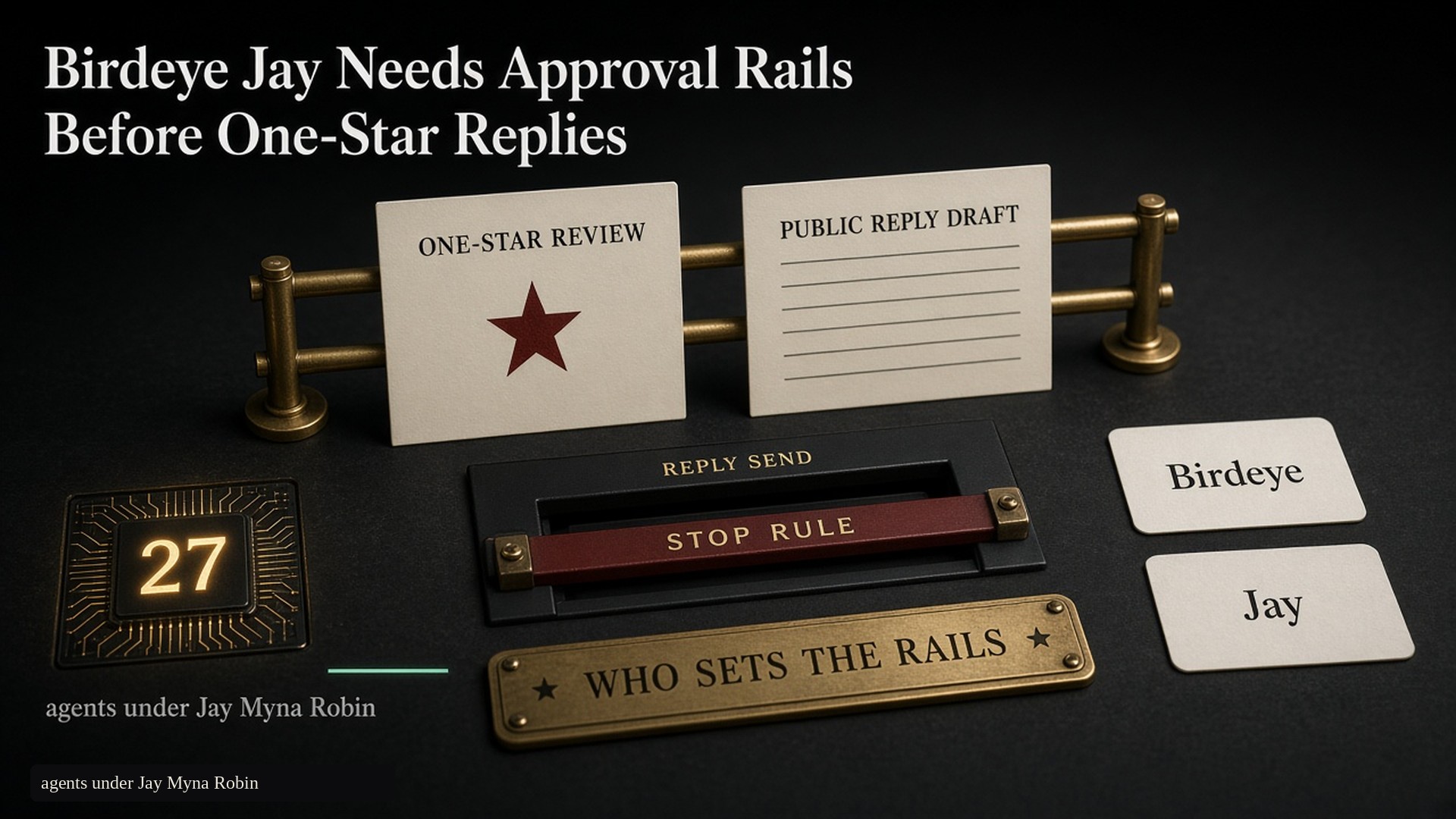
Name one coworker outcome you care about first, usually review response, then name the human who sets the stop rule. A stop rule here means the named line a reply or ticket may not cross without you: no one-star reply without brand language check, no marketing send to a guest who just filed a complaint ticket, no location left without an owner when the agent roster grows.
One star, one reply, one ticket
A venue or multi-site operator cannot be in every lobby when a one-star drops. Silence lets the complaint sit. A rushed public reply can break brand voice. Birdeye's own example is useful: when a one-star review flags a wait-time issue at a single location, Jay posts a compliant public response while Robin opens a ticket for that location's leadership and suppresses the customer from marketing sends. One review becomes an operational fix in seconds because the coworkers coordinated it.
Separately, Birdeye cites an enterprise financial-services provider that ran 49,000 reviews through the Review Response Agent, with 91 percent handled with no human touching the reply and every response kept on-brand. That 49,000 and 91 percent pair is a Birdeye customer case claim. Attribute it to Birdeye. Your venue still needs a named person who decides which star ratings auto-send and which ones wait for approval. Without that name, the same workflow that looks elegant in a press example becomes a public reply you cannot defend.
Visibility gaps that eat leads
A multi-location entertainment or attraction owner feels demand spike by site, then go dark when AI search cannot find the right location. Birdeye cites a senior-living operator with 46 communities that saw a 53 percent lift in lead volume after closing AI-search visibility gaps with the AI Search Optimization Agent. That +53 percent and 46-community figure is a Birdeye case claim. The job for you is closer to home: each location needs a named owner for AI visibility work, plus a stop rule on what publishes without a human. Paying for another agent roster that nobody owns is how a location goes dark while the invoice still clears.
Clinics that need volume without chaos
A multi-location dental or clinic group owner lives and dies on reviews and local search. Birdeye cites a national dental group with more than 4,000 locations that saw a 29 percent lift in review volume and a 15 percent lift in keyword-rich reviews with the Review Generation Agent. It also cites a top-three healthcare system case with a 30 percent lift in AI search visibility and 2.2 times monthly reviews. Those dental and healthcare figures are Birdeye customer case claims. Attribute every one. The fear underneath them is familiar: another login that writes replies while location managers still chase tickets by hand. Raise review volume under named coworkers, and keep the approval rails the group owner actually set.
Name the rails before Jay speaks
This is reputation work across locations, not a toy chat window. Birdeye already says agents create capacity, and that without an orchestration layer a growing roster becomes agent sprawl. Naveen Gupta, Birdeye's CEO and co-founder, said nobody wants to remember the name of 27 agents or manage an org chart of software. That is fair. The gap the press release cannot close for you is the first decision: who may let Jay reply to a one-star, who owns Robin's ticket loop at that site, and what must wait for a human.
First, name the outcome owner. Pick Jay for review response and AI visibility, Robin for tickets and CX loops, and leave Myna for operations work you will scope later so the phone story does not swallow the week. Second, name the human who sets approvals by workflow and location. Third, write the stop rule in the same sitting: which star ratings auto-send, which locations need a human on negative replies, and when marketing must stay quiet after a complaint. Birdeye says you decide what runs automatically and what needs approval down to the workflow and location. Use that. The coworker can own the outcome. It should not invent who is allowed to speak for the brand.
Startup Miracle's work here is the AI Readiness pass, not another reputation login. The quiz surfaces whether agent sprawl across locations has a named owner of who may reply. The $1,500 assessment, with a $1,000 credit if you continue, is the longer version of that same question. We do not replace Birdeye. We sit with you until the approval rails have a name before Jay answers the next one-star.
If coworkers are already available on your plan, write the names this week. If you have not enabled them yet, write the names first. The order is the point. Twenty-seven agents with no named rails is how a useful coworker layer becomes a reply you cannot own.
FAQ
What is a Birdeye AI Coworker?
A Birdeye AI Coworker is a named orchestration role, Jay for marketing, Myna for operations, or Robin for customer experience, that owns an outcome and deploys agents underneath it so you manage three owners instead of 27 agent logins. Humans still set the guardrails and decide where approvals are required by workflow and location.
How do I set approval rails before Jay replies to a one-star review?
Name the human who decides which star ratings and which locations may auto-reply, then write the stop rule in the same sitting so a public response and an internal ticket cannot leave without that person. Birdeye's own one-star example only works when those rails already exist.
How much review work does Birdeye say its agents have already handled?
Birdeye says its agents have responded to more than 12 million reviews for hundreds of enterprise brands, and it cites a financial-services case of 49,000 reviews with 91 percent handled with no human touching the reply. Those figures are Birdeye claims, not a Startup Miracle count of your locations.
The coworkers are genuinely useful. The gap is who may speak for each location.
If you want the long version of how we think about readiness, Start with a FREE quiz and Get Your AI Score.