
Blog
Car Dealers Spend $5,000/Month on Ads and Take 42 Hours to Respond. The Data Says After-Hours Response Is the Missing ROI.
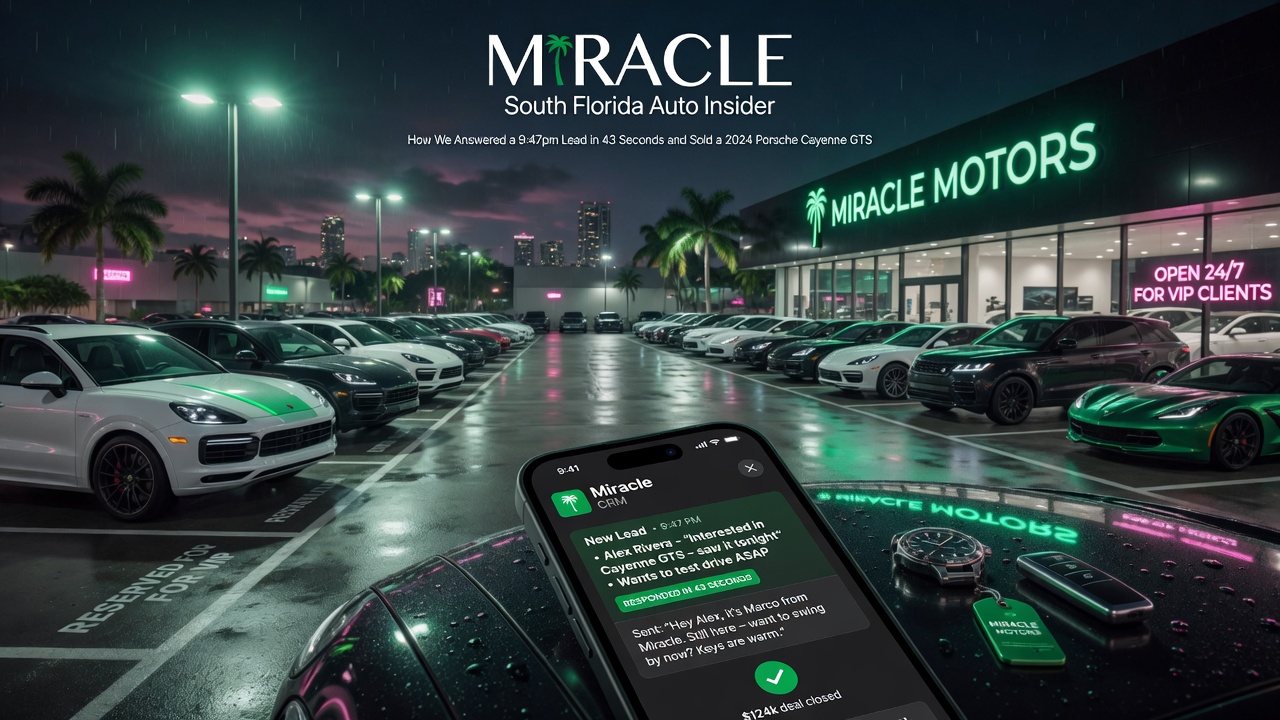
Car dealers in South Florida keep doing the same math.
You spend $5,000 — sometimes $8,000 or more — every month on Google Ads, Facebook Marketplace, and third-party lead sources. Your marketing budget buys demand. Your response time either captures it or wastes it. You track cost per lead (CPL) like it is the only number that matters.
Then those leads arrive at 9 PM on a Saturday. Your sales team left at 7. The Customer Relationship Management (CRM) system sends an auto-reply. The lead goes cold by Monday morning.
Automotive CPL hit $326 in 2026, up 15% year over year. Every lead you do not respond to within the first hour is a lead you paid for twice — once in ad spend, once in lost gross profit.
56% of dealership internet leads arrive outside business hours. The average dealer takes 42 hours to respond. By then, 78% of buyers have already purchased from the first dealership that responded meaningfully.
You do not need more leads. You need to stop losing the ones you already pay for.
The After-Hours Black Hole
Let's look at the data for a typical South Florida dealership.
200 internet leads per month. At $326 CPL, that is $65,200 in monthly ad spend before a single deal closes.
56% arrive after hours. That is 112 leads hitting your CRM at night, on weekends, during lunch — any time your Business Development Center (BDC) is not staffed.
The average after-hours response time across U.S. dealerships: 17 hours. Only 37% of dealers respond within one hour to after-hours leads.
At 17 hours, that Saturday 9 PM lead gets a callback at 2 PM Sunday. By then, the customer has submitted inquiries to three other dealerships, test-driven at one, and made a decision.
94% of after-hours leads abandon the process at dealerships without after-hours response coverage. Not 50%. Ninety-four percent.
Let me be direct: if 94% of your after-hours leads are unsalvageable, you are burning 52% of your monthly ad budget on unrecoverable demand.
The Internet Lead Response Gap
The data on lead response time and conversion is consistent across every source. Law firms face the same math, just with different numbers.
| Response Time | Close Rate | 200 Leads/Month → Deals |
|---|---|---|
| Under 60 seconds | ~24% | 48 deals |
| 1–5 minutes | ~18% | 36 deals |
| Industry average (47 min) | ~12% | 24 deals |
| 90+ minutes | ~6% | 12 deals |
The gap between sub-60-second response and industry average is 24 deals per month. At $3,200 average front-end gross per vehicle, that is $76,800/month. Over $920,000/year.
Same ad budget. Same salespeople. Same leads. The only variable is when the phone rings. We evaluated 7 AI voice platforms to find the fastest response stack.
43.2% of dealership sales leads are mishandled — never logged into the Customer Relationship Management (CRM) system, auto-replied but never called, or assigned and forgotten. 14.1% are never logged into the CRM at all.
What South Florida Dealers Face That Others Do Not
South Florida dealerships have a structural problem most markets do not.
Bilingual buyers. A significant portion of Miami-Dade and Broward car buyers speak Spanish as their primary language. They search in Spanish. They ask questions in Spanish. They expect a response in Spanish.
When your after-hours lead comes from a Spanish-speaking buyer and your auto-reply is in English, you have communicated something unintentional: we do not serve people like you.
78% of buyers purchase from whoever responds first — and first means in their language.
The BDC staffing gap. A Doral dealership with 200 leads per month needs a BDC that covers 7 PM to 11 PM weeknights and full weekend coverage. That is a second shift. At $18–$22/hour per BDC rep, you are looking at $4,000–$5,000/month in additional payroll for an extra shift.
Most dealers skip it. The math does not close on paper because the revenue loss is invisible.
But the data is clear: a dealer spending $65,200/month on leads with a 42-hour response time is leaving $76,800/month in gross profit on the table from slow response alone. That is not a cost. That is a return on investment (ROI) problem.
What "Speed to Lead" Actually Means for a Dealership
Speed to Lead is not a feature. It is a revenue operation.
It means:
- Every inbound lead — phone call, web form, text, chat, third-party — gets answered within 60 seconds, 24 hours a day, 7 days a week.
- Every response includes the specific vehicle the customer asked about, a price reference or payment range, and a clear next step.
- Every lead gets logged into the CRM automatically, with the full conversation history attached.
- Every after-hours inquiry gets handled instantly, not queued for the morning.
- Every Spanish-language inquiry gets answered in Spanish.
Responding within 60 seconds boosts conversion rates by 391% vs. 10+ minutes. That is not incremental improvement. That is a 4x multiple on the same ad spend.
The car dealerships that figure this out first in South Florida will win their market. Not because they spend more on ads. Because they stop losing the leads they already bought.
How the Math Changes With Instant Response
Let me show you the before-and-after for a Doral dealership.
Before: 200 leads/month. 56% after hours (112 leads). 42-hour average response. $65,200/mo ad spend. At 12% close rate = 24 deals. Gross profit at $3,200 front + $2,100 F&I = $5,300 combined per deal. Total monthly gross: $127,200.
After: Same 200 leads/month. Sub-60-second response across all hours. Bilingual coverage. At 24% close rate = 48 deals. Same $5,300 combined gross. Total monthly gross: $254,400.
Difference: $127,200/month. Over $1.5 million annually.
No additional ad spend. No additional sales headcount. The only change is when and how the first response happens.
Implementation Path
We build this inside Startup Miracle before recommending it to clients.
For car dealerships, the stack includes:
- Voice AI that answers inbound calls 24/7 in English and Spanish, qualifies the caller, and books appointments directly on the showroom calendar.
- Automated SMS and text follow-up that responds to every web lead within 60 seconds with the vehicle details the customer asked about.
- WhatsApp response for Spanish-dominant buyers who prefer messaging to calling.
- CRM integration that logs every interaction automatically so nothing falls through the cracks.
- Performance dashboard that shows response time, close rate, and revenue recovered by channel.
Your sales team still handles the test drives, the negotiations, and the deliveries. The system handles the first 60 seconds — which is where most deals are won or lost.
FAQ
What percentage of car dealership leads arrive after business hours?
56% of dealership internet leads arrive outside standard business hours, according to NADA and Dealership Accelerator data. This pattern is consistent across all market sizes.
How fast do car dealers respond to leads on average?
The average dealership lead response time is 42 hours. Only 13% of dealerships respond to web forms within 5 minutes. The average after-hours response time is 17 hours.
What is the cost per lead for automotive dealers in 2026?
Automotive CPL in 2026 averages $326 across all channels, up 15.2% from $283 in 2025. Electric vehicle (EV) leads average $412 per lead.
How much does slow lead response cost a dealership?
A dealership generating 200 leads per month at a 42-hour average response time loses approximately $76,800/month in gross profit compared to sub-60-second response. That is over $920,000 annually.
Is after-hours lead response worth the investment?
Yes. 94% of after-hours leads abandon the process at dealerships without automated response. Dealers using AI-powered after-hours response recover 15–20 extra deals per month on average, according to Dealership Accelerator data.
You are spending thousands on leads every month and then waiting 42 hours to respond. That is not a marketing problem. That is a response problem.
Book an AI Assessment. We will audit your lead response time, identify every revenue leak, and build a Speed to Lead system that answers in seconds, not days.