
Blog
We Run Claude Code, Codex, and Cursor Together. Here's When Each One Ships and When Each One Breaks.
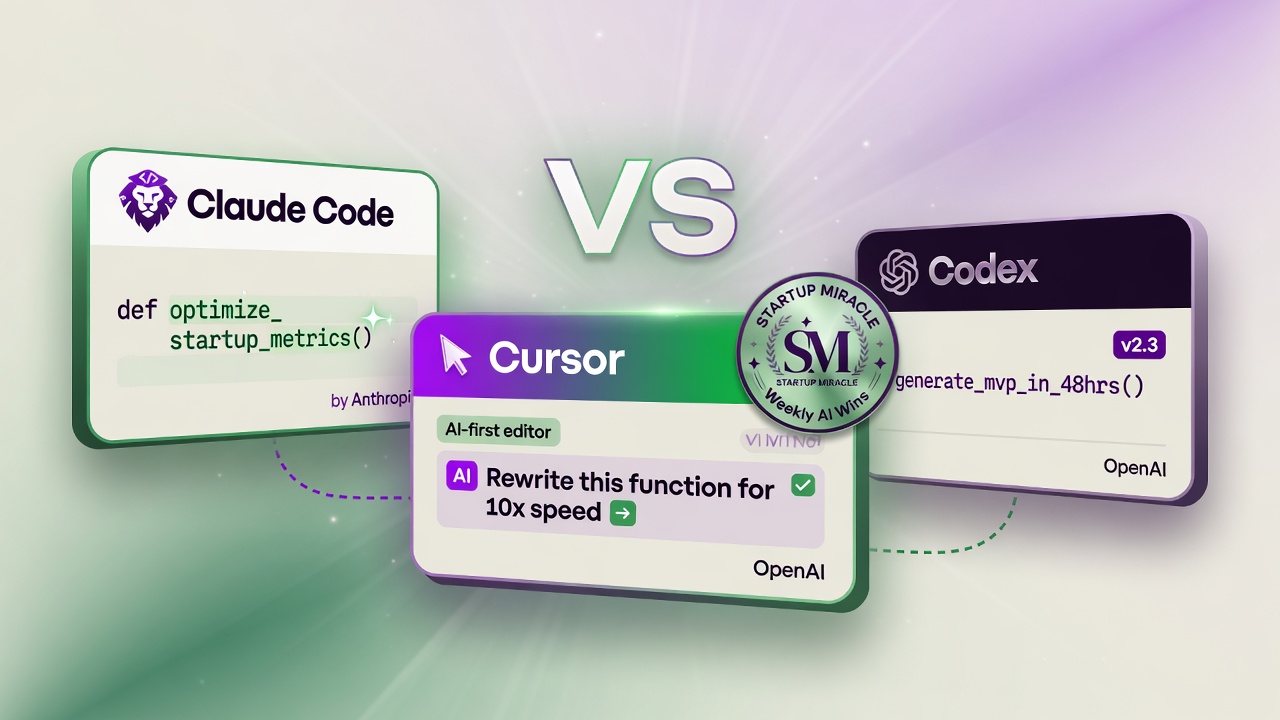
"Which is better -- Claude Code, Codex, or Cursor?"
I hear this question every week. At conferences, in DMs, on X.
It's the wrong question.
The AI coding tool market was supposed to consolidate by now. One winner. One tool to rule them all. That's not what happened. What emerged instead is a stack -- three specialized layers that work together, designed by no one, assembling itself anyway.
At Startup Miracle, we run all three in production. Not as competitors. As a team. Claude Code for strategic reasoning. OpenAI Codex for throughput. Cursor as the orchestration layer on top. Hermes Agent ties it all together.
Here's what that actually looks like, what breaks, and what the $150/month AI coding team buys you.
The stack nobody planned
In April 2026, three things happened in one week:
- Cursor 3 shipped a rebuilt Agents Window -- a standalone interface for managing multiple AI agents simultaneously
- OpenAI published `codex-plugin-cc` -- an Apache 2.0 plugin that runs inside Claude Code
- Developers started running all three together, not as competitors, but as layers in a stack
The New Stack called it "the unplanned AI coding stack." It mirrors how infrastructure works: nobody runs a single observability tool. You run Prometheus for metrics, Grafana for dashboards, PagerDuty for alerts. Specialized tools for specialized jobs.
Same thing is happening in AI coding. Three layers emerged:
| Layer | Tool | Job |
|---|---|---|
| Orchestration | Cursor 3 | Manage agents, spawn tasks, compare outputs |
| Execution | Claude Code | Strategic reasoning, complex refactors, architecture |
| Throughput | OpenAI Codex | Parallel tasks, code review, async batch work |
The magic is not any single tool. It is the orchestration layer that wires them together.
Claude Code: The strategist
Claude Code lives in our terminal. It has broad access to the local environment, the full codebase context, and the ability to reason through multi-step architectural decisions.
When a client needs a Supabase migration, a new API route, or a complex state change that touches 15 files, I hand it to Claude Code. It thinks through the change, validates the approach, and produces production-ready code.
What breaks: Claude Code is expensive at scale. Each complex task burns through tokens fast. If you throw everything at Claude, you hit usage limits before lunch. The tool is optimized for depth, not volume. According to a Pragmatic Engineer survey from February 2026, Claude Code was the "most-used AI coding tool" with a 46% "most loved" rating.
What it is terrible at: Parallel work. You cannot ask Claude to refactor auth, build a dashboard, and update tests simultaneously. It works sequentially. One thing at a time.
OpenAI Codex: The throughput engine
Codex runs as a subagent inside our workflow. When OpenAI shipped the `codex-plugin-cc` -- an official plugin that runs inside Claude Code -- they acknowledged the stack reality. They embedded Codex where developers already work instead of waiting for them to switch.
Codex handles the volume work. Boilerplate generation. API integrations. Code review. The `/codex:adversarial-review` command pressure-tests auth flows, data loss scenarios, and race conditions with genuinely independent scrutiny -- because asking the same model that wrote the code to review it is grading your own homework.
Codex reached over 3 million weekly active users within weeks of launch, up from 2 million a month earlier. It runs in cloud sandboxes, making it ideal for parallel tasks without risk to your local environment.
What breaks: Codex works in cloud sandboxes, not on your local machine. This is great for security but terrible when you need to debug something running locally. It also has no context about your full codebase unless you explicitly feed it.
What it is terrible at: Nuanced reasoning across long context windows. Codex handles the 80% case fast. The remaining 20% -- edge cases, architecture decisions, cross-cutting concerns -- needs Claude.
Cursor: The orchestration layer
Cursor 3's Agents Window is not an IDE with AI bolted on. It is a control plane for managing fleets of coding agents. You can see all active agents in a sidebar -- whether they were kicked off from desktop, mobile, Slack, GitHub, or Linear.
The `/best-of-n` command is the killer feature. Send the same prompt to multiple models, each in an isolated worktree, and compare outputs. It turns model selection into infrastructure -- treat models like cloud providers, not religion. Cursor now has over 360,000 paying users, and its shift from a VS Code fork to an independent orchestration platform is one of the most strategic moves in developer tools this year.
What breaks: Cursor's orchestration is ahead of its execution. It can spawn agents everywhere but does not always know how to merge outputs cleanly. The handoff between agents -- from orchestration to execution and back -- is the rough edge.
What it is terrible at: The tool assumes you want to manage agents. If you just want to write code and go home, the orchestration layer adds complexity you do not need. Cursor is built for teams running agentic workflows at scale.
The orchestrator that ties it together
Here is the part nobody talks about. Three tools, three interfaces, three billing cycles. Nobody wants to context-switch between a terminal, a cloud sandbox, and an agent window all day.
That is where Hermes Agent comes in. Hermes is the agent framework that wraps all three. It decides which tool handles which task based on the job's nature:
- Complex architectural decision -> Claude Code
- Parallel batch task -> OpenAI Codex
- Multi-agent orchestration -> Cursor 3
The framework handles task routing, output collection, and context preservation across sessions. Without it, you are just switching tabs.
This is the architecture we run at Startup Miracle. Three AI coding agents, one orchestrator. And one founder shipping more than a team of five.
What this costs
Let us be specific about the numbers since pricing changes fast in this market:
| Tool | Cost | What you get |
|---|---|---|
| Claude Code | $20/month (Pro) + API usage | Terminal-native agent, best reasoning, large refactors |
| OpenAI Codex | Free (temporary) / API usage | Cloud sandbox, parallel tasks, adversarial review |
| Cursor | $20/month (Pro) | Agent orchestration, multi-model comparison, agent tabs |
| Hermes | Free (open source) | Agent framework, task routing, context management |
| Total | ~$40-150/month | Three-agent AI coding team |
Compare that to a senior developer at $150K-200K/year. The tools do not replace the developer. They 10x the output of one.
One caveat: Codex was launched as free for 2 months. The pricing model post-free-period is not finalized. If it lands at $100-200/month (the rumored range), the math shifts. But even at $200/month total, this stack replaces zero headcount. It multiplies headcount.
What breaks in practice
After running this stack for months, here are the failure modes you need to know:
Context drift. When tasks hand off between Claude and Codex, context gets truncated. What Claude understood about the codebase, Codex does not inherit. The orchestrator layer has to maintain a shared context store, which Hermes does via its knowledge base.
Merge conflicts. Cursor's `/best-of-n` generates outputs in isolated worktrees. Merging them back into main is manual. There is no automated merge resolution for agent outputs -- yet.
Review loops. The Codex plugin's adversarial review is powerful but dangerous. You can create long-running review loops that drain usage limits. Set explicit timeouts on review gates.
Cost creep. Each tool has separate billing. Without monitoring, it is easy to burn through API credits. We track cost-per-task and flag anything over $0.50.
When you should NOT run all three
This stack is overkill for most teams.
Skip the orchestration if you are a solo developer writing CRUD apps. One tool -- whichever fits your workflow -- is enough. Claude Code if you want thoughtful, terminal-native work. Cursor if you want IDE integration. Codex if you want cloud sandboxes.
Skip the multi-agent setup if your codebase fits in a single model's context window. The complexity of routing between tools only pays off when you are regularly hitting context limits or running parallelizable tasks.
Skip entirely if you do not have a clear division of labor. The stack works because we know: Claude handles architecture, Codex handles throughput, Cursor handles orchestration. Without that clarity, you are just paying for three tools.
The bottom line
The AI coding tool market is not converging. It is layering.
We are moving toward a world where developers do not pick one AI coding agent. They pick a stack. Claude for strategy. Codex for volume. Cursor for orchestration. Hermes to wire it together.
The question is not "which one is best?"
It is "what does your stack look like?"
At Startup Miracle, ours costs $150/month and ships more code than a team of five. That is not a prediction. That is our current setup.
Book an AI Systems Audit -- we will design your agent architecture and help you build the stack that fits your workflow. Start here.
Frequently Asked Questions
Do you need all three tools to work effectively with AI coding agents?
No. Each tool serves a different purpose, and the right setup depends on your workload. If you are a solo developer on a small codebase, any single tool will serve you well. The multi-agent stack pays off when you regularly hit context limits, run parallel workloads, or manage multiple projects with different constraints.
How much does the full stack actually cost per month?
Claude Code Pro is $20/month plus API usage (typically $10-80/month depending on volume). Cursor is $20/month. Codex is currently free during its launch period. Hermes is free and open source. Total out-of-pocket is roughly $40-150/month, which replaces zero headcount but multiplies one developer's output significantly.
What happens when OpenAI starts charging for Codex?
This is the open question. If Codex lands at $100-200/month (the rumored range), the total stack cost hits $150-300/month. Even at that price, the stack compares favorably to a senior developer's salary. The Codex app is currently in its temporary free access window, and we recommend evaluating it now while pricing is unconstrained.
Can I run this stack without Hermes?
Yes, but you will be context-switching between three interfaces manually. Hermes provides the task routing and context preservation that makes the stack feel like one system instead of three disconnected tools. Without an agent framework, you lose the benefit of orchestration. You can still use each tool independently, but the "three tools as a team" value prop requires some form of orchestrator.