
Blog
Claude Code vs Codex: We Ship Production Software With Both Every Day. The Real Difference Isn’t Benchmarks — It’s Workflow.
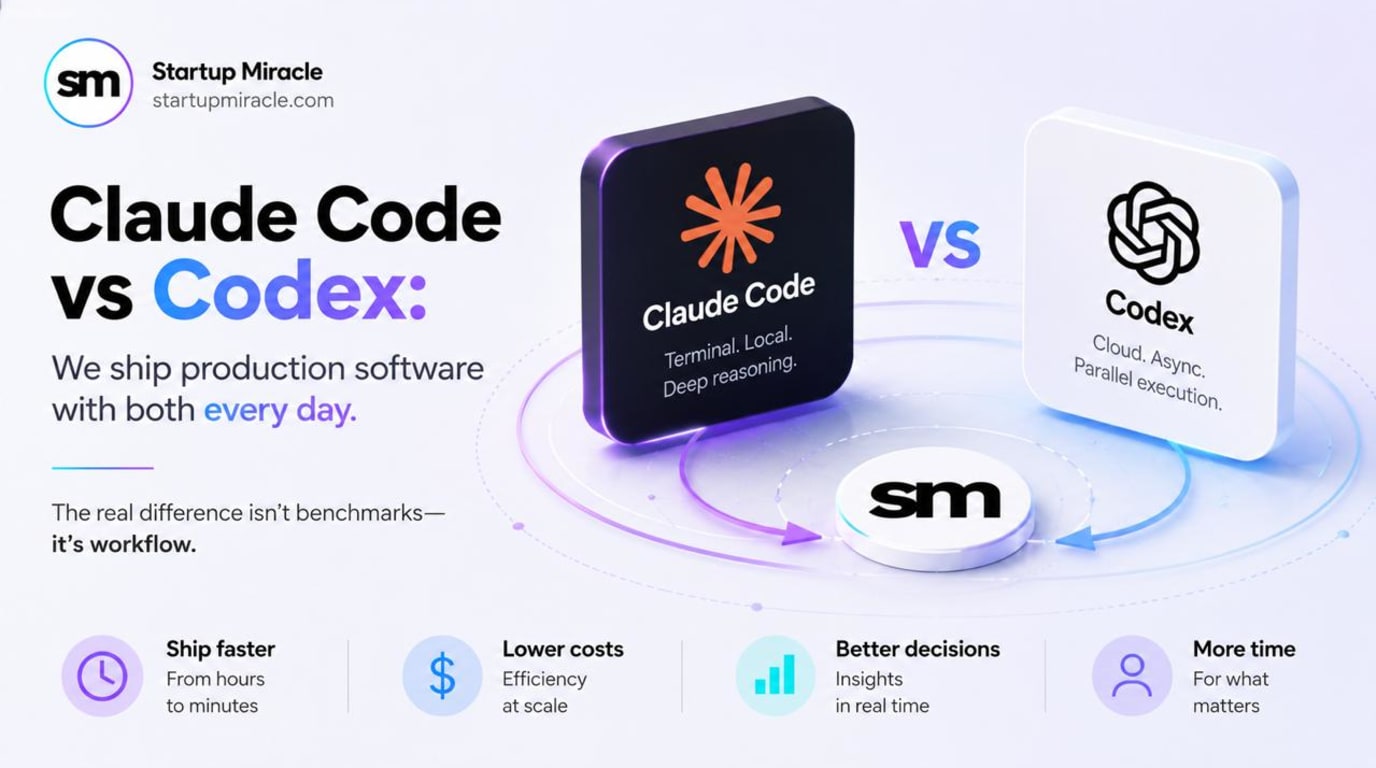
Here’s the setup at Startup Miracle: I have two AI coding agents. I pay for both. I use both every day. One of them wrote this article’s software infrastructure. The other manages the deployment pipeline. Neither replaced a developer — they both are developers with different specialties.
The question I get most from other founders and operators: which one should I use? Claude Code or Codex?
The answer is boring and useful: it depends on the task. But “it depends” isn’t a helpful answer when you’re spending $100-$200/month on a tool and need it to ship real software. So here’s the war story version — what we actually do, what breaks, and how we route between them.
Two Agents, Two Architectures
Claude Code (Anthropic) and Codex (OpenAI) start with the same core loop: read code, plan a change, execute tools, observe output, iterate. The similarity ends there.
Claude Code runs in your terminal. It reads files from your local filesystem, executes bash commands, runs tests, and edits code directly. It uses Anthropic’s Opus 4.8 model (since May 2026), which scores 69.2% on SWE-bench Pro — the strongest multi-file reasoning benchmark currently available.
Codex runs in a cloud sandbox. It clones your GitHub repository, executes tasks asynchronously, and opens pull requests. Powered by GPT-5.5 locally or GPT-5.3-Codex for cloud execution. It handles “you do this while I review something else” better than any tool I’ve used.
The MindStudio team documented this distinction well: “One lives in your terminal and works alongside you in real time. The other runs in the cloud, quietly handling tasks while you do something else.” That’s the workflow difference, and it matters more than any benchmark score.
When We Reach for Codex
At Startup Miracle, Codex handles the assembly line. When we need to deploy a blog article with images, update multiple Supabase rows, generate six social variants, and verify the frontend — that’s a Codex job.
Here’s why: Codex runs multiple tasks in parallel. I can say “update the article body, generate the hero and OG images, create the X thread, and save the LinkedIn draft” and it works on all four at once. Each task gets its own cloud sandbox. When one finishes, it moves to the next without blocking.
The parallel execution isn’t just a speed advantage. It changes how I think about task delegation. With Codex, I batch work by surface: “all the operations work between 9 and 10 AM” — not “write this file, wait, then write the next one.”
Codex also has two features I use daily:
codex cloud execlets me delegate tasks and check results later. I don’t watch the terminal.- Browser self-review spins up a headless browser, checks the rendered frontend, and attaches screenshots to the PR. This catches CSS breaks and broken links before any human looks at it.
The Composio review calls these “best-in-class” features, and I agree. They’re not nice-to-haves — they’re how one person ships work that would need a team of three.
When We Reach for Claude Code
Claude Code handles the deep work. When I need to understand why a 400-line TypeScript function breaks under a specific edge case, or design the architecture for a new API route that connects Stripe webhooks to Supabase triggers — that’s a Claude Code session.
The key advantage: Claude Code reads the entire codebase before it starts. It navigates directory structures, traces function calls across eight files, and understands how “changing this type definition in a utility file” affects “that API response in a completely different module.” The Composio team noted this in their 100-hour comparison: “Claude Code saves big tool outputs to file instead of truncating” — which means a 26-hour session with 570K tokens of context can be compressed and resumed the next day with the agent remembering the exact counterfactual from a day earlier.
I had that exact experience. I gave Claude Code a complex refactoring task involving our blog’s custom markdown renderer. It spent twelve minutes reading files, tracing the render pipeline across the operations and sales page components, and building a mental model of how the regex parser worked. Then it made the edit in one shot — correct, no bugs, tests passed. A human developer would need two hours just to understand the renderer’s edge cases.
Claude Code’s terminal loop is also faster for interactive debugging. When I type “run the test suite for the Stripe webhook handler, show me only failures, and explain why each failed” — Claude Code runs the tests, reads the output, identifies the failure pattern, and proposes a fix. All in one conversational turn. No context handoff. No file copying.
The Reddit thread on r/ClaudeCode captured this well: “Codex is noticeably slower, less interactive and more deliberate. Claude is faster, interactive (needs babysitting) and more ‘get it done.’” The “needs babysitting” part is real — Claude Code works best when I’m at the terminal guiding it. It’s not a fire-and-forget tool.
The Handoff: How We Route Between Two AI Coders
This is the part I don’t see written about. The routing decision.
At Startup Miracle, the handoff follows a simple rule: Claude Code designs the architecture. Codex ships the tasks. Claude Code reviews the output.
Here’s the workflow for a typical feature:
- Claude Code session (45 minutes): I describe the feature. Claude Code reads the relevant codebase, designs the architecture, writes the core logic, and creates the test file. Output: a branch with the complete implementation.
- Codex batch (15 minutes): I feed Claude Code’s output to Codex with: “Implement this architecture across the other components. Generate the API routes, update the types, and run the linter.” Codex takes it, parallel-processes, and opens a PR.
- Claude Code review (10 minutes): I run Claude Code on the PR branch. “Review this PR against our project rules. Are there edge cases we missed? Does the type system handle all possible states?” Claude Code reads the diff, catches issues, and suggests corrections.
This convoy pattern gives us both tools’ strengths: Claude Code’s architectural depth for the critical path, Codex’s parallel throughput for the commodity work, and Claude Code’s review discipline for quality control.
The Firecrawl analysis put it in perspective: “Claude Code has the deepest programmable harness and fastest terminal loop. Codex covers more surfaces at a lower entry price.” The routing decision is about matching the tool’s architecture to the task’s shape.
What Breaks at Scale
Nothing I’ve written here is a critique of either tool. Both ship production software. But both have failure modes you need to know about.
Claude Code’s break: Session cost. A single deep session running Opus 4.8 can consume 150K-200K tokens at roughly $2.50 per session. If you do five of those a day with Claude Max 5x ($100/month), you hit limits fast. The trade-off is real: smarter model, faster loop, more expensive per session. We mitigate this by routing commodity work to Codex and saving Claude Code sessions for architectural decisions only.
Codex’s break: Context misalignment. Because Codex runs in a cloud sandbox that clones your repo at task start, it doesn’t know about changes you’ve made locally since the last commit. If you’re iterating fast — edit, test, edit, test — Codex can miss context because it’s working from a snapshot. We mitigate this by committing frequently and using “cloud exec” only for well-defined tasks with clear acceptance criteria.
Both break on: Tool-heavy MCP configurations. The Composio-controlled test showed Claude Code consumed 1.4x more tokens than Codex on the same MCP-heavy task — not because Claude Code is wasteful, but because it reads more files and verifies more tool outputs before acting. For self-contained refactors, the gap nearly closes. But if you’re running 15 MCP servers, both tools spend more time discovering and verifying than they do writing code.
The Price: Who Wins at $20/Month?
Codex wins on entry price by a wide margin. At $20/month (ChatGPT Plus), you get meaningful daily coding-agent runtime — 15-80 GPT-5.5 messages per 5-hour window plus 10-60 cloud tasks. At $20/month (Claude Pro), Claude Code usage is limited to light sessions.
At $100/month, the gap narrows. Claude Max 5x gives you 5x the Pro limits. Codex Pro 5x gives you 5x the Plus limits. Both run at comparable levels.
The hidden cost is tokens per task. Claude Code’s “check first” loop reads more files and verifies more tool outputs. It buys better architecture — in the Composio test, Claude Code produced 12 components vs Codex’s 7 on the same task — but it costs more per completion. For tool-heavy MCP work, the token gap is real. For self-contained refactors, it nearly disappears.
One Founder, Two AI Coders
I don’t recommend picking one. I recommend building a routing discipline.
If you’re a solo founder or small team evaluating AI coding tools, here’s the practical test:
- When you need to design something complex and debug interactively, reach for Claude Code.
- When you need to ship multiple well-defined tasks in parallel and verify the output, reach for Codex.
- Build the handoff: Claude Code designs → Codex executes → Claude Code reviews.
That’s how one founder ships more than a team of three. Not because the tools are magic. Because the workflow between them is.
Try our AI Assessment — we’ll help you design your AI tool stack, not just sell you one.
Frequently Asked Questions
What is the main difference between Claude Code and Codex?
Claude Code runs in your terminal with direct access to your local filesystem. It’s designed for real-time, interactive debugging and architectural work. Codex runs in a cloud sandbox and executes tasks asynchronously. It’s designed for parallel task execution and PR-based workflows. Claude Code uses Anthropic’s Opus 4.8 model. Codex uses OpenAI’s GPT-5.5 locally or GPT-5.3-Codex in the cloud.
Which is better for production software development?
Both ship production software, but for different workflows. Claude Code handles complex reasoning, system design, and interactive debugging better — scoring 69.2% on SWE-bench Pro (Opus 4.8). Codex handles batch tasks, parallel workstreams, and fire-and-forget assignments better — scoring 78.2% on Terminal-Bench 2.1 (GPT-5.5 High). The best approach is to route tasks by type, not pick one tool.
How much does each tool cost in practice?
At $20/month entry, Codex gives more meaningful daily runtime. At $100/month (Max 5x for Claude, Pro 5x for Codex), both run at comparable levels. The hidden cost is tokens per task: Claude Code’s “check first” loop consumes ~1.4x more tokens on tool-heavy tasks, roughly $2.50 per session vs Codex’s $2.04 per session. For self-contained refactors, the gap nearly closes. See the full cost comparison at Composio.
Can I run both Claude Code and Codex together?
Yes — this is the most effective setup. We use a “convoy” pattern: Claude Code designs the architecture, Codex executes the implementation in parallel, and Claude Code reviews the output. This gives you both tools’ strengths — Claude Code’s architectural depth and Codex’s parallel throughput — while mitigating each tool’s weaker areas. The Firecrawl comparison notes that many teams run both and route by task type.
What are the security differences?
Claude Code runs locally with write access to your filesystem and uses hooks for security gating. Anthropic receives code only for inference. Codex clones your entire repository to OpenAI’s cloud infrastructure and runs in a kernel-level sandbox (sandbox-exec on macOS, bubblewrap+Landlock on Linux, Windows sandbox on Windows). Codex’s sandboxing is more deterministic (kernel-level enforcement), while Claude Code’s hooks are more expressive (custom policies). Teams subject to SOC 2, HIPAA, or government compliance should review specific policies for both.