
Blog
Conexiom Relay Turns a Handwritten PO Into an Order
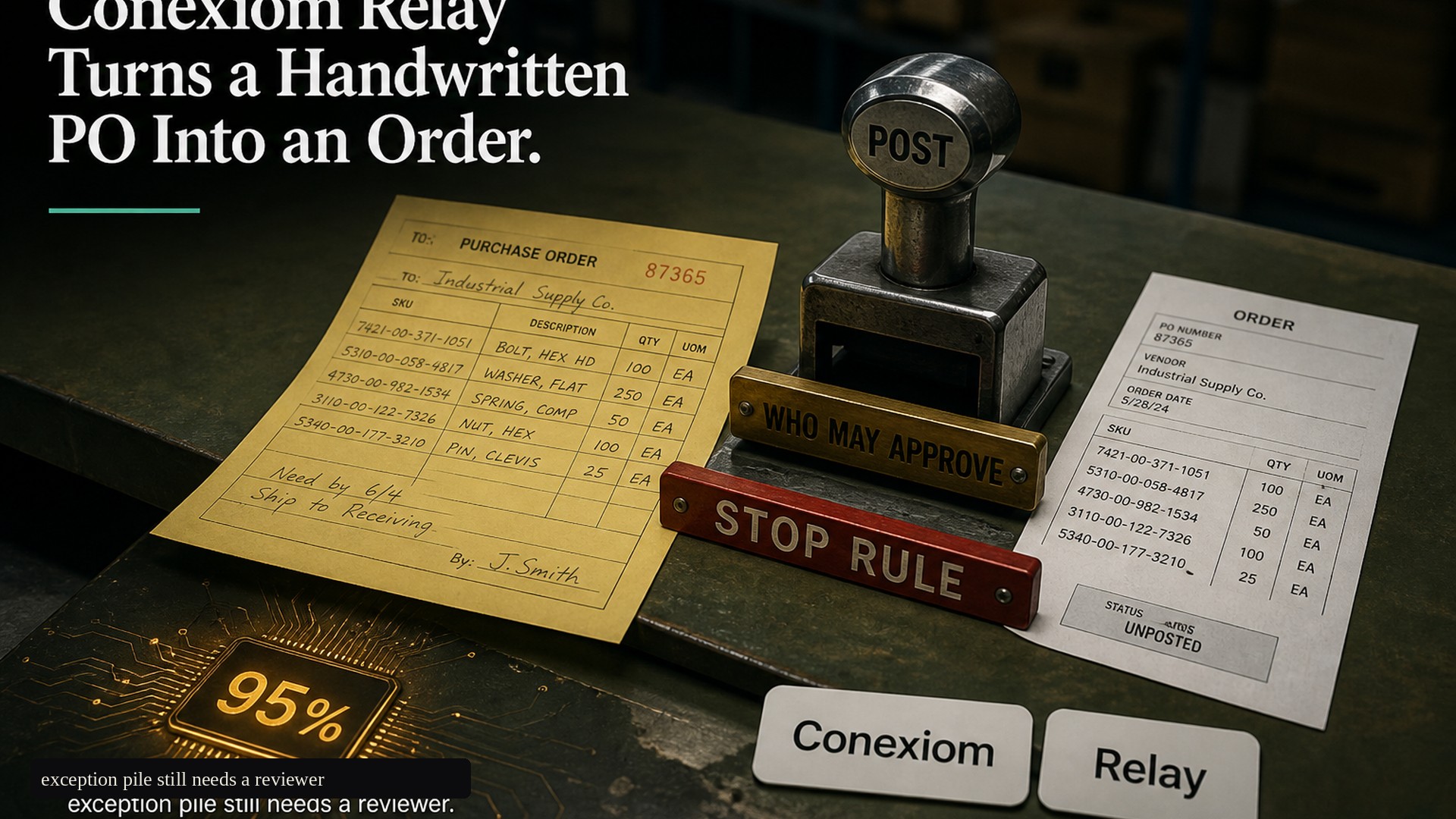
Conexiom Relay Turns a Handwritten PO Into an Order
On September 1, 2026, Conexiom announced Relay, an order and invoice automation product that takes email threads, spreadsheets, handwritten notes, images, and text messages and turns them into ERP-ready orders. ERP here means the purchasing system the warehouse already runs. Assist, unlike a chatbot, receives requests, flags exceptions, and executes against a Playbook, the named rule set built from how your CSRs already correct a line. If you still retype POs while the floor waits, or you email a parts list and hope the supply house keys it right, that is real help on incoming paper the ERP never saw.
Conexiom built something worth turning on. The question is not whether a handwritten PO can become a line. It is who may approve that line, meaning the named person who checks an exception before Relay posts it. It is also the stop rule, meaning the named rule Assist may not post without you. Write those names before the first post, not after a wrong SKU, qty, or price is on the truck.
Startup Miracle sits with distributor, plant, and trade owners who still are the order desk after the warehouse opens. We help you name who checks the exception and write that stop rule so a touchless claim does not post the wrong line.
Email, handwriting, and 40 ERPs
Conexiom's September 1 release is the product in the company's own words. Most order and invoice traffic never arrives as a clean PDF. Relay extends Conexiom's core work, ingest, classify, extract, validate, correct, and prepare for any of 40 compatible ERPs, to unstructured sources. The Intelligence Console sits on 15 years of order and invoice knowledge. The Playbook captures CSR corrections in natural language and shows its work. Automation Analytics measures how much actually ran. Revenue Signals flag upsell, churn risk, and vendor savings. Those are Conexiom's names for the pieces.
Michel Feaster, Conexiom's CEO, said distributors and manufacturers face a silver tsunami of retirement, pressure to put AI in, and risk from ERP modernization, and that Relay does not require changing the ERP. Bryan DeGraw of The Hackett Group said manufacturers and distributors cannot trust AI they cannot see, and that making rules visible and editable is the difference between automation a company can defend and automation it accepts on faith. Both are right about the window. You still name who teaches the Playbook, and who may approve a line, before Assist executes.
A first AI hire, meaning the first named job you let software run without you standing over it, can live here. It can be the exception pile. It cannot be "Assist now posts the book." The distributor who still is the order desk still owns the post.
Ninety-five percent still leaves a pile
Conexiom says it already processes more than 1.5 billion line items a year at over 95 percent accuracy for more than 600 customers across those 40 ERPs. Those figures are Conexiom claims on the September 1 page, not a Startup Miracle audit. Treat 95 percent as the product's own number. The 5 percent that is not clean is the job. A wrong SKU, qty, or price posting into the ERP is the fear that already lives on that desk. Looking sloppy when the AI took the line is how it shows up in front of the warehouse.
A wholesale owner whose quotes and invoices still arrive as photos and texts is living in that 5 percent all day. CSRs are supposed to spend the day on rush requests, disputed prices, and reorders, not retyping. Relay clears the retyping queue only if someone named who reviews what Assist flags. Distribution Strategy Group, also September 1, put the same move in trade language: AI is moving into the distributor order desk. The desk still needs a named Playbook teacher before Relay clears the queue.
The Playbook is the job
A plant owner whose CSR still retypes POs while the floor waits has a different version of the same gap. The order is in and the line is not, so the crew is standing while someone retypes. Assist takes action against the Playbook. If nobody owns that Playbook, Assist executes a process nobody named. Tribal knowledge walking out with the next retirement is the reason Feaster gave for encoding the rules now. Fifteen years of order and invoice knowledge sits behind the Intelligence Console. That history is Conexiom's. Your plant's rules are still yours to name.
Name the Playbook owner before Assist takes action on an order. That person decides which corrections become rules, which exceptions stay human, and which rush job never auto-posts. Compatible with 40 ERP systems is useful. It is not a named owner. Across those 40, Assist should execute the plant's rules, not a black box.
Sonepar's hours are not your hours
An electrical or HVAC owner who still emails a parts list and hopes the supply house keys it right is on the other side of that desk. Sonepar, a named Conexiom customer with 10,000-plus employees, says it automated 200,000 order lines a month and repurposed more than 1,000 hours a month. That is Sonepar's claim on Conexiom's case page, not a typical shop's hours, and not a Startup Miracle audit. Do not take 1,000 hours as your number. Take the shape: incoming lines still need a named checker before they become a truck.
The fear is the wrong part on the truck, or a 1,000-hour order desk that still posts without a named checker. The job is the same at a shop that emails a handwritten list. Name who checks the exception before the supply house AI posts the PO. A named checker on the exception pile beats unsupervised post, whether the volume is Sonepar's or Tuesday's four-line fax.
Before the line posts
This is incoming work. A customer or a tech sent a PO as a photo, a text, or a handwritten list. The ERP did not see it until someone typed. Relay sees it first. The shop still decides what may post. Turn Relay on if that pile already lands as email, photos, and texts. Then write three names before the first post.
First, who may approve an incoming order line. That person checks the exception Assist flags. Second, who owns the Playbook. That person decides which corrections become rules. Third, the stop rule. Write the line Assist may not post without you: no price change, no substitute SKU, no qty the buyer did not confirm, no handwritten PO that hits the floor unread. Relay can take the unstructured pile. It should not post under the shop name without a reader.
Startup Miracle's work here is the AI Readiness pass, not another order-desk product. The quiz names who checks the exception now that a handwritten PO can become an ERP order. The $1,500 assessment, with a $1,000 credit if you continue, is the longer version of that same question. We do not replace Conexiom. We sit with you until the line has a named approver, and the stop rule is on the card, before it posts.
If unstructured orders already clog the desk, write the names this week. If you have not turned Relay on yet, write the names first. The order is the point. A 95 percent touchless pass with no owner is how a useful launch becomes a wrong part on the truck.
FAQ
What is Conexiom Relay?
Conexiom Relay is an order and invoice automation product that turns unstructured email, handwriting, images, and texts into ERP-ready orders. Assist flags exceptions and executes against a Playbook, and Conexiom says it is compatible with 40 ERP systems.
How do I keep a stop rule before Relay posts a line?
Name who may approve an incoming line, and who owns the Playbook, before the first post. Write the stop rule in the same sitting so a wrong SKU, qty, or price cannot hit the ERP without that checker.
How accurate does Conexiom say the automation is?
Conexiom says it processes more than 1.5 billion line items a year at over 95 percent accuracy for more than 600 customers. Those are Conexiom claims, and the remaining 5 percent is the exception pile that still needs a named reviewer.
Relay can post the line. You still name who checks it.
If you want the long version of how we think about readiness, Start with a FREE quiz and Get Your AI Score.