
Blog
Construction Bidding in 2026: Why South Florida Contractors Using Artificial Intelligence Win 3x More Projects
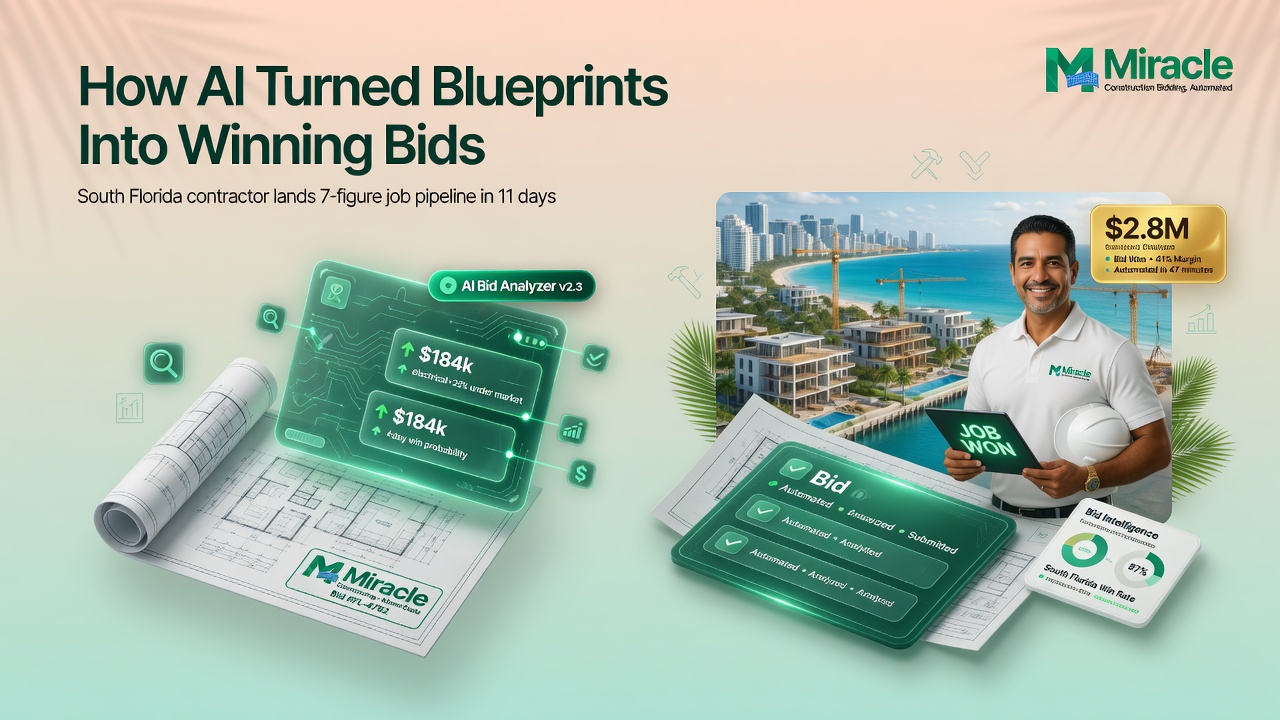
Your team spends 35% to 45% of every workday on administrative bid coordination. You are not estimating. Operations teams run on process. You are shuffling documents.
And while you shuffle, the contractor with an Artificial Intelligence (AI) workflow just submitted their bid in 3 hours - not 9 days.
That gap is not theoretical. It is the difference between winning a South Florida commercial project and watching someone else break ground on it.
The Manual Request for Proposal (RFP) Cycle Is the Problem
Most construction firms still process Requests for Proposal (RFPs) the same way they did a decade ago. A project announcement lands. Someone prints or downloads the full RFP package. An estimator reads through hundreds of pages to find scope requirements, compliance checklists, subcontractor clauses, and deadlines.
That process takes 9.3 days on average.
By day 9, the contractor who submitted on day 3 has already had their pricing reviewed. The general contractor or project owner has moved on. Your bid arrives late, rushed, or incomplete - because you ran out of time, not because you could not do the work.
The cost is concrete. Every day of delay in bid submission reduces win probability by an estimated 5% to 7%, according to bid management industry data. A 9-day cycle means you are submitting at a 40% or greater disadvantage before your pricing is even read.
What Changes with AI
For civil construction firms, AI-powered bidding tools automate the three parts of RFP response that take the most time:
Requirement extraction. Instead of an estimator reading every page, AI scans the RFP document and extracts every scope requirement, compliance item, deadline, and submission format. What takes a human 2 to 3 days takes AI 5 minutes.
Compliance tracking. Most RFPs have 50 to 200 specific requirements - bonding thresholds, subcontractor utilization goals, wage determinations, insurance minimums. Missing one means disqualification. AI cross-references every requirement against your firm's capabilities and flags gaps instantly.
Proposal assembly. The AI pulls from your past successful bids, selects the right project descriptions and resumes, and assembles a compliant proposal draft. Your sales and operations team reviews and customizes - they do not start from zero.
The result: what took 9.3 days now takes 3 to 6 hours. Your bid lands in the first wave. Your pricing gets read before the budget is burned.
Why South Florida Contractors Have the Most to Gain
South Florida's construction and flooring market has been on a multi-year growth run. CBRE data shows Miami-Dade, Broward, and Palm Beach counties leading the state in commercial and residential development activity through 2026.
More projects mean more RFPs. More RFPs mean more bid opportunities. But they also mean more competition.
Every South Florida contractor I talk to says the same thing: there are more jobs to bid than ever, but the window to bid keeps shrinking. Project owners are using digital platforms that accelerate the entire procurement cycle. If your firm cannot turn around a bid in under 48 hours, you are being filtered out before the selection committee sees your qualifications.
That is where AI is not an advantage. It is table stakes.
The Estimator Bottleneck
This is the part most articles miss. Estimators are the scarcest resource in construction. Good ones are hard to find and expensive to keep. They should be doing what only they can do: evaluating job complexity, pricing risk, negotiating with subcontractors.
Instead, estimators spend 35% to 45% of their time on administrative bid coordination - document management, compliance checking, formatting submissions. Industry surveys from the Associated General Contractors of America consistently cite administrative overload as the top productivity drain in estimating departments.
AI does not replace the estimator. It removes the 40% of their job that is paperwork. Your estimator goes from processing RFPs to winning projects.
What Startup Miracle Sees
We deploy AI systems for South Florida construction firms. Here is what we have learned:
Most contractors want AI for bidding - they know the manual process is broken. But they do not know where to start. They try ChatGPT for one RFP, get a mediocre result, and assume AI does not work for construction.
That is the wrong takeaway. The right takeaway is that a generic chatbot is not a bidding system.
A bidding system needs:
- Document ingestion that handles 200-page RFP packages with attachments
- Extraction logic trained on construction-specific language - scopes of work, AIA documents, pay apps, bid forms
- Compliance cross-referencing against your specific license, bonding, and certification profile
- Proposal generation that uses your firm's past winning language, not generic marketing copy
That requires a configured AI operations stack, not a single prompt. We build those stacks in under two weeks.
The Cost Picture
An AI bidding workflow costs $300 to $500 per month for most mid-size construction firms. That is less than one estimator day.
Compare that to the cost of losing one bid per month because your response was too slow. At average commercial project margins in South Florida, one additional win per quarter covers the annual cost of the system.
The math is not close.
What to Do Monday Morning
Here is a three-step plan that costs nothing and takes one hour:
Step 1. Pull your last five RFP submissions. Note the submission deadline and the date you actually submitted. Calculate your average cycle time. If it is over 5 days, you are leaving bids on the table.
Step 2. Track how much time your estimator spends on document management versus actual pricing. If the split is worse than 60/40 (pricing being the 60), you have a workflow problem, not a staffing problem.
Step 3. Book an AI Assessment. We will audit your bid preparation workflow and show you exactly what an automated pipeline looks like for your firm. Two weeks later, you submit your first AI-assisted RFP.
Frequently Asked Questions
Is AI bidding only for large contractors handling 50+ RFPs per year?
No. The automation gains are actually largest for mid-size firms (10 to 100 employees) because they have the least administrative overhead to absorb inefficiencies. A firm bidding 10 to 20 projects per year sees the same percentage time savings as a large contractor.
Does AI handle public-sector RFPs with strict compliance requirements?
Yes. Compliance checking is where AI provides the most value. The system can be configured to match any public-sector requirement set - Davis-Bacon wage determinations, disadvantaged business enterprise (DBE) goals, bid bond thresholds, and certification requirements.
Will AI replace my estimator?
No. AI removes the administrative work that currently consumes 35% to 45% of an estimator's time. Your estimator shifts from document management to high-value work: risk assessment, pricing strategy, and subcontractor negotiations.
Does the system need to be trained on my past bids?
Yes, and that is what makes it accurate. We configure the AI stack with your firm's past successful proposals, project descriptions, and pricing templates. The first bid takes slightly longer to set up. Every bid after that accelerates.
How fast can we deploy?
Two weeks from assessment to first assisted bid submission.