
Blog
Fieldproxy Data Puts Route Density Before Dispatch AI
Fieldproxy Data Puts Route Density Before Dispatch AI
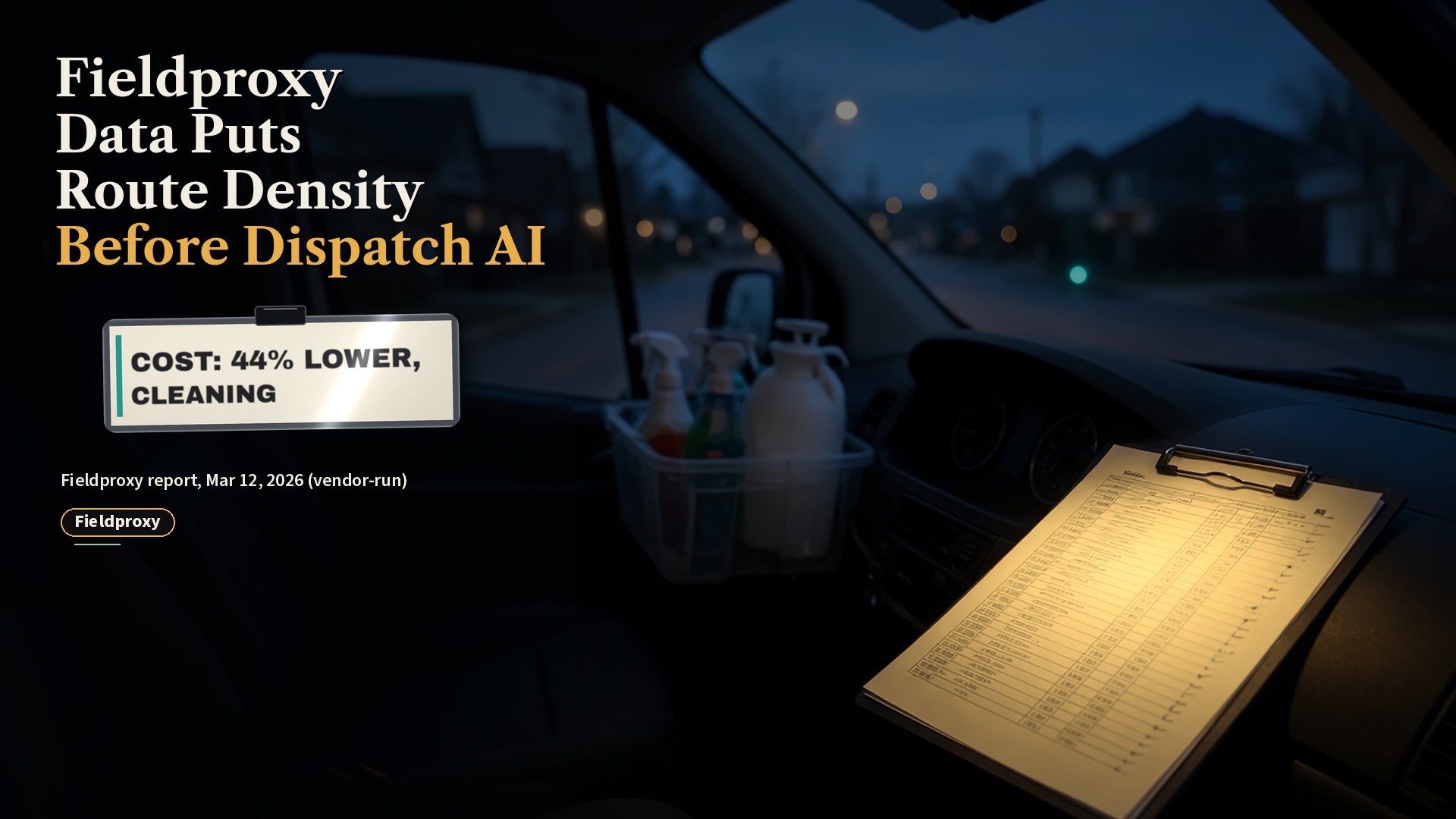
In March 2026, Fieldproxy, a field service software company, published its report on AI business impact in the trades, built on data from more than 500 companies. Per the report, cleaning led every trade with a median cost reduction of 44% (the middle result, so half the companies did better and half did worse) over six months, with pest control close behind at 42%. Fieldproxy ran the study itself and accounts for 62% of the dataset, so these are vendor-run numbers.
Our take: the useful part isn't the size of the cuts. It's Fieldproxy's explanation of why those two trades led. Route density is how many jobs a technician fits into a day and how close together they are. If that is where cleaning and pest control lose money, the first thing an owner should know is how full each technician's paid day really is. Know it before buying any dispatch AI, meaning software that decides which technician goes to which job.
Fieldproxy's report and what it measured
The report gives six-month medians for each trade, comparing results before and after companies used AI agents. In this report, an AI agent is software that handles a specific office or field task, such as assigning jobs or ordering stops.
For cleaning, Fieldproxy reports a sample of 38 companies, with median revenue growth of 29% and a median cost reduction of 44%. The top AI agent it lists for cleaning is a Dispatch Agent.
For pest control, it reports a sample of 52 companies, with median revenue growth of 38% and a median cost reduction of 42%. The top AI agent it lists for pest control is Route Optimization (software that sets the order of a truck's stops).
Why the two trades led, in Fieldproxy's words
Fieldproxy explains it directly: "Cleaning and pest control show the highest cost reductions (-44% and -42%) because these trades have the highest route density (many short jobs per day)."
A cleaning crew might hit several homes or offices in a day. A pest control technician might run a route of short recurring visits.
That's the vendor's reasoning, not an independent finding. Still, it matches the shape of the work: when a day is made of many short jobs, small changes in order and assignment repeat many times.
Utilization across the trades
Utilization is the share of a technician's working hours that go to billable jobs, the work a customer pays for. Drive time, waiting, and gaps between jobs are paid but not billable.
Fieldproxy reports that median technician utilization across all trades in its data went from 68% to 87%. That figure covers every trade in the study, not cleaning or pest control alone, so we won't apply it to either.
We include it because it names the number we think matters most. It's also a vendor-run median, from the same March report.
Dispatch and routing, defined plainly
In a small cleaning company, the owner or an office manager often assigns jobs by hand, on a whiteboard or a spreadsheet.
Routing is setting the order of a truck's stops and the path between them. For a pest control company with recurring customers, the order of the stops shapes how many fit in a day.
Both jobs get harder as density goes up. More short jobs mean more decisions, and more chances for a gap or a long drive to slip into the day.
Density cuts both ways. A tight day with jobs close together leaves little room for idle time. A scattered day of short jobs can leave technicians paid for drive time between every stop, which is exactly the time utilization doesn't count as billable.
What Fieldproxy shows about its own study
Fieldproxy published its sample sizes, its time window, and how much of the data is its own. That makes the report easier to weigh, and we'd rather credit a vendor that shows its setup than one that doesn't. The page also says the Fieldproxy team wrote it with AI assistance.
The limits are real, though: the study is vendor-run, Fieldproxy accounts for 62% of the data, and the samples are 38 cleaning companies and 52 pest control companies. None of that makes the numbers wrong, but it means they describe Fieldproxy's users, not a typical shop, and not yours.
A survey that points the same way
Mianro Systems, an automation firm, wrote in an October 2026 guide to AI for home service businesses that Housecall Pro's 2026 survey found 48% of trade professionals use AI. Per Mianro, 68% of those users say it has contributed to revenue growth. Those survey figures are secondhand through Mianro.
"Contributed to revenue growth" is what users said, not a measured result. We read it as a sign that owners feel something working, not proof of how much.
Mianro also estimates a starting set of AI tools often runs about $150 to $400 a month. That's Mianro's estimate. The spend is real, so the result should be measured too.
Your baseline comes before any tool
For many cleaning and pest control companies, the gap isn't the software. It's the baseline. If you can't say what share of paid hours went to billable work last month, no tool can show you a before and after.
Mianro offers a rule we like: fix one costly bottleneck, measure it, then move on. A bottleneck is the one step that holds up the rest of the work. On a dense schedule, it's usually either who gets assigned where or the order of the stops.
Know your own utilization first
Start with paid hours. Pull a few normal weeks of payroll hours per technician, and skip holiday weeks, since they skew the picture.
Then add billable hours from your job records, using start and end times or the hours you charged. Divide billable by paid for each technician over the same weeks. That's your utilization.
For route work, also count completed stops per truck per day across the same weeks. Note the days that ran short and why.
Then look at the gaps. Mark each stretch of paid time with no job attached, and note whether it was drive time, waiting on a customer, or a hole in the schedule. That tells you whether the fix is closer to dispatch or to routing.
Write down where every number came from. If you try a dispatch or route tool later, measure the same way, from the same records, so the comparison is fair.
Picking dispatch or routing first
If utilization is low because of gaps between jobs, dispatch is the likely first fix. If trucks cross town between customers, routing is the likely first fix.
Pick one, run it for a set window, then measure again with the same method. That's the comparison Mianro's rule calls for. It's also a result you can check in your own books. For another case of checking field work before acting on it, see our ServicePower Vision AI post.
Route density FAQ for cleaning and pest control owners
What did Fieldproxy report for cleaning and pest control?
Fieldproxy's March 2026 report lists six-month median cost reductions of 44% for cleaning and 42% for pest control, the highest of any trade. The study is vendor-run, and Fieldproxy accounts for 62% of the data.
Why does route density matter for dispatch AI?
Fieldproxy says cleaning and pest control saw the largest cost cuts because they have the highest route density, meaning many short jobs per day. More short jobs mean more dispatch and routing decisions each day.
What should I measure before buying dispatch AI?
Measure technician utilization: billable hours divided by paid hours over a few normal weeks. For route work, also count completed stops per truck per day.
If you want the long version of how we think about readiness, Start with a FREE quiz and Get Your AI Score.