
Blog
The 5-Minute Rule Is Getting Worse: Why 63.5% of Leads Never Get a Reply (and What SMBs Can Do About It)
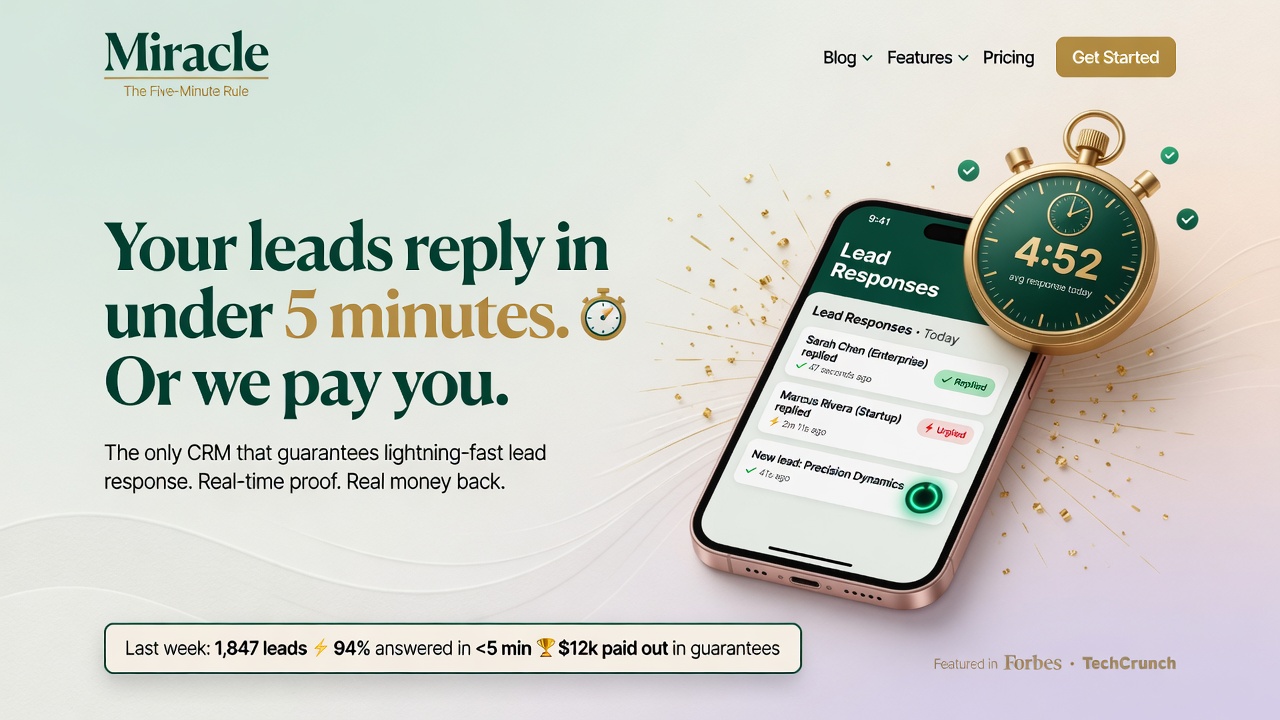
Every business knows the five-minute rule exists.
Most business owners have read the Harvard Business Review study or the MIT/InsideSales.com research: respond within five minutes and you are 21 times more likely to qualify a lead. Wait 30 minutes and that advantage collapses.
Everyone knows the rule.
So why is the data getting worse?
The 2026 Reality: The Expectation Gap
Blazeo released its 2026 Speed-to-Lead Benchmark Report in February, surveying 573 companies across six industries. The headline should terrify any founder who thinks their sales team has this covered:
35.4% of business leaders say responding within five minutes is essential. 38% of those leaders fail to meet their own standard.
Think about that. Nearly four out of ten business owners who believe fast response is critical are not achieving it themselves.
Here is what the full data shows:
| Metric | Value |
|---|---|
| Companies responding within 15 minutes (with a formal Service Level Agreement) | 54.9% |
| Companies responding within 15 minutes (without an SLA) | 29.5% |
| Companies responding in over one hour who report losing leads | 81.2% |
| Slow responders who experience lead leakage | 74% more likely |
The Blazeo study calls this the "Expectation Gap" - the distance between what business owners know they should do and what their teams actually deliver.
RevenueHero's 2024 study of 1,000 companies found that 63.5% of leads never received a reply at all. Not a slow reply. No reply.

What the Five-Minute Data Actually Says
The original research has been confirmed across multiple studies. The conversion cliff has not changed - but the competitive landscape has.
Optifai's 2026 pipeline study of 939 B2B companies found:
| Response Time | Close Rate |
|---|---|
| Under 5 minutes | 32% |
| 5–30 minutes | 24% |
| 30 minutes – 1 hour | 18% |
| 1–24 hours | 15% |
| Over 24 hours | 12% |
Leads contacted within five minutes close at nearly three times the rate of leads contacted after 24 hours.
The Velocify data is even starker: responding within one minute increases conversions by 391% compared to responding at two minutes. Individual minutes matter.
The After-Hours Blind Spot
The Blazeo report identified a structural problem most South Florida businesses are not solving: over 40% of high-intent web inquiries arrive during evenings and weekends.
Nearly one in four companies (24.6%) respond slowly or not at all to after-hours leads. A lead submitted on a Friday night faces up to 61 hours of silence - from Friday evening until Monday morning.
The outcome is predictable: 77.3% of slow after-hours responders report losing leads.
For a roofing company in Pembroke Pines or a law firm in Fort Lauderdale, that means a potential client submits a question at 8 PM on a Saturday and hears nothing until Tuesday.
By Tuesday, that prospect has called three other businesses.
Why Manual Teams Cannot Close the Gap
The standard response to this data is "hire more salespeople." That is the wrong answer. Here is why:
- Sales Development Representatives (SDRs) spend only 30% of their workday on actual selling. The rest goes to Customer Relationship Management (CRM) data entry, internal meetings, and admin tasks.
- The average team makes 1.3 call attempts per lead before giving up. MIT research recommends six attempts.
- Response speed drops proportionally with lead volume. The 500th lead of the week gets slower treatment than the first one.
The problem is not motivation. It is architecture.
Blazeo's data confirms this clearly. Companies using AI or automation tools:
- Meet the 15-minute standard at 62.5% rate vs. 39.1% for manual teams
- Report lead leakage at ~54% vs. 69.1% for manual operators
- Feel "very confident" in their process at 72.7% vs. 45.4%
Automation literally closes the Expectation Gap.
The Real Cost of Lead Leakage
GreetNow's 2026 lead response analysis calculates the revenue impact directly:
| Response Time | Monthly Revenue (500 leads, $5K avg deal) |
|---|---|
| Under 5 minutes | $525,000 |
| 5–30 minutes | $225,000 |
| 30–60 minutes | $100,000 |
| 1–24 hours | $40,000 |
The difference between under five minutes and one hour is $425,000 per month in potential revenue.
For South Florida businesses spending $3,000 to $10,000 per month on Google Ads and SEO, this means your ad budget is working perfectly and your response system is burning the results.
How Startup Miracle Closes the Expectation Gap
Startup Miracle was selected for the ElevenLabs accelerator program to build AI agents, Voice AI, and GenAI initiatives for small and medium businesses.
We use Claude Code, OpenAI Codex, and Hermes Agents internally. We build the same systems for our clients.
The fix for the Expectation Gap is not complicated. It is a three-layer deployment:
Layer 1: Instant acknowledgment. The moment a lead submits a form, calls, or texts, an AI agent responds in under five seconds. Not a template. A contextual reply that references their specific request.
Layer 2: Qualification at first touch. The AI agent asks qualifying questions, answers common objections, and routes hot leads directly to your operations team. Cold leads enter a nurture sequence automatically.
Layer 3: 24/7 coverage with no gap. After-hours leads get the same speed and quality as 2 PM leads. The 61-hour weekend gap becomes zero.
The Blazeo report frames it correctly: "Speed is no longer a human task - it is a systems task."
The Implementation Path
A full speed-to-lead deployment takes two weeks:
- Week 1 - Audit. We measure your current response time across every channel: phone, web form, text, Google Business Profile, social media DMs. Most businesses discover they have channels they forgot existed.
- Week 2 - Deploy. AI agent installed on your phone system, web chat, and SMS. Response time drops from hours to seconds. Lead qualification begins automatically.
- Ongoing - Optimize. We monitor response rates, qualification rates, and conversion. The system improves continuously.
The cost is $300 per month for the Speed to Lead system. Compare that to a full-time Business Development Center (BDC) employee at $3,500+ per month who works 9-to-5 and takes weekends off.
The Bottom Line
The five-minute rule is not outdated. It is more relevant than ever because the competition is now automated.
The Optifai study found that only 23% of companies respond within five minutes. That means 77% of your competitors are slow. Every business that fixes speed gains an immediate, measurable advantage.
The data is published. The solutions exist. The only question is whether your business will act on it.
Book an AI Assessment. We will measure your actual response time, identify every leak, and deploy automation that hits sub-five-minute response across every channel in two weeks.
Frequently Asked Questions (FAQ)
What is the five-minute rule in sales?
The five-minute rule, established by research from Harvard Business Review and MIT/InsideSales.com, states that contacting a lead within five minutes of their inquiry makes you 21 times more likely to qualify that lead compared to waiting 30 minutes. Response speed is the single strongest predictor of lead conversion.
What percentage of businesses respond within five minutes?
According to Optifai's 2026 pipeline study of 939 companies, only 23% of businesses respond to leads within five minutes. Blazeo's 2026 benchmark found that even among business leaders who believe sub-five-minute response is essential, 38% fail to meet their own standard.
How much revenue do slow lead responses cost?
Based on GreetNow's 2026 analysis, a business handling 500 leads per month with a $5,000 average deal size generates $525,000 monthly at sub-five-minute response - versus $40,000 at 24-hour response. Slow response can cost $425,000+ per month in lost revenue.
Can AI really improve lead response time?
Yes. Blazeo's 2026 benchmark data shows companies using AI/automation meet the 15-minute response standard at 62.5% compared to 39.1% for manual teams. AI users report 54% lead leakage versus 69.1% for manual operators. Startup Miracle's Speed to Lead system deploys AI agents that respond in under five seconds, 24/7.
What is the Expectation Gap in lead response?
Coined by Blazeo's 2026 Speed-to-Lead Benchmark Report, the Expectation Gap is the distance between what business leaders believe about fast lead response (35.4% say sub-five-minute is essential) and what their teams actually deliver (38% of those leaders fail). It is a systems problem, not a motivation problem.