
Blog
Google's August Spam Update: Name the Page That Earns
Google's August Spam Update: Name the Page That Earns
On August 21, 2026, Google finished rolling out its August 2026 spam update. The pass started on August 18 and closed after about two days and sixteen hours. It was the third spam update of 2026, and it applied globally. Google's spam policies call out scaled content abuse, bulk pages made mainly to rank, and doorway abuse, near-identical city pages that funnel people to one form. If you earn work from search, that cleanup is real leverage for shops that publish pages a customer would actually read.
The honest take is simple. The update is good. The question is which of your pages still earn their keep, and which job you are hiring content for, before you buy another batch of thin AI pages after a pass that can take months to recover from.
That is the shop so-what. The contractor still has to run the crew. The CPA still owns the calendar. The restaurant still has guests asking AI where to eat. The plant office still has quotes waiting on one head. Startup Miracle's job is to help you name the page and the process before you spend another week feeding the farm.
What Google finished this week
Search Engine Journal covered the start of the rollout, and Search Engine Roundtable reported it closed on August 21 after starting around midday Eastern on August 18. Google called it a normal spam update. There is no published impact share for this pass, and it does not target link spam. Google also said recovery can take many months while systems re-check the site.
If a site got hit, the owner is looking at months of review while the practice still has to book work. Buying another stack of AI pages into that window digs the hole deeper. Naming what stays is how you stop.
In May 2026, Google also clarified that its spam policies cover attempts to manipulate generative AI answers in Search, including AI Overviews and AI Mode. Thin service pages built only to catch keywords put a practice in that queue twice.
What scaled content and doorway pages actually are
It helps to use Google's own words, because the marketing language around "AI content" blurs the line.
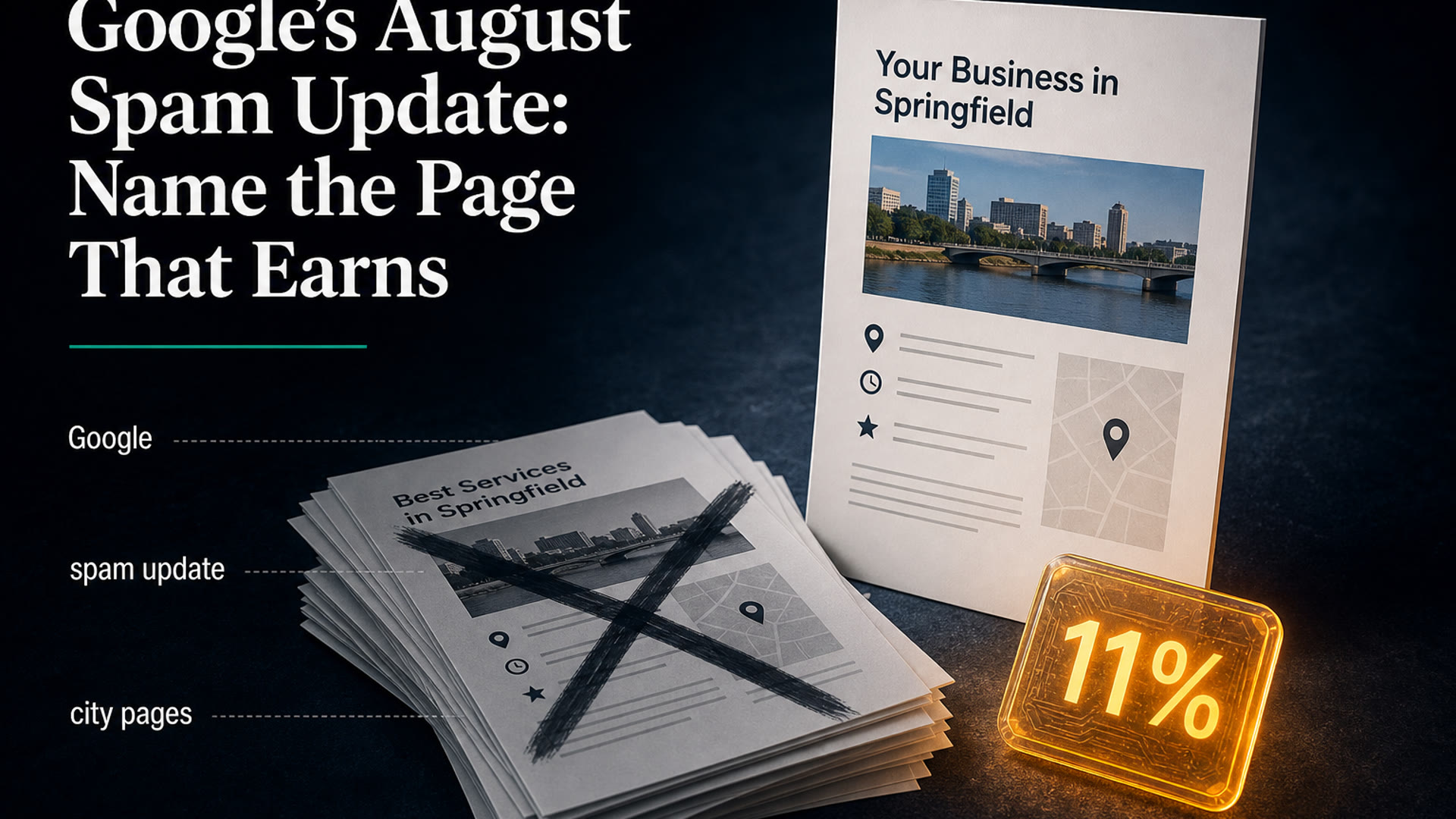
Google's spam policies define scaled content abuse as generating many pages mainly to manipulate rankings, not to help users, including generative AI pages with little value. Doorway abuse is when pages are built to rank for similar queries and funnel people through intermediate pages that are not as useful as the real destination, including multiple city pages that send everyone to one form.
A city-name farm, in plain shop language, is dozens of near-identical town pages that change the city name and push every visitor toward the same form. They were meant to catch the query, not teach a customer anything.
A first AI hire, in the way we use the phrase at Startup Miracle, is not a product you purchase. It is a decision you make: the single process you hand over first, with a way to check the work and one number that tells you whether it is paying off. "Rewrite the three service pages that already book calls, and hold every publish for me" is a first hire. "Generate eighty town pages by Friday" is a wider open on the same risk Google just finished cleaning.
A stop rule is the named line the assistant may not cross without you. Do not publish a new city page. Do not ship a how-to that only restates the keyword. Do not replace the quote desk with more blog posts. If you cannot say the stop rule out loud, you have not hired a content job. You have opened a factory.
The hours already gone
You do not need a traffic percent from Google to feel the cost. Most shops already know the hours.
Markel Direct surveyed 501 UK tradespeople and small-business owners, as reported by Landscape Magazine. Seventy-six percent create social or web content every week. Fifty-five percent feel pressure to stay visible. Eleven percent burn up to a full working day each week on that presence. Sixty-nine percent have never hired anyone to create content for them. Those are Markel's numbers, not ours, and they describe the grind even before you add a spam recovery.
For a contractor, that full day often shows up as interchangeable town pages that never turn into jobs. The fix is not more towns. It is a named content job: the page that explains the work you actually sell, with a stop rule on the farm.
For a restaurant owner, the how-to blog can still look busy while guests ask AI who to book. Scaled how-tos are the pattern Google names under scaled content abuse. Hours spent feeding that channel are hours not spent on the page that books the table.
For a plant-office or supply-shop owner, the Markel split is the whole story. Sixty-nine percent never hired content help, and eleven percent already spend a day a week on the presence. Automating more interchangeable pages does not free the quote desk. The empty seat is still tribal knowledge on specs and follow-up. Put the first employee there, not on another town page.
Recovery can take months
A CPA or law owner who paid for a pile of service pages feels a different clock. Google's guidance, relayed in the Roundtable write-up, is that recovery from a spam update can take many months while systems re-check the site. The August pass closed on August 21. The practice still has to run on one head while that re-check happens.
If the site is in the queue, another batch of AI copy built only to catch keywords is not a recovery plan. Know which pages Google can still trust before you buy more. Make a short list with a named owner. Kill or noindex the farm pages that only exist to funnel. Keep the pages a client would send to a colleague.
The fear is not abstract. Recovery takes months while the calendar still belongs to one person. A short list of trusted pages is how you stop waiting on a farm you should not have built.
Three things to name before you buy more pages
Here is the 1-2-3 I would hand a neighbor the week after a spam pass closes.
1. Name the page that earns its keep.
Say it out loud. The service page that already books. The menu or catering page guests actually use. The quote or specs page the plant office needs. The practice page a client would forward. If you cannot name it, do not buy eighty more. A city-name farm that only changes the town label is the doorway pattern Google already wrote down. Keep the pages with a real job. Cut the rest.
2. Name the content job, not the volume.
Not "do more AI content." One process. For the contractor, replace interchangeable town pages with a named rewrite of the pages that sell the work. For the restaurant, stop feeding scaled how-tos into a channel that already ate them. For the CPA or lawyer, decide which service pages stay before any new AI draft goes live. For the plant office, put the first employee on tribal knowledge at the quote desk. If you want a second opinion on which job to pick first, take the free AI Readiness quiz. That is what it is for.
3. Put a stop rule on publish.
Write the line. The assistant may draft. It may not publish a new city page. It may not ship a how-to that only restates the keyword. Recurring drafts are fine. Recurring publishes are not, until you have watched two weeks and the number you named actually moved: calls, booked tables, quotes sent, matters opened. The stop rule is how useful AI stays a hire instead of another farm.
The shape is the same whether the vendor is selling an assistant or a content machine: the tool can help, and the gap is still where you point it. Google's spam pass just raised the price of pointing it at volume.
The cleanup is good. The first page is still yours.
Google lowered the room for scaled and doorway spam. It did not lower the price of knowing which page earns its keep. The update is genuinely useful for owners who publish for customers, not for ranking tricks. The gap it cannot close for you is the first decision: which page stays, which job the content is doing, and what may not publish without you.
If you are not sure which page to name before you buy another batch, that is exactly why the quiz exists. It is so you do not spend another week on thin pages after a spam pass that can take months to recover from.
FAQ
What is Google's August 2026 spam update?
It is a global spam update that began on August 18, 2026 and finished rolling out on August 21, after about two days and sixteen hours. Google described it as a normal spam update aimed at sites that violate its spam policies, and Search Engine Roundtable reported that recovery can take many months.
What are scaled content abuse and doorway pages?
Scaled content abuse is Google's term for generating many pages mainly to manipulate rankings, including generative AI pages with little value for users. Doorway abuse includes near-identical city or region pages that funnel visitors to one destination instead of offering a useful page of their own.
How much time are owners already spending on content?
Markel Direct's survey of 501 UK trades and small owners found 76% create content every week, 11% spend up to a full working day each week on that presence, and 69% have never hired anyone to create content for them. Those hours are the cost even before a spam recovery starts.
If you want the long version of how we think about readiness, Start with a FREE quiz and Get Your AI Score.