
Blog
Our Content Machine Has a Feedback Loop That Starts in Client Meetings. Here’s How 40 Weekly Meetings Become Daily Blog Posts Without Anyone Writing.
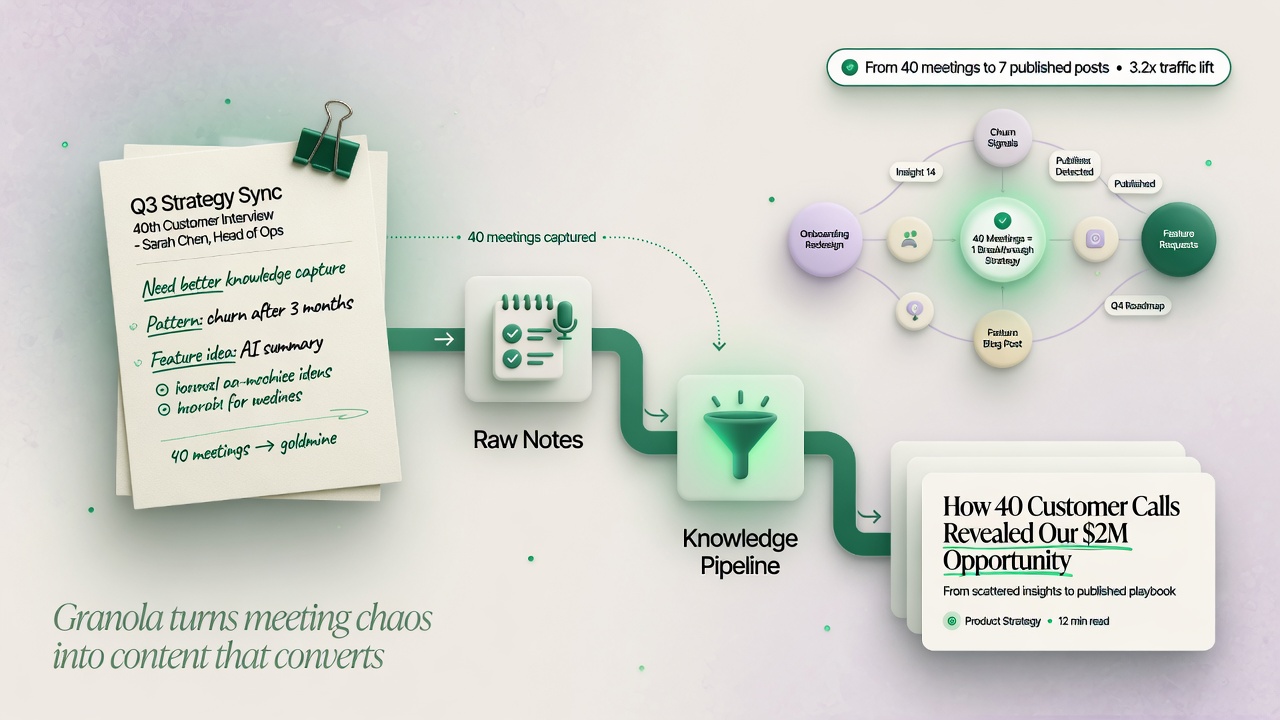
Here is a truth most content marketing agencies will never admit.
They write about what they think you want to read. They guess at keywords. They draft articles based on Google’s suggested searches, not on what real customers are actually saying.
We do the opposite.
Our content machine runs on a feedback loop that starts in client meetings. Every conversation, every pain point, every objection a real business owner brings up becomes raw material for the next article. No guesswork. No keyword plays. Just signal from real conversations.
Here is exactly how it works.
The Pipeline
Step 1: Capture Every Meeting
We run 40 to 50 client meetings per week. Discovery calls, training sessions, onboarding reviews, strategy check-ins, escalation calls. Every single one gets recorded and transcribed.
We use Granola as our meeting notepad. Unlike Otter or Fireflies, Granola does not join the call as a bot. It runs locally on the laptop, listens to the conversation, and produces structured notes after the meeting ends. Actions, decisions, objections, pain points. All captured without the awkward “a bot has joined the call” notification.
The output is a clean set of notes per meeting. Client name, date, key topics, action items, and the raw transcript.
Step 2: Filter Signal from Noise
Every two weeks, a Hermes cron job (an AI agent that runs on a schedule) scans the Granola notes vault. It does three things:
- Deduplicates. If three clients mentioned the same pain point (slow lead response, messy Customer Relationship Management (CRM), no follow-up after hours), it collapses them into one entry with a signal strength score.
- Filters out rambling. Not every meeting minute is quotable. The cron strips false starts, off-topic tangents, and internal team chatter. Only the signal survives.
- Categorizes by pillar. Each pain point gets tagged to one of SM’s four content pillars: AI Operating System (OS) thesis, Tools of the Trade, Speed to Lead, or Behind the AI Office.
The output is a clean markdown file. Each entry has the pain, the client context (anonymized), the pillar, and the signal strength.
Step 3: Feed the Knowledge Base
The filtered pain points get appended to our internal knowledge base. This is a version-controlled markdown vault that every AI agent in our system reads.
When the Trend Radar (a daily cron that runs at 6 AM UTC) scans for article topics, it does not search the web for trending keywords. It reads the knowledge base. It looks for patterns across the last two weeks of client conversations. If three CPAs mentioned that they struggle with manual client onboarding, the radar surfaces that as a topic candidate with high urgency.
The Trend Radar produces 10 ranked topic candidates every morning. The Publisher (the 12:30 PM cron) takes the highest-ranked candidate that matches the day’s pillar rotation and produces a full article.
Step 4: Publish Without a Writer
This is the part that surprises most people.
The Publisher does not just write an article. It generates the hero image, the Open Graph (OG) image, the meta description, the internal links, and the FAQ section. It uploads images to Cloudinary. It upserts the article to Supabase. It verifies the frontend renders correctly. It even produces distinct social drafts for X, LinkedIn, and Reddit.
No human touched the writing process between the client meeting and the published post.
The human role is strategy. Javier, the founder, sets the pillar rotation, reviews the QA scorecard, and approves topics that cross a 95-point threshold. The AI handles production.
Step 5: Close the Loop
The published article attracts more clients. The new clients have more meetings. Those meetings generate more pain points. The pain points feed the next batch of articles.
That is the feedback loop.
It is not a theory. It is running right now. This article you are reading was produced by the same pipeline. The topic came from a pattern in the knowledge base: founders kept asking how we produce so much content without a writing team. The answer became the article.
Why This Beats SEO Content
Most content marketing teams do this:
- Research keywords with SEMrush or Ahrefs
- Brief a writer on the keyword
- Writer produces a generic article
- SEO team adds meta tags and links
- Publish and hope
The problem is step 1. Keyword research tells you what people are searching for. It does not tell you what people actually need. A customer who searches “best CRM for contractors” has a different problem than one who says “I closed three deals last month because my CRM did not remind me to follow up.”
The second conversation is the real signal. The first is a search query.
Our pipeline captures the second conversation every time. The articles we produce address real pain points from real business owners in South Florida. That is why they convert better than generic SEO content.
The Architecture
Here is the technical stack if you want to build something similar:
| Component | Tool | Role |
|---|---|---|
| Meeting capture | Granola | Listens, transcribes, structures notes |
| Cron orchestration | Hermes Agent | Runs scheduled jobs on a Linux VPS |
| Knowledge base | Markdown vault | Version-controlled pain point registry |
| Content generation | AI model pipeline | Drafts, images, SEO, QA |
| Distribution | Postiz | Schedules and publishes social posts |
| Hosting | Next.js + Supabase | Blog CMS and frontend |
What It Costs
This is the build-in-public part.
The pipeline costs about $150 per month in tool subscriptions. Granola is $20/month. The VPS hosting the Hermes agent is $10/month. The AI model usage (OpenRouter and Higgsfield for image generation) averages $100/month. The rest is time spent configuring the initial architecture.
Compare that to hiring a content marketing agency at $3,000 to $8,000 per month, or an in-house writer at $50,000 to $70,000 per year.
The output is 30 articles per month, each with hero images, OG images, SEO metadata, and distribution across 4 platforms. That is roughly $5 per published asset.
What We Learned Building It
The hardest part is not the technology. It is the filtering.
Granola captures everything. The cron job’s most important job is deciding what to discard. Not every client complaint is a content topic. Not every meeting insight is quotable. The filter stage is where the quality lives.
The anonymization rule is non-negotiable.
We never publish client-identifiable data. No names, no company names, no contract terms, no revenue figures tied to a specific client. The pain points are real, but the context is always anonymized to “a South Florida contractor” or “a Miami CPA firm.” Violating that trust would kill the pipeline.
The feedback loop only works if you keep meeting.
The pipeline relies on volume. If we stopped running 40 meetings per week, the knowledge base would stop growing, and the articles would become generic. The content machine is a byproduct of the business, not the other way around.
The Bottom Line
Most content marketing is guesswork dressed up as strategy.
Our approach is different. We let real client conversations dictate what we write. The AI handles the production. The humans handle the relationships.
The result is a content machine that produces 30 articles per month, each one rooted in a real business problem, without a single writer on staff.
That is not a prediction. That is our current setup.
Frequently Asked Questions
Does this mean the AI writes everything without human review?
No. Every article passes through a deterministic QA scorecard that checks for Javier’s voice, strategy fit, SEO completeness, image quality, and frontend rendering. The AI drafts, but the system validates against a hard 95-point threshold before publishing. Articles that score below 95 do not go live.
What happens if Granola captures something confidential?
Granola notes are stored locally. The cron job runs on our own VPS. The extraction pipeline is designed to strip client identifiers before anything enters the knowledge base. No client name, company name, or identifiable data ever reaches the public content pipeline.
Can other businesses build this pipeline?
Yes. The components are all available to anyone. Granola for meeting capture, Hermes for cron orchestration, a markdown vault for the knowledge base, and an AI model for generation. The hard part is not the tools. It is the filtering logic and the commitment to keep the loop running. We are working on productizing this as an internal template for clients who want their own content machine.
How do you avoid the content sounding repetitive?
The pillar rotation ensures variety. P1 (AI OS thesis), P2 (Tools of the Trade), P3 (Speed to Lead), and P4 (Behind the AI Office) each have different formats and audience angles. The knowledge base gets fresh pain points every two weeks, which means the topics shift with what clients are actually saying. The system self-corrects.