
Blog
It’s July in South Florida. HVAC Contractors Miss 40-50% of Calls During Peak Season. Each One Costs $450-$950.
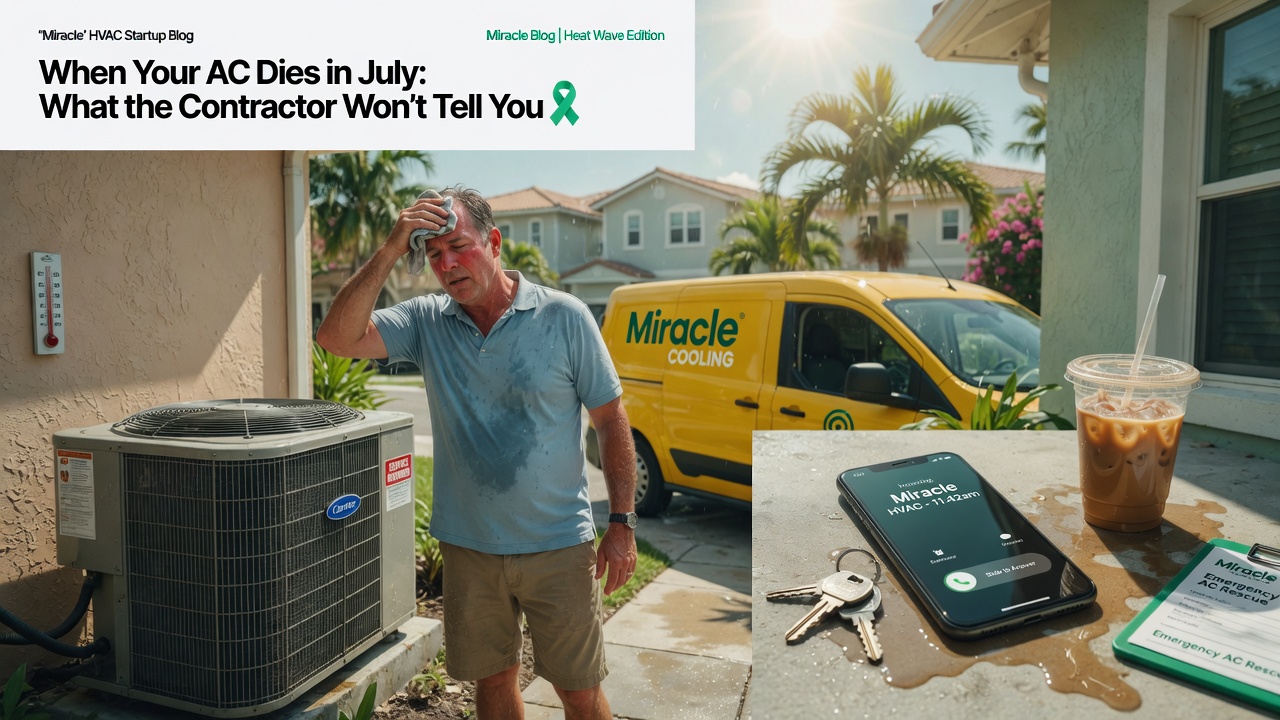
July in South Florida means one thing for HVAC contractors: heat waves, 95-degree afternoons, and phones ringing off the hook.
It also means 40-50% of those calls go unanswered.
ServiceTitan research on field-service call patterns shows that miss rate during peak demand climbs to 30-50%. The Ainora 2026 Service Call Study puts the average at 20-30% year-round, with seasonal peaks pushing past 40-50%.
A Revin analysis of July call abandonment found that a single operator processing 40,000 inbound calls in July can lose $2.16 million in a month at a 20% abandonment rate.
That is not a staffing problem. That is a revenue leak the size of a hurricane.
The Money Leak: By the Numbers
Let me run the math for a mid-size South Florida HVAC shop.
The AgentZap HVAC Phone Statistics Report documents that 62% of HVAC calls come outside regular business hours. Summer call volume increases 340% compared to spring. And 85% of callers who reach voicemail do not leave a message.
Here is what that means in dollars:
- Blended revenue per booked call: $450-$950 (Service Roundtable benchmarks from Ainora study)
- Emergency after-hours tickets: $250-$650 median, 40-60% above standard daytime calls (ACCA 2025 survey via Novacall AI)
- Miss rate during peak: 40-50% (ServiceTitan + Ainora data)
- After-hours share: 25-40% of all inbound calls
The Novacall AI analysis breaks it down by shop size:
| Scenario | Monthly Calls | After-Hours % | Unanswered % | Annual Revenue at Risk |
|---|---|---|---|---|
| Small shop (50 calls) | 50 | 42% | 15% | $5,670 |
| Mid-size (200 calls) | 200 | 42% | 20% | $54,331 |
| Peak-heavy (350 calls) | 350 | 45% | 25% | $159,469 |
| Heat-wave shop (500+ calls) | 500 | 45% | 30% | $367,500+ |
A contractor missing 20 calls per week at $450 blended revenue and 65% book rate loses $5,850 per week. Over $300,000 per year. That is a full-time hire's salary walking out the door unanswered.
What Most HVAC Shops Do Wrong
The instinct is to throw bodies at the problem. Hire more Customer Service Representatives (CSRs). Add a second phone line. Forward calls to the owner's cell.
None of those fix the structural issue.
The US Tech Automations analysis identifies three factors that amplify the leak:
- Staffing mismatch. One CSR per 10 technicians is standard. During a heat wave, one person cannot handle 40-60 calls in a three-hour window.
- Seasonal spikes. 73% of annual HVAC revenue comes from six months (June-August and December-February). You cannot staff for 340% summer volume without bleeding money the rest of the year.
- No safety net. Voicemail is not a safety net. 85% of callers hang up without leaving a message. The ones who do leave a message have most likely already called your competitor.
CSR turnover runs 40-60% annually at most shops. By next summer, most of the people you hired this July will be gone.
Javier POV
I run Startup Miracle. We build Voice AI systems for South Florida home service contractors, law firms, and dealerships. The pattern I see every time: owners know they are missing calls, but they do not know how bad it is until they pull the data.
Here is what the data always shows:
- The miss rate is worse than you think. 20-30% is the industry average. During a heat wave, it hits 40-50%.
- The cost per missed call is higher than you think. The Harvard Business Review speed-to-lead study found that contact rates drop 10x after the first hour. An HVAC caller with a broken AC at 7 PM is not calling back at 9 AM. They called the next contractor on Google.
- The fix is not more people. It is a system that answers every call, every time, in under five seconds.
The Startup Miracle Solution
The fix does not require a call center. It does not require a night shift. It requires one layer of automation between the phone ring and the human handoff.
Here is the architecture we deploy for home service contractors:
Layer 1: AI Voice Agent answers every call instantly, 24/7. Picks up in under three seconds. Qualifies the caller: is it an emergency? A standard service call? A new customer inquiry? Books the appointment directly into the CRM.
Layer 2: Smart routing. If the caller has an emergency (no AC, no heat, burning smell), the system pages the on-call technician immediately. If it is a standard service call, it books the next available slot. If it is after hours with no emergency, it schedules a callback for the morning and sends a confirmation SMS.
Layer 3: Multi-channel follow-up. After the call, the system sends a text message with the appointment confirmation, a link to the technician's bio, and an option to reschedule. The homeowner never feels abandoned, even if the service is scheduled for tomorrow.
We call this the Speed to Lead stack. It costs a fraction of a single CSR. It never takes a lunch break. It answers every call during a heat wave when your human team is already overwhelmed.
Implementation Path
Step 1: Pull your 30-day call logs. Count how many calls rang more than 30 seconds without being answered. Multiply by your average ticket. That is your monthly leak.
Step 2: Set up the automation layer. Most major CRMs (ServiceTitan, Jobber, Housecall Pro) integrate directly with Voice AI platforms. You do not need to rip out your existing operations stack.
Step 3: Test during a weekday first. Let the AI handle overflow while your CSRs are still in the office. Once you trust the system, open the after-hours channel.
Step 4: Measure. Track miss rate week over week. The first month, you should see unanswered calls drop from 40% to under 5%. By peak season, you will answer every single call.
What This Looks Like in South Florida
A Pembroke Pines HVAC shop with 200 monthly calls at 20% miss rate is losing $54,000+ per year in immediate revenue. Add the replacement pipeline (a missed service call that could have led to a $7,200 AC replacement) and the lifetime value of a lost customer ($12,000-$15,000 per the AgentZap analysis), and the real number is closer to $100,000-$150,000 per year.
A Doral shop that answers 100% of calls during a heat wave week is capturing 40-60 incremental calls that every competitor in their zip code is missing. The IBISWorld HVAC Consumer Decision Research shows that the first contractor to respond wins 78% of emergency jobs. When everyone else is letting calls go to voicemail, the shop that answers wins the market.
Call to Action
South Florida HVAC contractors: your phones are ringing right now. The data says you are missing 40-50% of those calls during peak hours. The fix is not more hiring. It is not a second phone line. It is a Speed to Lead system that answers every call, qualifies every lead, and books every appointment.
Book an AI Assessment and let us build yours before the next heat wave.
FAQ
What percentage of HVAC calls go unanswered during peak season?
Industry data from ServiceTitan and Ainora shows 20-30% average year-round miss rate, climbing to 40-50% during peak summer demand. Heat waves push this higher.
What is the cost of a missed HVAC call?
Each missed call has an expected value of $290-$450 based on a 65% book rate and $450 average ticket. Emergency calls carry $250-$650 median value. The lifetime value of a lost customer is $12,000-$15,000.
How fast do HVAC customers expect a response?
Customers expect a callback within 30 minutes. The HBR speed-to-lead study shows contact rates drop 10x after the first hour. Callers with active emergencies call 2-3 competitors within 10-15 minutes.
Can I fix missed calls by hiring more CSRs?
Partially, but the math rarely works. Summer call volume spikes 340%, and CSR turnover runs 40-60% annually. Most shops cannot staff for peak season without bleeding money the rest of the year. AI voice agents handle the spike while your human team handles the right calls.
What is the best time to implement a Speed to Lead system?
Before the next heat wave. July and August are peak months in South Florida. Every week without 24/7 call coverage costs hundreds to thousands in missed revenue. Implementation takes 2-5 business days with existing CRM integrations.