
Blog
IFS Industrial Index 2026 Raises the AI Sign-Off Question
IFS Industrial Index 2026 Raises the AI Sign-Off Question
On October 13, 2026, at its IFS Unleashed event, the software vendor IFS released its Industrial Index 2026, and the headline is how fast big operators are putting AI to work. According to IFS's release, 43% of respondents introduced agentic digital workers in the past 12 months. An agentic digital worker, in our words, is AI set up to carry out a task on its own, step by step, instead of only answering a question.
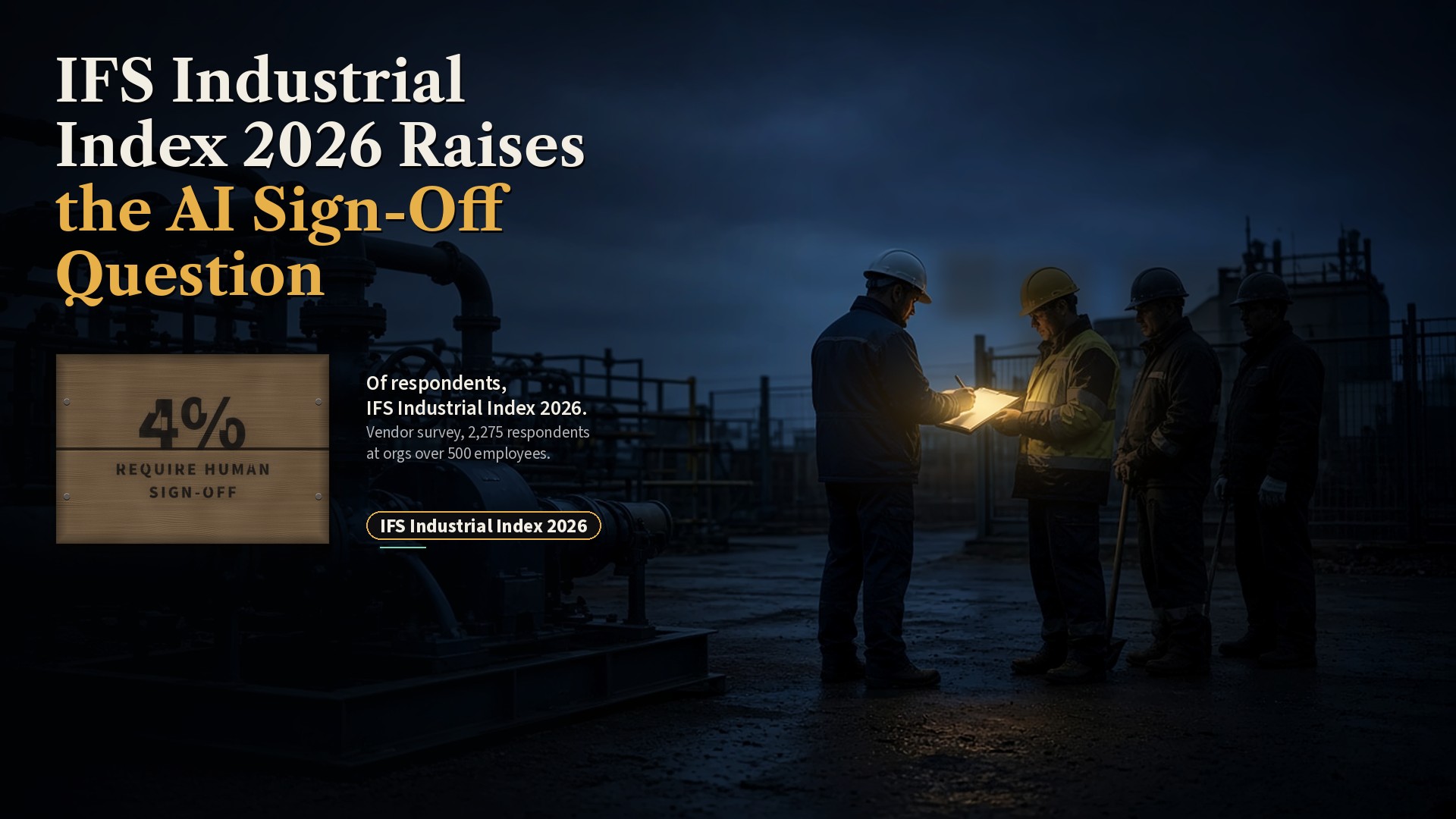
The same survey found only 4% of respondents require human oversight or approval for AI-supported decisions, meaning a person reviews or approves the decision before it takes effect. If you run an industrial service, maintenance, or fabrication business, that's the number to sit with. Our read, not the survey's, is that the gap isn't the AI itself. It's the missing rule for who signs off on what, sorted by how much damage a wrong answer could do.
Inside the IFS Industrial Index
Credit to IFS for publishing numbers that don't all flatter the market it sells into. The index was fielded by Censuswide across 2,275 respondents in 14 countries, all at organizations with more than 500 employees and more than $250 million in revenue. That's an enterprise sample, so we read it as what big operators are learning rather than as a picture of a smaller shop.
Beyond the 43% and the 4%, IFS reports that only 11% of respondents validated AI outputs for safety, quality, or mission-critical processes. Validation here means checking that what the AI produces is actually correct before anyone relies on it. Mission-critical processes are the ones where a failure stops the operation or puts people at risk.
Every one of those figures is a share of IFS's respondents. IFS is also a vendor with AI to sell, which is worth keeping in mind while reading any survey it publishes.
Confidence runs ahead of checking
One more pair of figures from the same index, as IFS laid out in its Industrial Index announcement, is worth reading together. Over 70% of respondents claim confidence in their safety and data policies. Only 20% have embedded industrial AI into supply chain management or maintenance planning, which IFS describes as the functions where operational failures carry the highest consequences.
We won't turn those into a ratio. Still, the picture is hard to miss: confidence in policy is high, while the share of respondents validating AI outputs on safety or quality work sits at 11%. A policy on paper doesn't check a work order. Someone has to.
For an owner, the lesson from these big operators is not that AI is risky. It's that adoption moved faster than the habit of checking, even at organizations of that size.
Why a field service CIO chose not to build
IFS's release includes a customer quote, so read it as one customer speaking inside a vendor's announcement. Mo Dawood, CIO of Eight Group, said the company decided against building AI agents in house because of the governance, expertise, and knowledge needed. In his words, "we are a field service business, not a software business."
That line will land with any owner who has watched a side project quietly turn into a second job. Building an agent is one task. Keeping it governed, meaning someone decides what it may do while somebody checks that it did it right, is ongoing work.
The release also cites Futurum research, which we'll keep separate from IFS's numbers. Futurum found 66% of enterprises plan to invest in digital workers within 12 months, but just 5.7% trust AI to act fully autonomously. Read on its own, that's enterprises saying they want the help without wanting to let go of the wheel.
A sign-off rule sorted by risk
Here's how we'd approach it. We'd treat each AI task like a new employee's duties, then decide sign-off by the risk of the job rather than by the tool. An AI employee, as we use the term, is an AI given one defined job, with written instructions plus a named person who answers for the result.
We'd sort the jobs into three tiers. The low tier covers work where a mistake costs a few minutes, such as summarizing a service report or drafting an internal note. There, a person spot checks a sample each week instead of approving every item.
The middle tier covers work a customer or supplier will see, such as a quote, a parts order, or a follow-up message about a completed job. For those, a named person approves before anything goes out.
The top tier is anything touching safety, quality, or mission-critical work, such as a maintenance decision on equipment that keeps a site running. In that tier, the AI can prepare the recommendation, but a qualified person signs off every single time. That's exactly where IFS found only 11% validating outputs, so it's where we'd start writing the rule.
Sign-off also needs a definition of what the approver actually checks, or it turns into a rubber stamp. For a parts order, that might be the part number against the work order. For a maintenance recommendation, it's whether the asset history supports the call. Writing those checks down takes an afternoon. It also means a new supervisor can sign off the same way your most experienced one does.
Here's the short version we'd give any owner. Decide who signs off on each AI task by asking what a wrong answer could break, then require a named person's approval on anything touching safety, quality, or customers. The tool can change later, while the rule stays.
Where maintenance planning fits
IFS's 20% figure covers supply chain management or maintenance planning together, so it doesn't tell you how many respondents run AI on maintenance alone. Even so, maintenance planning is a natural place for a field service or industrial owner to think about first, because a planning mistake there shows up as downtime rather than as a typo.
That's also why it belongs in the top tier. An AI that suggests which asset to service next can save a planner real effort. If it's wrong, though, the cost shows up as a breakdown, so the person who knows the equipment approves the plan before a crew acts on it.
We've written before about tools that make this kind of rule visible, including an industrial AI that shows the rule it applied before it acts. We've also covered deciding who may approve job cost before it posts, which is the same sign-off question on the money side.
Writing the rule before the first mistake
The cheapest time to write a sign-off rule is before anything goes wrong. List the AI tasks you already run or plan to run. Next to each one, write its tier, the person who signs off, and what they check.
Then look at the top tier first. If any safety, quality, or mission-critical task has AI in it without a named approver, fix that before adding anything new. That one page is a small thing to keep up, and it's the habit the big operators in IFS's survey mostly haven't built yet.
Sign-off rules, briefly
What is an agentic digital worker?
An agentic digital worker is AI set up to carry out a task on its own, step by step, rather than only answering questions. In the IFS Industrial Index 2026, 43% of respondents said they introduced agentic digital workers in the past 12 months.
How to decide which AI decisions need human sign-off?
Sort each AI task by what a wrong answer could break, from internal drafts up to safety, quality, or mission-critical work. Require a named person's approval on anything customer-facing or higher, with sign-off every time on the top tier.
How much human oversight do big operators require for AI?
In the IFS Industrial Index 2026, a vendor survey of 2,275 respondents at large organizations, only 4% require human oversight or approval for AI-supported decisions. Only 11% validated AI outputs for safety, quality, or mission-critical processes.
If you want the long version of how we think about readiness, Start with a FREE quiz and Get Your AI Score.