
Blog
Jobber Teammate Beta: Who Reschedules the Rain Day?
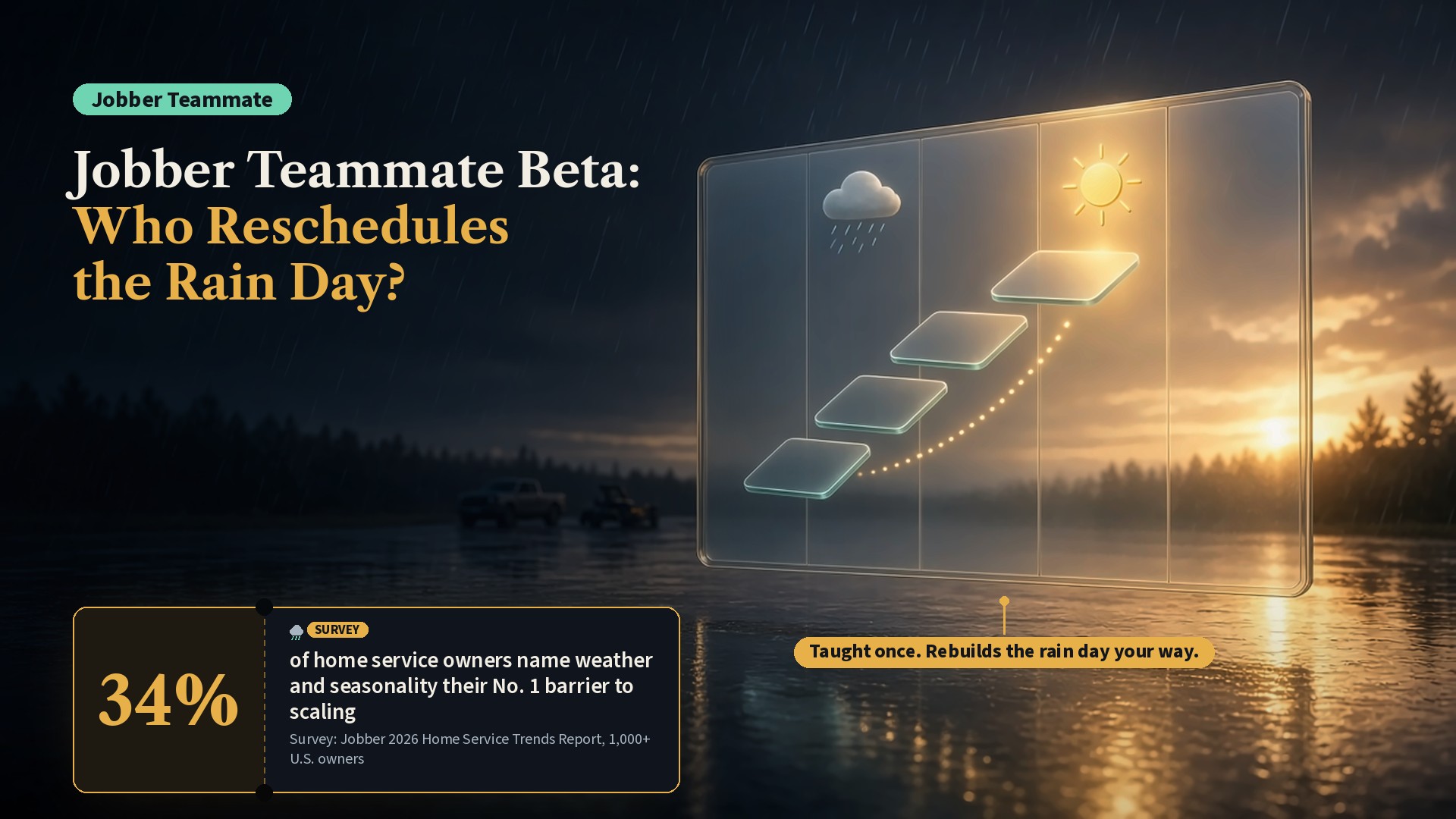
Jobber Teammate Beta: Who Reschedules the Rain Day?
It is 5:45 in the morning, the radar is green over half the county, and four crews are supposed to roll at 7. If you run a lawn care, roofing, or contracting crew, you know the next hour belongs to the phone. Customers need new dates, crews need new stops, and you are the only person who knows how the board should reshuffle. A rained-out day puts a full day of crew revenue at risk, and when someone calls in sick, the same scramble starts over.
Jobber Teammate, Jobber's new AI agent for home and commercial service businesses, goes straight at that hour. With its Customizable Routines, you show it once how you reschedule the day for bad weather or a sick employee, and it handles that situation your way from then on. An agent here means software that prepares real work inside the system you already use and brings it to you for review and approval, instead of waiting for you to type into a chat box.
This is real leverage for a trade owner. The part Jobber cannot do for you is the first decision. You still have to pick which job the agent learns first, write down how you actually handle it, and decide what you want to check before anything goes out.
Jobber calls Teammate a beta, with early access opening to Jobber customers on September 23, 2026. Beta means it is still being tested and refined. Jobber serves more than 100,000 businesses, and you can read the details in Jobber's launch announcement.
What Teammate's three features do
Jobber describes three pieces, and each name is worth translating.
Customizable Routines are instructions you teach once. Jobber's example is exactly the 5:45 AM problem. You show Teammate how you handle a recurring situation, like rescheduling the day for bad weather or a sick employee, and it handles that situation the same way from then on.
Daily Digest is a personalized morning briefing. It pulls together the money collected, the money expected, and the money still outstanding, along with the jobs scheduled and where each crew stands.
Action Board triages the day and gets a head start on work, such as drafting quotes, then leaves that work ready for your review. Across all of it, Jobber says Teammate prepares the work and brings it to you for review and approval.
You are the scheduling system
Jobber's February 2026 Home Service Trends Report surveyed 1,050 U.S. home service owners and asked what holds them back from scaling. Weather and seasonality came first at 34 percent, ahead of rising competition at 28 percent, labor shortages at 23 percent, and margins at 20 percent.
Read that as an owner. The thing capping your growth most often is not the shop down the road. It is the sky, and the fact that the only reschedule plan lives in your head. Every rained-out morning you spend on the phone is a morning you are not quoting, selling, or checking work. And the risk is bigger than one lost day of revenue. If the reshuffle depends on you and you get it wrong, the crew stops trusting the board.
That is the hour a Customizable Routine is built to take back. Your rules do not change. What changes is that they no longer depend on you being awake at 5:45.
Where the morning actually goes
The same Jobber report asked owners what eats the most time. Jobsite management came first at 48 percent, customer communication was next at 40 percent, and quoting followed at 37 percent.
Most owners assemble the answer to "what needs my attention today" from three places. They open the app, scroll the texts, and check the bank account. That is how you run a business from memory, and memory is how the invoice that should have gone out Thursday slips another week.
Daily Digest puts that picture in one briefing before the first truck rolls: money collected, expected, and outstanding, plus jobs and crew status. You read it in minutes instead of building it by hand. It does not fix jobsite management or customer communication by itself, but it tells you where to spend the first hour instead of making you discover it at noon.
The quote that goes out with one price
Quoting is the third biggest time drain, and it hides the most money. According to Jobber's data in the same report, businesses that add optional line items to a quote see upsell rates between 25 and 50 percent. An optional line item is an add-on the customer can check or skip, like a maintenance plan or an upgraded part. Yet only 16 percent of pros offer tiered good, better, best pricing, meaning three versions of the same job at three price points.
Put another way, more than eight in ten pros don't offer good, better, best options. For a lot of owners, that's because the quote gets written at 10 PM, and building three options takes longer than building one. The upgrade the customer might have said yes to never appears on the page.
Action Board can draft quotes and leave them ready for your review. If the draft already carries the options you would have added with a clear head, you still approve every price. The difference is that you start from a better draft instead of a blank screen.
Win rates show what a lost quote costs. In the same report, top-performing businesses win over 60 percent of their quotes, and 69 percent of all pros win more than half. Meanwhile, 21 percent of starting businesses win under 30 percent of what they quote, and many do not track their win rate at all. That is what owners told Jobber, not anything Teammate did, and every quote that loses is still an evening of estimating with nothing to show for it.
Booked solid and capped by your own time
The same Trends Report found that 80 percent of service businesses are fully booked or close to it. For most shops, then, the limit on growth is not demand. It is how many hours the owner can put in. Fifty-two percent of owners now use AI day to day, with 54 percent of them using it for quoting and 52 percent for invoicing.
The confidence split is the number to sit with. Jobber defines high-confidence businesses as those that are fully booked and seeing strong gains in customer demand, job size, and projected revenue. In the report, 88 percent of them use AI, compared with 27 percent of low-confidence businesses, and nearly 90 percent of the high-confidence group close more than half their quotes. That is a link, not proof that AI causes either one.
Still, the numbers describe two kinds of shops, and if you tried ChatGPT for a quote once and decided AI is for bigger outfits, it is worth asking which group your shop looks like today.
We have made this point before, when Wix launched Symphony, its group of AI agents. The tools are getting good fast, and the shops that pull ahead are the ones that decided in advance what the tool should handle first.
Before the next storm, pick one routine
Teammate can learn your rain-day playbook, but it cannot write that playbook for you. Writing it is the work we do with owners, and at a crew-based shop we would take it in this order.
- Write your rain-day rules on one page. Decide which jobs move first, which customers get a call instead of a text, and which crew picks up the slack. If you cannot write it down, the agent cannot learn it. That page becomes your first AI hire, which is our term for the one task you trust software with before any other.
- Decide what you check closely. Teammate brings its work to you for review and approval, so name the things you look at hardest, such as anything that reaches a customer or a crew. Since it is a beta, review everything it prepares until it matches what you would have done.
- Count the mornings you get back. Pick one number and track it for a month, such as how many rain or sick days you rebuilt without making calls, or how many quotes went out with options on them.
The free AI Readiness quiz scores your shop's daily jobs and shows a booked-solid owner where an agent should start. The $1,500 AI Readiness Assessment, with a $1,000 credit if you continue with us, turns that answer into the written rules, approval lines, and scoreboard that make a tool like Teammate pay off.
FAQ
What is Jobber Teammate?
Jobber Teammate is an AI agent inside Jobber, in beta with early access opened on September 23, 2026, for home and commercial service businesses. It runs routines you teach it once, gives you a morning briefing on money and crews, and drafts work like quotes that it brings to you for review and approval.
How do I set up a rain day reschedule with AI?
Write down exactly how you move a rained-out day, including who moves first and who gets a call, and then teach that to a tool built for it, such as a Jobber Teammate Customizable Routine. Keep your approval on anything customer-facing until the results match what you would have done.
How much does it cost to find the right first AI job?
The Startup Miracle AI Readiness quiz is free and scores which workflow is ready first. The full AI Readiness Assessment is $1,500, with a $1,000 credit toward ongoing work if you continue.
Jobber Teammate is a genuinely strong step for trade owners, and the rain-day routine alone could give you back your worst mornings. What it still needs from you is the first call: which bad day you stop dispatching yourself.
If you want the long version of how we think about readiness, Start with a FREE quiz and Get Your AI Score.