
Blog
JobNimbus Syncs Job Revenue Into WhatConverts
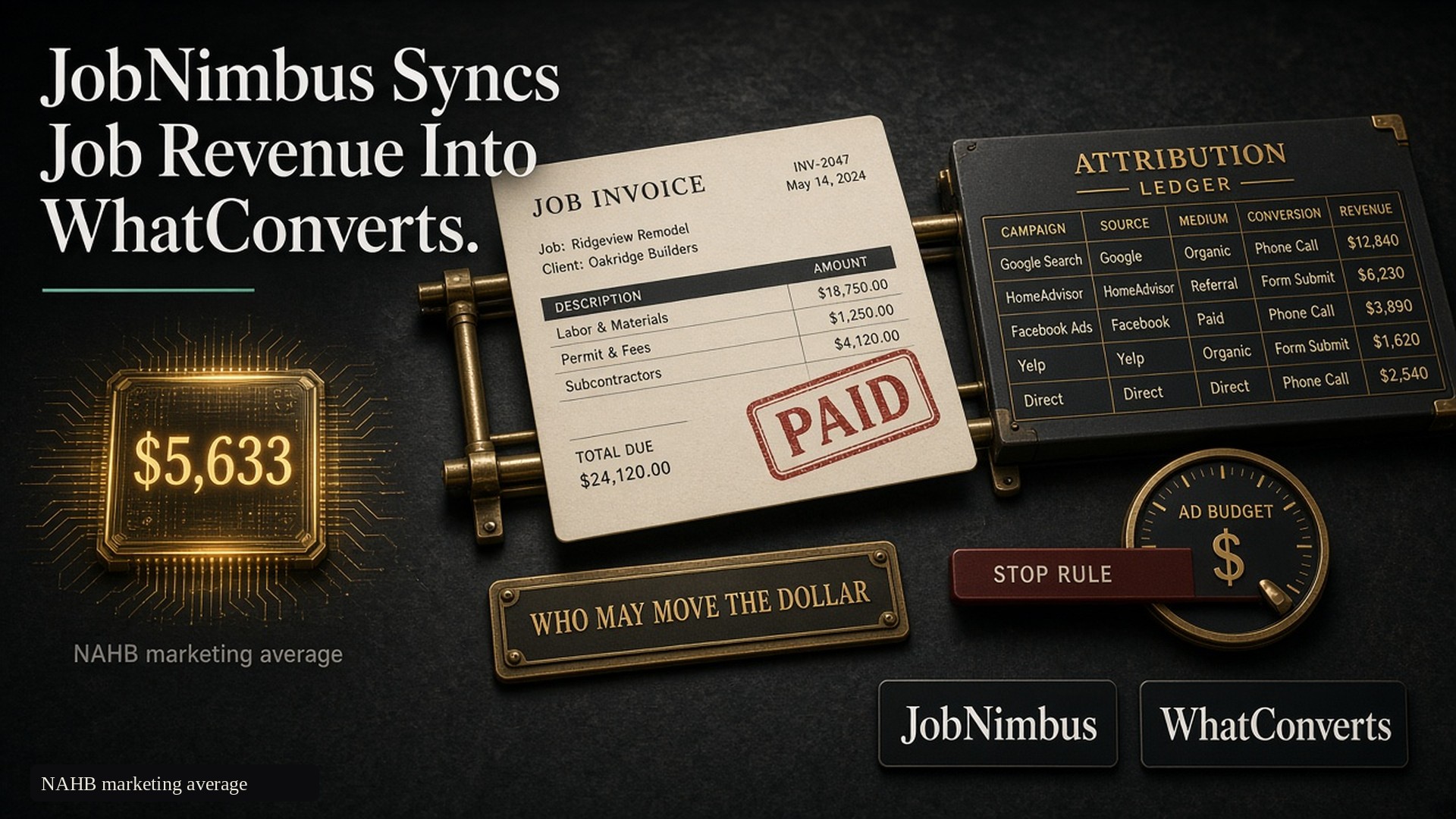
JobNimbus Syncs Job Revenue Into WhatConverts
On September 3, 2026, JobNimbus announced a native integration with WhatConverts that automatically syncs job and invoice revenue from JobNimbus into the lead attribution platform. A lead comes in, the team works it through an estimate and a job, and the customer gets invoiced inside JobNimbus. The missing line was back to marketing. With the sync, contractors and their agencies can see which campaigns, channels, and keywords produced signed jobs and how much revenue each one produced, without CSV exports or spreadsheet matching. If you already buy Google and Meta every month and still decide next month's budget from form fills, that is real help in software you already run.
JobNimbus and WhatConverts built something worth turning on. The question is not whether the sync can show paid jobs. It is who may move the next marketing dollar, meaning the named person allowed to reallocate spend from job and invoice revenue. It is also the stop rule, meaning the named line that sync may not rewrite without you. Write those names before the dashboard celebrates leads while cash stays flat, not after the budget already moved.
Startup Miracle sits with roofing and exterior owners, multi-truck HVAC shops, distributors whose ads still report leads, and agencies buying for contractor clients. We help you name who may move the next dollar and write that stop rule so a revenue sync does not rewrite the budget alone.
From lead count to job dollars
JobNimbus's September 3 announcement is the product in the companies' own words. When a job or invoice is created in JobNimbus, revenue flows into WhatConverts without manual entry. Lead-to-revenue tracking connects each lead to the job it produced. Marketing performance can be read by revenue, not only by lead volume. That revenue data can feed back into platforms like Google and Facebook so spend targets the customers worth the most to the business. The integration is available now to JobNimbus customers with a WhatConverts account.
Marc Hansen, SVP of Marketing at JobNimbus, said contractors can use real revenue data to make better budget decisions and spend more on the marketing that drives the best business. Michael Cooney, co-founder of WhatConverts, said contractors do not need another report on how many leads they got. They need to know which marketing efforts led to paying jobs. Both are right about the bridge. You still name who may move the next dollar when that bridge is live.
A first AI hire, meaning the first named job you let software run without you standing over it, can live in this sync. It can be the weekly revenue-by-campaign view you already wanted. It cannot be "the dashboard now owns the ad buy." The roofing and exterior contractor who owns the brand and the ad spend still owns the buy.
Eight thousand shops already in the CRM
JobNimbus says over 8,000 contractors already run estimates, jobs, and invoices in the CRM that just got this native WhatConverts revenue sync. That 8,000 figure is a JobNimbus claim on the September 3 page, not a Startup Miracle count. Lead counts stay loud while job dollars stay dark until the sync lands. Looking stupid for burning marketing dollars on leads that never become paid jobs is the fear that already lives in that office. Connect every JobNimbus job and invoice back to the campaign that produced it without spreadsheet matching, then name who may move the next dollar there.
The marketing line on the P&L
A multi-truck HVAC or plumbing owner who buys Google and Meta every month already feels marketing as a real line. NAHB's Cost of Constructing a Home 2024 special study, published January 2025, puts marketing at an average of $5,633, or 0.8 percent of a $665,298 average new-home sale price. Those dollars are NAHB builder-survey math, not a JobNimbus product claim, and not a promise about your trade. Treat them as proof that marketing is a P&L line with no automatic bridge from ad click to paid job until revenue attribution lands. Decide next month's ad budget from closed-job revenue, not form fills. Know which campaigns recover that marketing line as booked job revenue before the next buy.
Reps sell forty percent of the week
A building-materials or wholesale distributor owner whose reps sell and whose ads still report leads is running a double tax. Salesforce State of Sales, 7th edition, surveying 4,050 sales professionals in August and September 2025, says sales reps spend only 40 percent of an average workweek selling and 60 percent on nonselling work. Those figures are Salesforce Research, not a Startup Miracle cut of distributors alone. Blind ad spend on top of that admin load is expensive. Tie campaign spend to ERP-synced orders and invoices without CSV exports so marketing dollars point at campaigns that produced real orders, while reps sell more of the week. Name who may move that spend when the sync shows which campaigns paid.
Same-visit close and the agency report
An agency owner buying ads for roofing and exterior contractor clients lives or dies on whether the client's cash matches the lead report. ServiceTitan's State of the Trades top-performer profile, May 19, 2026, analyzing anonymized ServiceTitan customers for the trailing 12 months through January 2026, says top performers, the 90th percentile of revenue in their trade and market, close 77 percent of estimates during the same visit, while the rest close 62 percent. That is a 15-point gap on estimate-to-job, attributed to ServiceTitan platform data, not a phone-answer story.
Agencies that stop at lead volume still leave unpaid quotes on the table. JobNimbus revenue sync gives them the job dollars their clients actually cash. Report client ROI as signed-job and invoice revenue by campaign, with a named owner who can change spend. The fear is the client firing the agency when lead reports look good and cash looks bad. Prove campaign ROI with JobNimbus job and invoice revenue, not cost per lead.
Before the sync rewrites the budget
Turn the WhatConverts sync on if you already live in JobNimbus. Then write three names before the first revenue-by-campaign report becomes a buy.
First, who may move the next marketing dollar. That person reallocates spend from job and invoice revenue, not from lead counts alone. Second, who reads the weekly revenue report before Google or Facebook get a new target. Third, the stop rule. Write the line the sync may not cross: no budget cut without the named owner, no spend increase from a single week's revenue spike, no agency change of client budgets without the contractor's named approver. The sync can show which ads produced paid jobs. It should not rewrite the budget alone.
Startup Miracle's work here is the AI Readiness pass, not another attribution product. The quiz names who may move the next marketing dollar now that job and invoice revenue can flow into WhatConverts. The $1,500 assessment, with a $1,000 credit if you continue, is the longer version of that same question. We do not replace JobNimbus or WhatConverts. We sit with you until the budget has a named owner, and the stop rule is on the card, before the sync rewrites the spend.
If you already have both accounts, write the names this week. If you have not connected yet, write the names first. The order is the point. A revenue sync with no named owner is how a useful bridge becomes another dashboard that celebrates leads while cash stays flat.
FAQ
What is the JobNimbus and WhatConverts integration?
It is a native sync that pushes JobNimbus job and invoice revenue into WhatConverts so each lead can be tied to signed-job dollars by campaign, channel, and keyword. It is available now to JobNimbus customers with a WhatConverts account.
How do I keep a stop rule before the sync rewrites the budget?
Name who may move the next marketing dollar before the first revenue report becomes a buy. Write the stop rule in the same sitting so spend cannot change without that person.
How much is marketing on a typical new-home build?
NAHB's Cost of Constructing a Home 2024 special study puts marketing at an average of $5,633, or 0.8 percent of a $665,298 average sale price. That is NAHB builder-survey math, not a JobNimbus product claim.
The sync can show paid jobs. You still name who moves the dollar.
If you want the long version of how we think about readiness, Start with a FREE quiz and Get Your AI Score.