
Blog
Law Firms Miss 1 in 4 Intake Calls During Business Hours. Full Intake Automation Costs Less Than a Paralegal’s Monthly Salary.
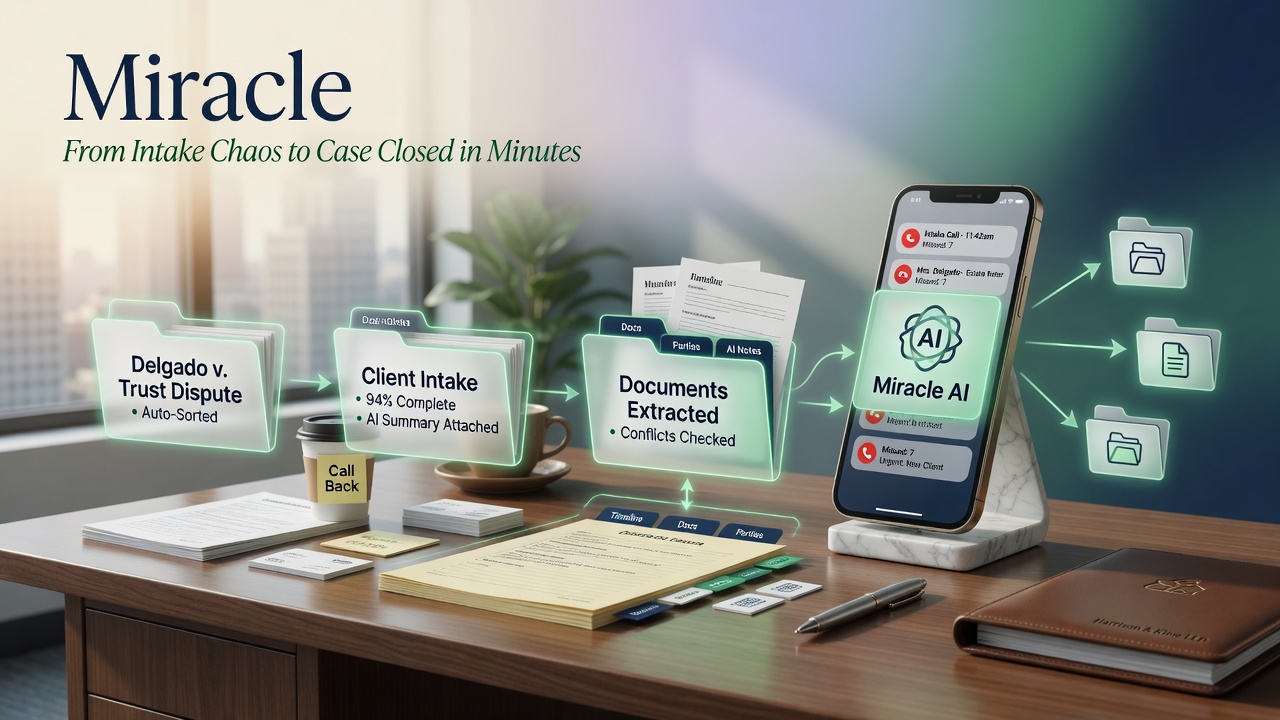
Every law firm in South Florida has the same problem: the phone rings during business hours, and nobody picks up.
Not because the firm is bad at law. Because the people who answer calls are also reviewing discovery, drafting motions, and returning client emails. The intake function (the process of capturing, qualifying, routing, and following up on new leads) is treated as a side task, not a system.
The numbers are brutal. Law firms miss 35% of all incoming calls during business hours, and 34% of those callers never try again. 26% of firms never respond to online leads at all. The legal sector loses an estimated $109 billion annually to missed calls.
For a personal injury firm in Miami running 80 intakes per month, that is 20 missed opportunities, each worth $15,000 to $50,000 in potential case value. At a 33% contingency fee, that is $100,000 to $330,000 in lost revenue every month. From calls that rang and nobody answered.
The four-stage intake pipeline
Client intake is not one thing. It is four distinct stages, and most law firms automate only the first one.
1. Capture. The lead arrives: phone call, website form, text, or chat. The goal is to capture context, not just contact info. A form captures fields. A good intake system captures what matters: "I was rear-ended on I-95 and my back has been killing me."
2. Qualify. Does this case fit your practice? Is the statute of limitations still open? Is the jurisdiction correct? For a personal injury firm, qualification means checking liability, injury severity, and insurance limits. For immigration, it means visa type and eligibility window. The average law firm converts 14% of leads into clients. Top performers hit 40 to 50%. The difference is how well they qualify upfront.
3. Route. A qualified lead needs to reach the right person instantly, with context attached. Most firms route to a shared inbox or a Customer Relationship Management (CRM) system that nobody checks until end of day. By then, the caller has already contacted three other firms.
4. Follow-up. 42% of inquiries arrive outside 9-to-5. Getting back to them the next morning is too late. The consumer has already moved on. Automated intake sequences lift conversion from 19% to 38%, a 2x improvement, simply by closing the follow-up gap.
The problem: most firms automate capture (a form on the website) and call it done. The other three stages (qualify, route, follow-up) run on whatever the paralegal has time for.
What slow intake actually costs
Let’s use real numbers. A Fort Lauderdale personal injury firm handles 80 intake calls per month. Average case value: $25,000. At 33% contingency, each case is worth $8,250 in fees.
At a 35% miss rate, 28 calls per month go unanswered. Even if half of those callers try again, 14 potential cases disappear. That is $115,500 in lost fees. Every month. Before accounting for the 42% of inquiries that arrive after hours.
And that is just the calls. Most firms also have a website form, a chat widget, and a Google Business profile. 61% of firms say admin bottlenecks cut billable hours by more than 20%. The intake paralegal who should be screening cases is instead playing phone tag.
81% of law firms admit to losing business due to slow responses. 35% estimate losing 11 to 25% of total annual revenue. This is not a marketing problem. It is a pipeline leak.
What most firms do wrong
The standard approach is to hire more intake staff. A full-time intake paralegal in South Florida costs $45,000 to $60,000 per year plus benefits. Add a second person and you are at $100K+ annually. The calls still get missed during lunch, after 5 PM, and on weekends.
The other common move is to buy a Customer Relationship Management (CRM) tool like Clio, Lawmatics, or Filevine and assume it solves intake. These tools are excellent for managing existing clients. They are not designed to answer the phone at 7 PM, qualify a car accident lead in Spanish, and route the summarized case to the right attorney by 7:02 PM.
What happens instead: the lead fills a form, enters the CRM, and sits there until someone opens it. Firms responding within 5 minutes are up to 21x more likely to convert a lead. A CRM that is checked every 2 hours cannot deliver that.
The fix: a full intake agent, not a tool
At Startup Miracle, we build intake systems that handle all four stages. Not just capture. Not just the form. The full pipeline.
We use a Voice AI agent that:
- Answers every call in English or Spanish, during business hours and after
- Qualifies the lead with branching questions based on practice area, including statute of limitations checks for personal injury, jurisdiction for family law, and visa type for immigration
- Routes the qualified lead to the right attorney with a structured summary, not a voicemail, not a CRM entry, but a complete case snapshot
- Follows up automatically on unanswered calls, abandoned web forms, and after-hours inquiries
The cost is a fraction of a paralegal’s salary. Our clients pay $300/month for Speed to Lead, which covers the Voice AI agent, the routing system, and the follow-up sequences. Compare that to $5,000/month for a full-time intake paralegal.
The system runs on Retell AI for the voice layer, with compliance configurations for HIPAA (required for personal injury firms) and state bar rules. It integrates with the firm’s existing CRM through webhooks, so the lead data flows into the same system the team already uses.
The implementation path
Setting up a full intake pipeline takes less than a week:
- Intake audit. We map your current intake flow: where leads come from, how they get qualified, where they get stuck, and how long each stage takes.
- Voice agent configuration. We train the AI on your practice areas, intake criteria, and compliance requirements, including Spanish-language intake for South Florida’s Hispanic client base.
- CRM integration. We connect the agent to your existing system (Clio, Lawmatics, Filevine, or whatever you use) so qualified leads land in the right place with full context.
- Testing and go-live. We run 50 test calls across scenarios (car accident, divorce consultation, business formation, immigration inquiry) before turning it on for real traffic.
- Ongoing optimization. We review call transcripts, update qualification criteria, and tune the routing rules based on which cases actually convert.
The goal is not to replace the intake team. It is to make sure every call gets answered, every lead gets qualified, and your paralegals spend their time on cases that matter, not on phone tag with people who already contacted three other firms.
Why this matters for South Florida law firms
South Florida is a unique legal market. The client base is heavily bilingual. Spanish-speaking callers make up a significant portion of intake volume for Miami, Hialeah, and Doral law firms. A system that only handles English is leaving cases on the table.
The Merchant Response Stack that we deploy across South Florida includes Voice AI, SMS, and WhatsApp channels, because the channel preferences vary by demographic. A Hialeah family law firm’s leads might prefer WhatsApp. A Fort Lauderdale personal injury firm’s leads might call. The system handles all of them with the same qualification logic.
Startup Miracle was selected for the ElevenLabs accelerator program to build Voice AI and agent initiatives. We run our own AI operations on Claude Code, OpenAI Codex, and Hermes Agents. We test these systems on our own pipeline before we recommend them to clients.
The bottom line
Your law firm is losing cases every time an intake call goes to voicemail. Not because your attorneys are bad. Because the intake function is treated as overhead instead of a pipeline.
Full intake automation (capture, qualify, route, follow-up) costs less than a paralegal’s monthly salary. It recovers the 35% of calls you are currently missing. And it works in English and Spanish, 24/7, without overtime.
Book an AI Assessment and let’s automate your intake pipeline. We will audit your current flow, map the four stages, and show you exactly how much revenue is leaking through missed calls.
Frequently Asked Questions
How much does law firm intake automation cost?
A full intake automation system (Voice AI agent, routing, CRM integration, and follow-up sequences) starts at $300/month for our Speed to Lead plan. This covers unlimited calls, bilingual support, and after-hours coverage. Compare to $45,000 to $60,000/year for a full-time intake paralegal, or $100,000+ for a team of two.
Is AI client intake compliant with bar rules and HIPAA?
Yes. The Voice AI layer we use (Retell AI) is HIPAA-compliant, which is required for personal injury firms that handle medical records. State bar rules vary: we configure the system to match your jurisdiction’s requirements for client communication, solicitation, and intake procedures. The system does not give legal advice. It qualifies and routes leads, then hands off to a licensed attorney.
What practice areas benefit most from intake automation?
Personal injury firms see the highest return because case values are high ($15K to $50K+) and the intake window is short, as accident victims often call multiple firms within hours of an incident. Family law, immigration, real estate, and business formation firms also benefit significantly because their intake involves qualification questions that a conversational Artificial Intelligence (AI) can handle: jurisdiction, timeline, entity type, and eligibility.
How does bilingual intake work for Spanish-speaking leads?
The Voice AI agent detects the caller’s language at the start of the call and switches to Spanish (or English) automatically. The qualification logic, case summary, and routing all work in both languages. For South Florida firms with a significant Hispanic client base, this alone recovers a large portion of the 35% of missed calls, because many Spanish-speaking callers hang up when they hear an English-only voicemail.
Can the system integrate with our existing CRM?
Yes. The system connects to Clio, Lawmatics, Filevine, MyCase, LawPay, and any CRM with a REST API or webhook support. The integration is bidirectional: the intake system sends qualified leads to the CRM with full context, and the CRM can trigger follow-up sequences through the voice agent.