
Blog
Miami Owners Are Still the Only Memory in the Shop. Hire a First AI Employee.
Miami Owners Are Still the Only Memory in the Shop. Hire a First AI Employee.
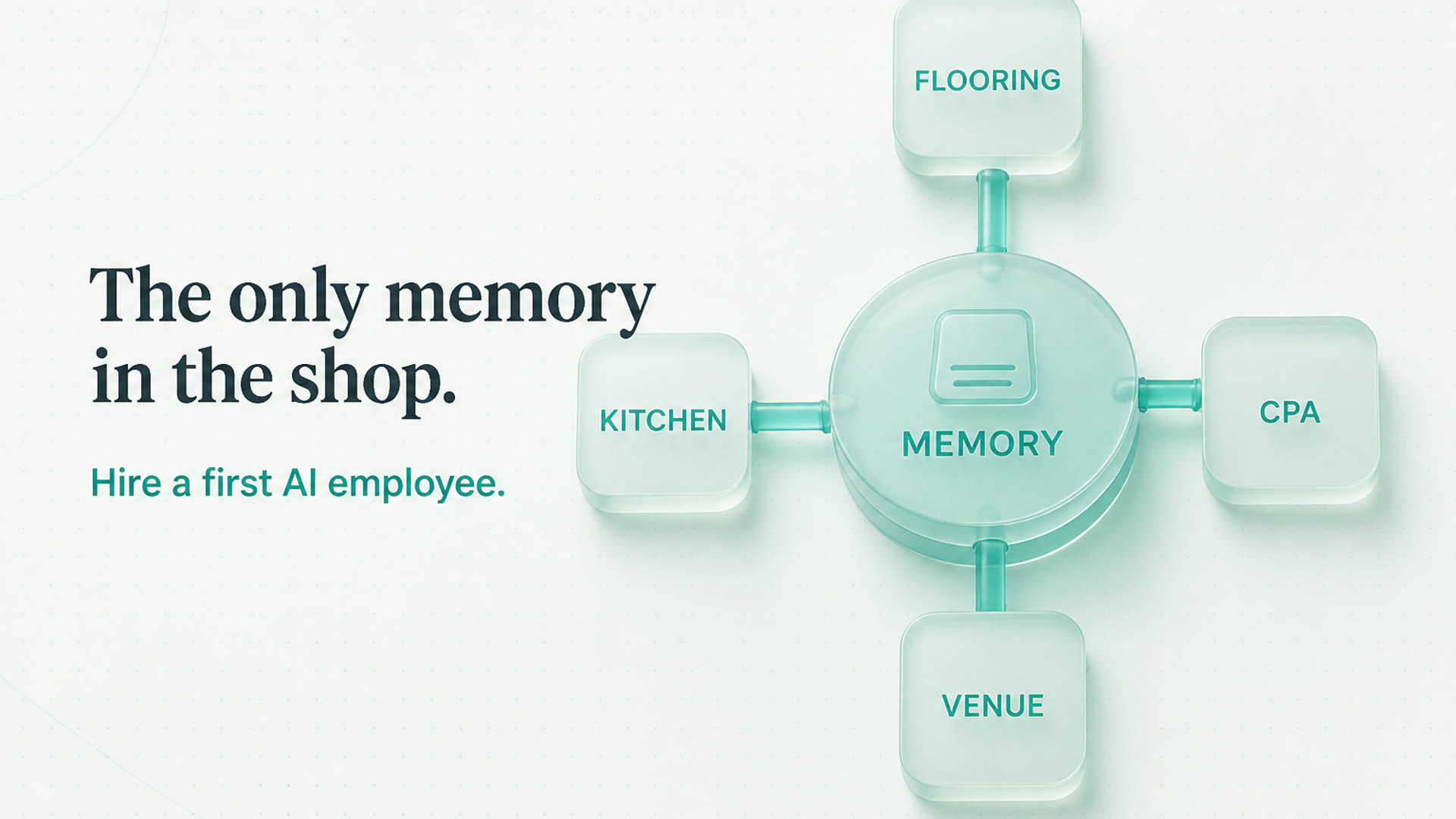
If you run a Miami shop, you are the memory. A first AI employee holds the quotes, the intake, the recipes, and the run-of-show so the night still works when you are not in the room.
I talk to owners here every week. Flooring. CPAs. Restaurants. Event planners.
Different trades. Same Tuesday.
You already paid for the tools. The CRM. The inbox. The reservation book. The shared drive with last year's menus.
None of them remember the job the way you do.
So you stay the router.
That is the whole problem. Not "AI." Not a missing app. You.
The shop still lives in one head
A Miami flooring or reno owner is the brand. Every estimate, every crew, every unfinished follow-up sits in one person.
The lead came in. Somebody walked the job. The number is half-written in a notes app. The follow-up never left because only you can write it in your voice.
That is not a marketing problem. That is shop memory.
You can hire a coordinator. You can buy another CRM seat. The quote still waits on you, because the voice on the estimate is yours. The crew notes are yours. The "I will send it tonight" is yours.
A Miami CPA or law owner sells time. The new matter is in the inbox, the portal, and a voicemail. The facts that make the consult useful live in one head.
The intake memo never gets filed before the meeting. You walk in cold. Or you stay up the night before rebuilding the file from scratch.
Clients do not see the rebuild. They see a sloppy first fifteen minutes. That is the fear. Looking like the shop that did not read the file.
A Miami restaurant owner is the night. Recipes, vendors, shift notes, guest replies. When people leave, the how-we-run-it leaves with them.
You become every station.
The line still has to fire. The guest still has to get a reply. The vendor still has to get paid. None of that cares that the person who knew the book walked out on Thursday.
A North Miami event planner is the run-of-show. Holds, deposits, vendor calls, the checklist that makes a wedding land. If that list lives in one person, a no-show is not a staffing issue.
It is a failed event.
I am not guessing at these rooms. They are the rooms I sit in.
What it costs when you stay the memory
You already feel the hours. You do not need a lecture.
A SoFi survey of 515 owners, carried by the Miami Herald in 2026, put numbers on it. 26% said the main structural challenge is finding enough time in the day. 20% named unmanageable workloads as a growth obstacle. Construction owners were the most likely to name inflation as their top constraint, at 59%.
That is a national sample. It still sounds like Miami in August.
Time is the constraint. Workload is the constraint. And the work that dies is the work only you can finish.
Home-services search is not cheap. LocaliQ's home-services benchmarks (3,211 US campaigns) put median cost per lead at $90.92. Conversion fell 14.96% year over year. 69% of those businesses paid more for a lead.
That is not a Miami survey. Treat it as the national price of a lead. Then watch what happens to that lead on a Coral Gables or Doral job when the follow-up sits in the owner's head.
The expensive lead does not die in the ad account.
It dies in the notes you were going to send after the next walkthrough.
I have watched that pile grow. Three open estimates. Then seven. Then the owner says they will catch up on Sunday. Sunday is a job site. The pile is still there on Tuesday.
Professional shops have the same leak with different nouns. Census Business Trends and Outlook (December 2025 to May 2026) found less than 20% of firms with four or fewer employees used AI.
The smallest Miami professional shop is still the owner's memory plus a chat tab.
A chat tab does not hold a matter. It does not write an intake memo. It does not stop itself from filing the wrong thing.
That is why the small firm waits. They tried the tab. The tab forgot the client. They went back to being the hard drive, because the hard drive was safer.
The night, and the wedding that almost did not happen
Wilkinson Sejour runs seven Chef Creole locations in Miami. He told Local 10 he lost four employees and expects labor cost to move from 23.5% toward 27% or 28%.
He later told the Miami Herald the restaurant is a chain with a thousand links. Miss one and guests talk about the food and the service.
That is the point. Not the headline. The process.
When people leave, the how-we-run-it was in their heads. The owner becomes every station. The night still has to work.
Same Herald story. Sabine Dulcio, a North Miami event planner, said 5 of 10 staff did not show for a wedding setup at the Coral Gables Country Club.
Never in 20 years, she said.
She has two October events of 800 people each. You cannot run on hoping for the best.
I read that and I did not think staffing crisis. I thought: the run-of-show lived in one person.
If 5 of 10 do not show, the event still has to happen. The checklist cannot be a hope.
This is Miami. The night is the product. The wedding is the product. If the memory walks out, the guest does not care that you were short. They care that the link broke.
I already did the keep-up. Here is the 1-2-3.
You do not need another tool tab.
You need a first AI employee. A named teammate with a job, the shop's knowledge, and a stop rule. Startup Miracle is the Miami AI consultant that installs that hire.
We map the leak. We put memory outside your head. You keep the judgment.
Here is the digest.
1. Name one job.
Not "do AI." One leak.
Flooring: every estimate followed up without you writing it from memory.
CPA or law: every new matter becomes an intake memo that never auto-files.
Restaurant: recipes, vendors, shift notes, and guest replies stay alive when the floor is short.
Venue: the run-of-show and the checklist survive a no-show.
Pick the one that woke you up last night. That is the first hire.
Do not start with four jobs. Start with the one that costs you sleep. We can add the next one after the first list is clean.
2. Point it at the truth.
The employee only works if it knows how you run the shop. Quotes in your voice. Intake the way your firm files a matter. Recipes and vendor notes the way the night actually cooks. The run-of-show the way you call a cue.
That is a knowledge base. Not a chat window you re-explain every morning.
We already run this as AI ops. Identity, knowledge, a clock. The teammate shows up with the list. You do not rebuild the context.
If the knowledge is still only in your head, the hire will sound like a brochure. That is not a model problem. That is a memory problem. We pull the memory out first.
3. Put a stop rule on the send.
Nothing emails. Nothing files. Nothing posts. Nothing confirms a hold.
You approve.
The flooring owner taps send on the follow-up list. The CPA reads the memo before the consult. The restaurant owner keeps the guest. The planner keeps the event.
The first AI employee holds the memory. You keep the shop.
That is the whole product. A hire with a stop rule. Not a gadget.
What this is not
This is not a virtual receptionist pitch. One tool can cover a phone. It does not hold quote memory, intake, recipes, or a run-of-show.
This is not a model bake-off. You do not need to keep up with the industry. Local shops already use AI in small, concrete ways. The ones who get stuck bought a tab and stayed the router.
This is not "turn it all on and hope." We have said this before. Readiness is revenue, compliance, and operations in one pass. If you skip the map, you buy another login that dies in 30 days.
An AI readiness assessment starts with the shop, not the software. That is the only order that works.
What a Miami first AI employee actually does
I will stay in the four shops.
The flooring owner wakes up to a draft list. Every open estimate from the CRM. Written in the voice they already use on a Coral Way walkthrough. They approve the send. They do not rewrite the job from memory in the truck.
The CPA walks into the consult with an intake memo. Form, inbox, the last email. Nothing filed itself. They correct two lines and start the meeting like a firm, not like a person who stayed up rebuilding the file.
The restaurant still plates the night. Shift notes are in the book. The vendor list did not leave with last week's sous. Guest replies sit in draft. The owner taps send after the rush, not at 1 a.m. from the office.
The planner still owns the wedding. The run-of-show is a document, not a hope. If 5 of 10 do not show, the cues are still on paper a second person can run. She approves the changes. The 800-person October event does not depend on one head.
Same hire. Different nouns.
That is the result they asked for in the research. Owner approves. Shop memory is not one person.
Why the smallest shops wait
The Census number is the quiet one. Less than 20% of the smallest firms used AI in that window.
I see why. You tried a chat tab. It forgot the job. It sounded like a brochure. You went back to being the memory because the memory was safer.
Fair.
A first AI employee is not that tab. It has your identity. It has the shop knowledge. It has one job. It stops.
You stay the owner. You stop being the hard drive.
That is what AI ops means in a Miami shop. Not a demo. A delivery.
Startup Miracle already ran this machine on our own work. Research, draft, visuals, a clock, a stop rule. We did not add a tab and hope. We named the jobs and we made the memory live outside one head.
You can do the same thing in a flooring office, a firm, a kitchen, or a venue. The nouns change. The hire does not.
If you want the long version of how we think about readiness, Start with a FREE quiz and Get Your AI Score. We use it to see whether the shop is still running on manual follow-up, manual intake, and one-person memory.
Javier, from next door
I am in Miami. I am not writing this from a conference.
When I sit with an owner, I do not ask which model they like. I ask which job dies when they leave the room.
If the answer is "all of them," we do not start with all of them. We start with one.
Follow-up. Intake. The night. The run-of-show.
Then we install the employee. Then we watch the list. Then we add the next job.
That is what a Miami AI consultant should sell. Not a gadget tour. A hire you can point at.
You already did the hard part. You built the shop. You are the brand. You are the night.
Let the memory live somewhere that does not get tired.
If the business still runs on your head, take the free AI Readiness quiz. We will map the first job. You keep the keys.