
Blog
The $285 Missed Call: Why 78% of Homeowners Hire the First Contractor Who Answers and 85% Who Hit Voicemail Never Call Back
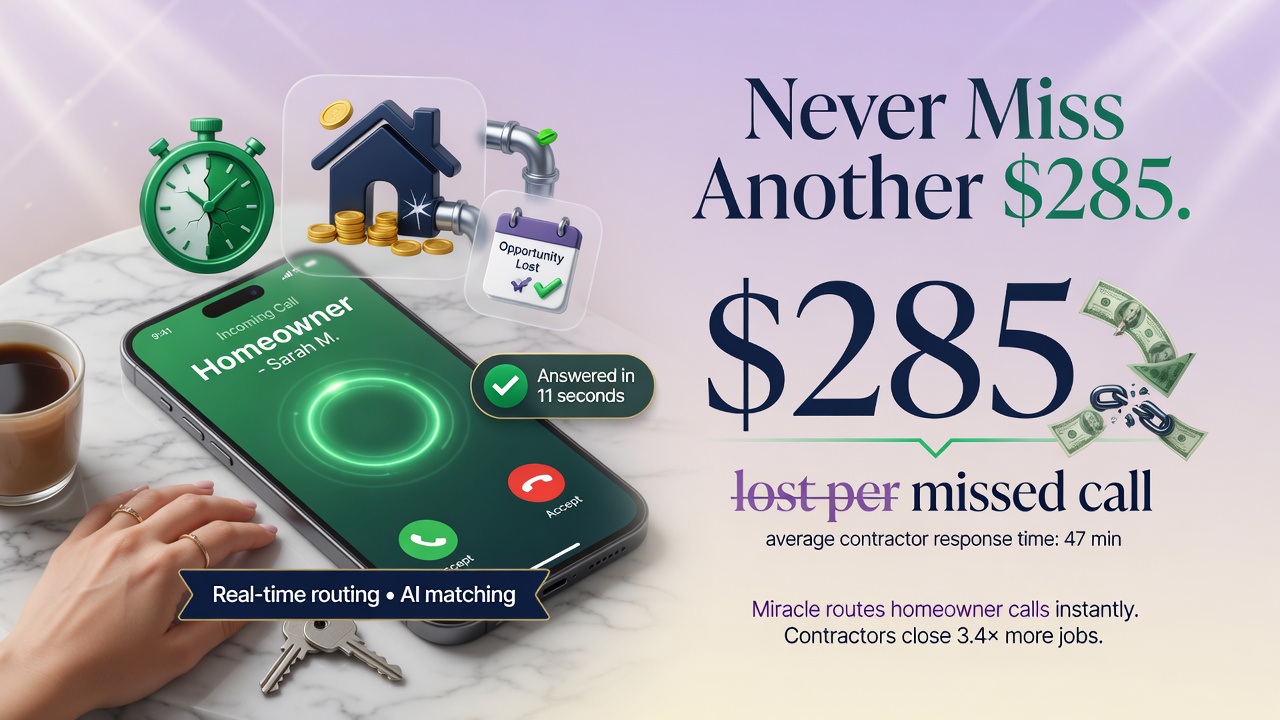
Home service contractors have a phone problem. Not a marketing problem, not a pricing problem, not a staffing problem. A phone problem.
The phone ringing is the most valuable sound in your business. But right now, you are leaving tens of thousands of dollars on the table every month because nobody is picking it up when it matters most.
Here is the data. It is not comfortable.
The $285 Floor
According to HomeAdvisor's data, the average home service job is worth $285 or more in revenue. For HVAC, plumbing, and electrical work, the number climbs to $450-$950 per booked call. A single emergency call during a heat wave or cold snap, when homeowners are desperate and calling 2-3 competitors at once, can be worth $1,000 or more.
Now multiply that by the number of calls you are missing every day.
The industry baseline is sobering: 20-30% of all inbound calls to home service contractors go unanswered. During peak seasons, that number hits 40-50%. For a mid-size shop doing 50 calls a day, that is 10-15 missed opportunities every single day.
At a blended $450 per booked call and a 65% book rate, each missed call has an expected value of roughly $290. Miss 20 calls per week, and you are looking at $5,850 in weekly missed revenue. That is over $300,000 annually.
The Voicemail Trap
Here is where most contractors make their first mistake. They assume voicemail works as a safety net.
It does not.
85% of callers who hit voicemail hang up without leaving a message. They do not wait. They do not call back. They scroll to the next Google result and dial the next contractor.
Homeowners who are actively searching for a service provider have a short decision window. They call 2-3 competitors within 10-15 minutes. The first one who answers gets the job.
78% of customers hire the first contractor who responds. That is not a theory. That is HomeAdvisor's data from millions of service transactions.
The 5-Minute Window
The research on lead response time is settled. Contacting a lead within 5 minutes makes you 21x more likely to qualify them than waiting 30 minutes. Responding within 1 minute increases conversions by 391% compared to a 2-minute delay.
The average home service business takes 6.8 hours to respond to a lead. Only 12% of contractors respond within the 5-minute window.
Think about that. 88% of your competitors are not answering the phone fast enough. The ones who fix this win.
After-Hours: The Silent Revenue Leak
47% of home service calls arrive outside normal business hours — before 8 AM, after 6 PM, and on weekends.
These are not low-quality calls. Emergency calls convert at 73% higher rates than routine inquiries. A homeowner with a burst pipe at 10 PM or a dead air conditioning unit on a Saturday afternoon is not price shopping. They are hiring the first person who answers.
But most contractors are not there to answer. The phone rings into silence. Voicemail captures 15% of those callers. The rest move on.
What Most Contractors Do Wrong
There are three common approaches to fixing the phone problem, and none of them work:
Hiring more CSRs. The problem is not the number of people you have. It is that calls spike unpredictably, and you cannot staff for every peak. You will either overpay for idle staff or under-staff during surges.
Answering services. Generalist operators who do not know the difference between a heat pump and a furnace. They miss qualification cues, fail to book appointments correctly, and create more callbacks than they prevent.
Letting it ring and calling back. The missed call gets returned 47 hours later, on average. By then, the homeowner has already hired someone else and forgotten they called you.
The Fix: Speed to Lead Infrastructure
The contractors who are winning in 2026 are not necessarily the ones with the best websites or the biggest ad budgets. They are the ones who answer the phone first.
Speed to Lead is the practice of responding to every inbound lead within minutes, not hours. It requires a system that works 24/7, understands the language of your trade, and qualifies leads before they reach your team.
This is not about replacing your team. It is about covering the gap between what your team can handle and what your customers expect.
At Startup Miracle, we build Speed to Lead infrastructure for South Florida home service contractors. We start with a Missed Call Audit — we measure exactly how many calls you are losing, what they are worth, and what it would take to capture them.
The Math
Let us be specific about the numbers.
A mid-size HVAC contractor doing 50 calls per day, missing 25% of them (industry average), with an average ticket of $600 and a 65% book rate:
- Missed calls per day: 12.5
- Missed calls per week: 62.5
- Expected loss per week: $24,375
- Expected loss per year: $1,267,500
Even at the most conservative estimate — $285 per call, 20% miss rate, 50 calls per day — the annual loss is $208,050.
The fix costs a fraction of that.
Javier POV
I see this pattern every week with home service contractors in South Florida. A shop owner tells me business is slow. I look at their phone data. They are missing 30% of calls. They have no idea because they are not tracking it.
The phone is the most expensive asset in your business that you are not monitoring. You track ad spend, material costs, truck utilization. But you are not tracking the single thing that generates every dollar of revenue.
The gap between "business is slow" and "we are not answering the phone" is the most expensive blind spot in home services.
Implementation Path
- Audit your current call volume. How many calls come in per day? How many are answered? What is the average response time? Most contractors do not know these numbers. Start measuring.
- Identify your after-hours gap. 47% of calls arrive outside business hours. If you do not have coverage during those hours, you are losing half your opportunity.
- Deploy a Speed to Lead system. The goal is not to replace your CSRs. It is to answer every call within 5 minutes, 24/7, with the same quality and follow-through your best CSR provides.
- Track the delta. Once you implement coverage, measure the change in booked calls, revenue per call, and response time. The data will tell you exactly what it is worth.
The Bottom Line
Missed calls are not a cost of doing business. They are a revenue leak you can fix.
The contractors who answer first are winning. The ones who let it ring are competing on price, scrambling for leads, and wondering why their marketing is not working.
Fix the phone. Everything else gets easier.
Book a Missed Call Audit — we will calculate exactly how much you are losing and build the system to capture it.
FAQ
How much does a missed call cost a home service contractor?
According to HomeAdvisor, the average home service job is worth $285+ in revenue. For HVAC and plumbing, industry data puts the average at $450-$950 per booked call. With a 65% book rate, each missed call has an expected value of roughly $290.
What percentage of home service calls go unanswered?
CallRail industry benchmarks put the average missed-call rate at 20-30% of total inbound volume, rising to 40-50% during seasonal peaks. IBISWorld data shows 62% of calls to small service businesses go unanswered during business hours.
How quickly do homeowners expect a response?
Homeowners expect a response within 10 minutes. After 30 minutes, conversion drops more than 50%. 78% of customers hire the first contractor who responds. Google's click-to-call data shows a median decision window of 9 minutes.
Why do 85% of callers hang up on voicemail?
Homeowners searching for a service provider call 2-3 competitors within 10-15 minutes. Voicemail signals the business is not available, so they move to the next option. Voicemail captures only 15% of potential leads.
What percentage of calls come after hours?
HomeAdvisor data shows 47% of home service calls come outside normal business hours. Emergency calls convert at 73% higher rates than routine inquiries. HVAC and plumbing calls spike 25-45% after hours during peak seasons.
How much can a contractor save by fixing missed calls?
A mid-size shop missing 25% of 50 daily calls at $450 per booked call can lose over $1.2 million annually. Even conservative estimates show $200,000+ in annual losses. The cost of a Speed to Lead system is a fraction of that.
Do phone leads convert better than web leads?
Phone leads convert 10-15x higher than web forms. 91% of homeowners rate phone experience as their primary factor in choosing a contractor. 83% prefer phone for service requests.