
Blog
Noteefy AI Booking Engine Books Tee Times Inside AI Chats
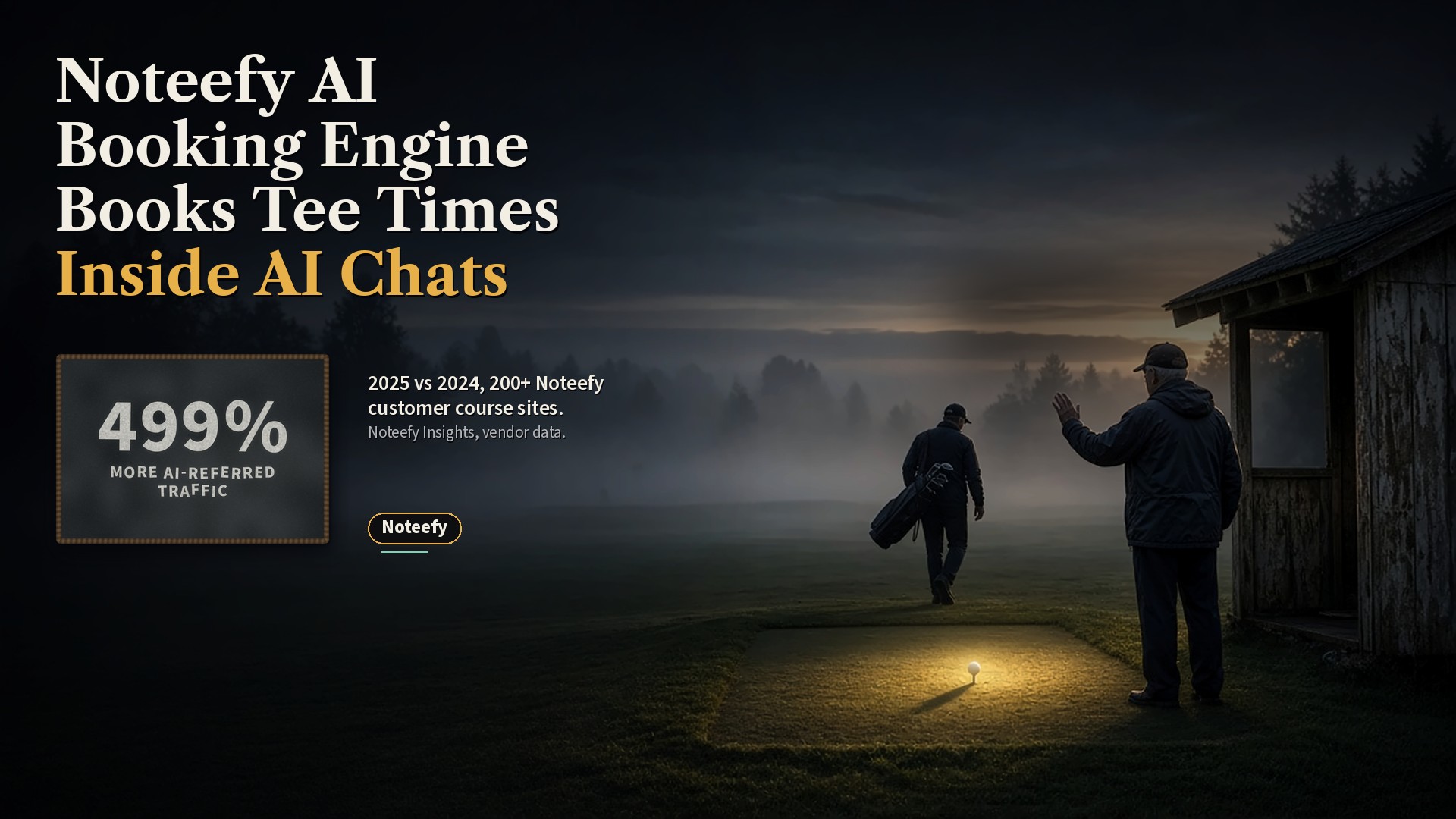
Noteefy AI Booking Engine Books Tee Times Inside AI Chats
On October 15, 2026, Noteefy launched its AI Booking Engine, a tool that lets golfers book tee times inside AI assistants such as ChatGPT, according to Noteefy's launch post. An AI assistant is a chat tool a person types questions into and gets answers back from. Noteefy built this for golf courses and resorts. It says it already serves more than 1,500 of them. For a course, that's real leverage: a golfer who asks an assistant where to play can, in Noteefy's telling, end up booked without leaving the chat.
The launch is a real step for courses, and our honest take is that the harder question sits with the course. If you own or run an independent course, the question isn't whether AI booking works in a demo. It's whether an assistant can find your course, read accurate information about it, and book a round on your own tee sheet. A tee sheet is the course's schedule of tee times, the record of who plays when. That's where we'd start.
The traffic numbers behind the launch
Noteefy's launch post leans on its own data, which it calls Noteefy Insights, drawn from more than 200 of its customers' course websites. That's a vendor's view of its own sites, not a census of every course, so we read it as a signal rather than a measurement of the whole industry.
On those sites, AI-referred traffic rose 499% year over year in 2025, with ChatGPT making up about 90% of those visits. AI-referred traffic means visitors who reached the course website by clicking through from an AI assistant's answer.
The same data shows direct traffic fell from 49% of course website traffic in 2023 to 41% in 2025. Direct traffic is visitors who arrive by typing the address or using a bookmark. Noteefy's post doesn't say AI caused that drop, and we won't either. The two numbers sit side by side in the data, and that's as far as they go.
Even read carefully, they say something to an owner. Some golfers are starting the hunt for a tee time in a chat window, while a shrinking share of visits arrives straight at the front door.
When the booking happens inside the chat
Noteefy says it serves more than 1,500 golf courses and resorts. That's the company's own count, but it tells an owner this isn't a single experimental course trying something odd.
In Noteefy's data, ChatGPT accounted for about 90% of AI-referred visits to its customers' course websites. Our read is practical: if you only have time to check one assistant this week, start with ChatGPT, since that's where most of the AI-referred visits in Noteefy's data came from.
Booking inside an assistant changes where the golfer meets you. In Noteefy's description, the golfer can go from asking about a round to having one booked without leaving the conversation. That means your website may never get the visit, so the information an assistant uses about your course has to be right on its own.
It also raises the question every owner should ask about any booking channel. When a round is booked somewhere other than your website, does it land on your own tee sheet at your posted rate, with the golfer's details coming to you? An aggregator, a third-party site that sells tee times for many courses, answers that question differently than a direct booking does. Ask it of every tool before you switch one on.
Three messages at The Broadlands
Noteefy's launch post walks through one example at The Broadlands in Broomfield, Colorado. A golfer booked and paid for a $100 round inside an AI assistant in three messages. The round was two players at the $40 rate plus a $20 cart, and it went straight onto the course's tee sheet.
That's Noteefy's demo example, not an independent result, and the post doesn't claim any revenue lift from it. What it shows is the shape of the experience: a short conversation that ends in a paid tee time.
We'd point out one detail an owner should like. The booking landed on the course's own tee sheet, at the course's posted rate. Keeping your tee sheet as the single source of truth is worth protecting, whatever booking tools you add on top of it.
What an assistant needs to know about your course
Here's our read on the gap, and it's ours rather than Noteefy's. A booking engine can only book what it can find. Before any course worries about the booking step, it's worth asking whether an assistant can answer basic questions about you correctly.
That means your rates, your cart policy, your hours, and how to get a tee time should be clear on your own website. If a golfer asks an assistant about your course and gets an old rate or the wrong hours, the problem started before any booking tool was involved.
The second part is onboarding, the setup work that connects a new tool to how your course actually operates. Someone on staff has to decide which tee times are bookable this way, which rates apply, and who checks that bookings look right in the first weeks. A tool can't make those decisions for you.
If you run more than one course, the same check applies to each one separately. Rates, carts, and policies can differ by property, so an assistant needs to tell them apart.
Where an independent course should start
If we sat down with an independent course owner, we'd suggest three steps in order. First, ask a few AI assistants about your course the way a golfer would, then note what they get right and wrong. Second, fix the information on your own website so the right answers are easy to find. Third, decide whether AI booking fits your tee sheet, your rates, and your staff before you switch anything on.
Here's the short version we'd give any course owner. Make sure an AI assistant can find accurate information about your course before you worry about booking through one. Once it can, a booking tool like Noteefy's has accurate information to work from.
We've covered the broader shift before, including how AI search is changing local visibility and using Search Console to find the searches that actually pay you. Both apply to a course as much as to any local business.
Reporting, the other place operators point AI
Booking isn't the only place golf operators see AI helping. Xplor's 2026 golf and club research was reported by Golf Business Technology on October 7, 2026. In it, more than half of respondents picked reporting and analytics as where AI could create the most value in the next 12 months. Xplor owns Clubessential, foreUP, and BlueGolf, so this is another vendor's survey. The article doesn't disclose a sample size.
We keep that finding separate from Noteefy's data. Still, it fits a pattern worth noting. Operators want time back on the numbers, and the booking data a course already collects is one place those numbers can start.
For a GM buried in reports, that's a reasonable second job for AI after the course is findable. The order matters less than picking one and doing it properly.
What course owners want to know
What is Noteefy's AI Booking Engine?
Noteefy's AI Booking Engine, launched October 15, 2026, lets golfers book tee times inside AI assistants such as ChatGPT. Noteefy says it serves more than 1,500 golf courses and resorts.
How to get a golf course ready for AI booking?
Ask a few AI assistants about your course the way a golfer would, then fix any wrong rates, hours, or policies on your own website. Once the information is accurate, decide which tee times and rates should be bookable through AI before turning a tool on.
How much was the AI-booked round in Noteefy's demo?
In Noteefy's demo example at The Broadlands in Broomfield, Colorado, a golfer booked and paid a $100 round in three messages: two players at $40 plus a $20 cart. That's a vendor example of the booking flow, not a reported revenue result.
If you want the long version of how we think about readiness, Start with a FREE quiz and Get Your AI Score.