
Blog
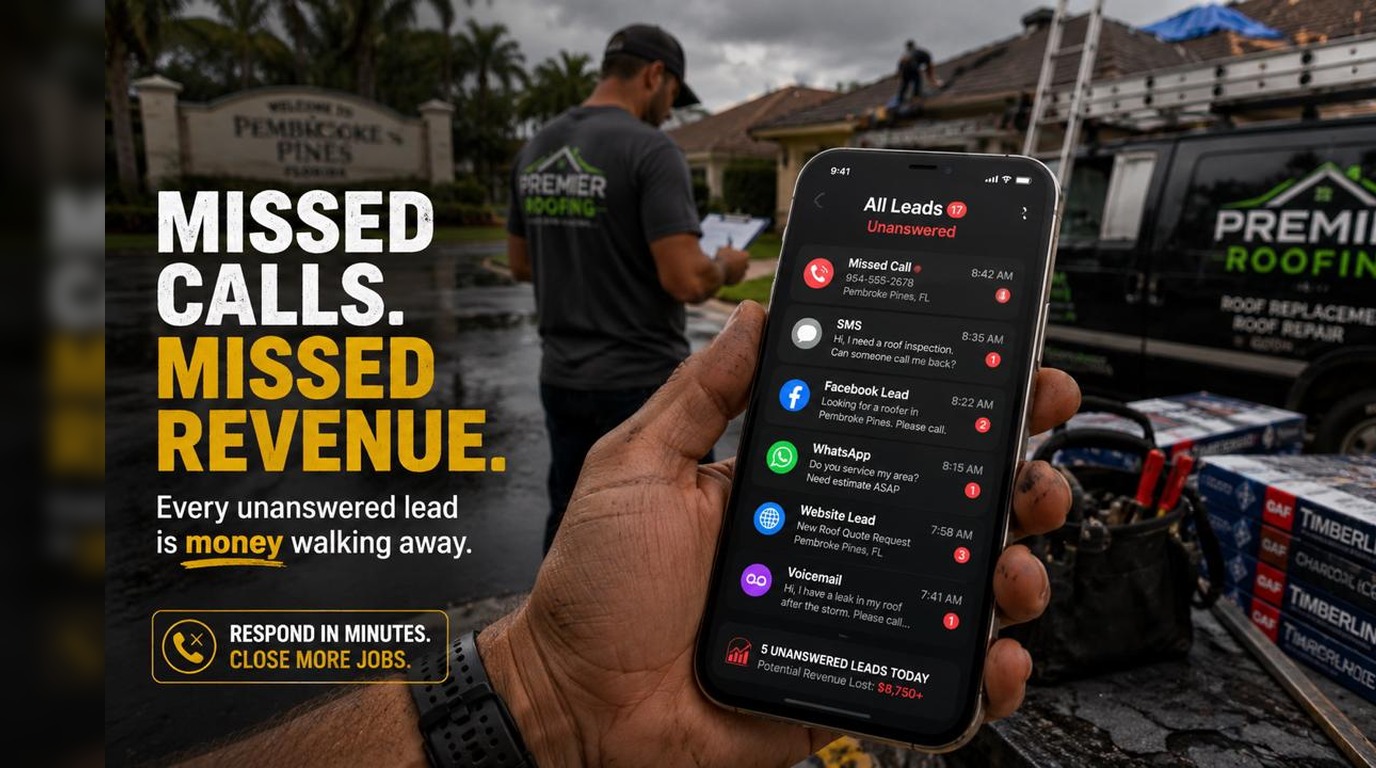
Pembroke Pines Roofers Don’t Have a Lead Problem. They Have a Callback Problem.
Pembroke Pines Roofers Don’t Have a Lead Problem. They Have a Callback Problem.
A roofing lead in Pembroke Pines does not wait around.
If a homeowner has a leak after heavy rain, missing shingles, an insurance question, or a roof that needs replacing before the next storm season, they are not calmly filling out one form and waiting three days.
They are calling three roofers.
The contractor who responds first usually controls the conversation.
That is the part most roofing companies miss. They keep spending on Google Ads, yard signs, referrals, SEO, and Facebook campaigns while the real leak sits inside the business: slow callbacks.
The money leak is after the lead shows up
Most roofing owners think the growth problem is demand.
They want more calls. More estimate requests. More website traffic. More referrals.
But when we audit home-service businesses, the first leak is usually simpler:
- calls go to voicemail
- web forms sit until the end of the day
- estimate requests are answered once and then forgotten
- after-hours leads wait until morning
- callbacks depend on whoever remembered to check the inbox
- the CRM has names, but no real follow-up system
That is not a marketing problem.
That is a response system problem.
Lead response research keeps pointing to the same pattern: the longer a business waits, the lower the chance of reaching and qualifying the buyer. The commonly cited five-minute response window exists because intent decays fast when customers are actively shopping.
And for roofing, it gets expensive fast. A single roof replacement can be worth thousands of dollars. One missed callback can cost more than a month of software.
Why Pembroke Pines roofing leads go cold
Pembroke Pines homeowners are not shopping in a vacuum.
They are dealing with weather, insurance timelines, HOA pressure, financing questions, and family schedules. When they reach out, they want clarity quickly:
- Can you inspect it?
- How soon can someone come out?
- Do you handle insurance claims?
- Is this repair urgent?
- What happens next?
If your team takes hours to respond, the homeowner does not see “busy company.”
They see risk.
Roofing is trust-heavy. Slow response creates doubt before the estimate even happens.
What most roofers do wrong
Most roofing companies try to fix slow callbacks with reminders, meetings, or another CRM field.
That rarely works.
The issue is not that the team does not care. The issue is that the process depends too much on memory.
A healthy roofing sales process should not require the owner to ask, “Did anyone call that lead back?”
It should answer automatically:
- who called
- who texted
- who booked
- who needs a second touch
- which leads came in after hours
- which estimates are sitting without follow-up
- which source is wasting ad spend
That is where the sales team, operations team, and marketing function have to connect. If they stay separate, the business keeps buying demand it cannot convert.
Javier’s view: fix response before buying more leads
My rule is simple:
Before a roofing company spends more money on lead generation, it should know what happens in the first 15 minutes after a lead arrives.
Not in theory.
In the real workflow.
Who gets the alert? Who calls? What happens if they miss it? Does the homeowner get a text? Does the lead enter the CRM correctly? Does anyone follow up if the estimate is not booked?
If the answer is “it depends,” the company does not need more leads yet.
It needs a response system.
What a roofing callback system should include
For a Pembroke Pines roofing company, the first version does not need to be complicated.
It needs to be consistent.
A practical response system includes:
- Missed-call recovery
If a call is missed, the lead gets an immediate text and a callback task.
- After-hours intake
A homeowner can share the issue, address, urgency, and preferred appointment window even when the office is closed.
- Speed-to-lead routing
The right person gets notified fast, with enough context to call back intelligently.
- Estimate booking follow-up
If the homeowner does not book, the system follows up without waiting for a rep to remember.
- CRM cleanup
Every lead source, status, note, and next step is visible.
- Owner visibility
The owner can see how many leads came in, how fast the team responded, and where deals are getting stuck.
This is not about replacing the roofing team.
It is about protecting the revenue they already earned the chance to win.
Where AI actually helps
AI is useful when it removes the manual gaps:
- answering or qualifying missed calls
- sending fast SMS follow-up
- collecting basic job details
- routing urgent roof leaks differently from general estimates
- reminding homeowners before inspection appointments
- reactivating old estimates
- summarizing calls into the CRM
But the tool is not the strategy.
Revenue recovery is the strategy.
That is how Startup Miracle approaches it. We do not start by selling a random chatbot. We start with an AI Assessment to find the exact points where leads, callbacks, appointments, and estimates are leaking.
For roofing companies, that usually means connecting sales, operations, and local construction workflows into one simple response stack.
A simple 15-minute audit for roofing owners
Pull the last 20 roofing leads.
For each one, answer:
- How did the lead come in?
- How long did it take to respond?
- Was there a missed call?
- Did the homeowner receive a text?
- Was the estimate booked?
- Was there a second follow-up?
- Is the next step visible in the CRM?
- Did the owner know this lead was stuck?
If you cannot answer those questions quickly, the problem is already clear.
You do not have a lead problem first.
You have a callback problem.
The bottom line
Pembroke Pines roofers do not win only because they have better crews, better materials, or better ads.
They win because homeowners trust the company that responds clearly and quickly.
If your roofing company is paying for leads but responding manually, slowly, or inconsistently, you are letting competitors win jobs you already paid to compete for.
Book an AI Assessment with Startup Miracle. We will map where your roofing leads are leaking and show you the simplest response system to recover them.
FAQ
Why do roofing companies lose leads after someone requests an estimate?
Roofing companies usually lose estimate leads because response time is too slow, follow-up is inconsistent, or the lead gets buried in calls, texts, email, and CRM notes. Homeowners often contact multiple contractors, so the company that responds first with a clear next step has the advantage.
Should a roofing company use AI to answer missed calls?
Yes, when it is implemented as part of a real response process. AI can capture basic job details, send immediate text follow-up, route urgent issues, and create CRM notes. It should support the team, not replace human judgment on inspections, pricing, or insurance conversations.
What is speed-to-lead for roofing companies?
Speed-to-lead is how fast your team responds after a homeowner calls, submits a form, or asks for an estimate. For roofing companies, faster response can mean more booked inspections, fewer cold leads, and less wasted ad spend.
What should a roofing callback system track?
A roofing callback system should track source, response time, missed calls, text follow-up, appointment status, estimate status, owner notes, and next steps. The owner should be able to see which leads are active, which are stuck, and which sources are wasting money.