
Blog
The RCS Revolution: Why Every South Florida Business Needs to Rethink Business Messaging in 2026
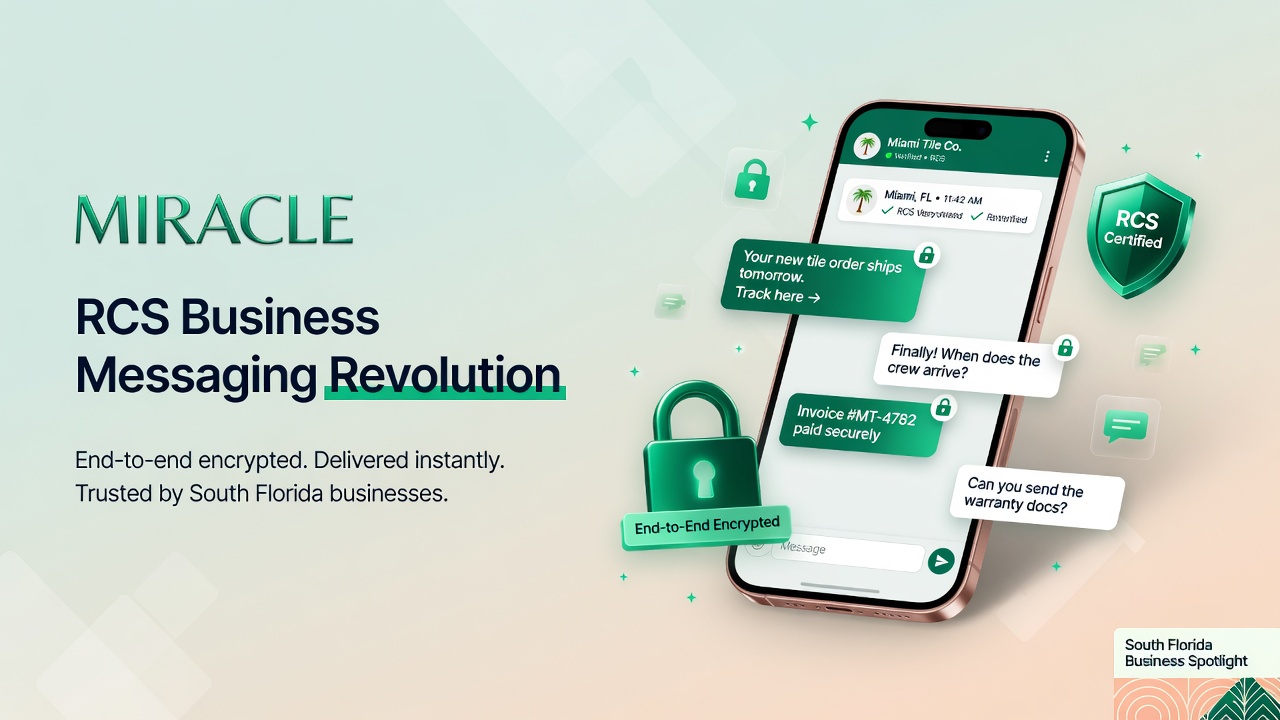
On May 11, 2026, Apple and Google flipped a switch that changes how every business in America communicates with customers.
End-to-end encrypted RCS messaging started rolling out in beta on iOS 26.5 and the latest Google Messages. That lock icon in your chat thread is not just a security feature. It is the final piece of a puzzle that makes RCS a legitimate enterprise-grade business channel.
For years, RCS was the standard that almost mattered but never quite arrived. Rich media. Read receipts. Typing indicators. Higher engagement than SMS. Native on every Android phone without an app download. The feature set was always better than SMS. But two things held it back.
First, Apple would not play ball. RCS only worked between Android devices. That limited reach to roughly half the market.
Second, there was no end-to-end encryption. Business messaging without encryption is a non-starter for any industry handling sensitive customer data. Legal. Medical. Financial services. Even a simple roofing estimate contains personal contact info.
Both of those barriers just collapsed.
What changed and why it matters for your business
The Apple-Google collaboration with GSMA brought E2EE to RCS cross-platform. iPhone users on iOS 26.5 and Android users on Google Messages now see encrypted RCS chats with a lock icon. Encryption is on by default.
This is not theoretical. Google reported over one billion RCS messages are sent daily in the US alone. Infobip, one of the largest messaging platforms globally, saw 311% RCS traffic growth in 2025. The US penetration rate went from 4-5% before Apple adopted RCS to 70% after. A 15x increase in addressable audience.
The global RCS market is projected to reach $28.2 billion by 2035, growing at 12.17% CAGR. Analysts at Juniper Research project 3.8 billion monthly active RCS users by the end of 2026.
For a South Florida business, this means one thing: the customer communication channel you have been ignoring is now the default.
The three-channel reality for South Florida businesses
At Startup Miracle, we build and test messaging systems internally before we recommend them to our clients. Over the last six months, we have run SMS, WhatsApp, and RCS side-by-side across different industries. Here is what we found.
SMS is the floor. Near-universal reach. No app required. But no rich media, no encryption, no branding, and 30% engagement on a good day. SMS is better than nothing, but it is table stakes, not a competitive advantage.
WhatsApp is the incumbent for Hispanic-market businesses. In South Florida, especially in Hialeah, Doral, and Miami, WhatsApp is not optional. It is how customers expect to communicate. WhatsApp Business has 90% open rates and 25-45% click-through rates. For businesses serving Cuban American, Venezuelan, and Colombian customers, WhatsApp is the primary channel. Period.
RCS is the new default for everyone else. Native on every Android phone. Rich cards, carousels, action buttons, verified sender branding. Encryption built in. No app download. For English-dominant customers and younger demographics, RCS has the engagement of an app without the friction of one.
The smart play is not picking one. It is having all three in a unified response stack whether you run an HVAC company, a restaurant, or a law firm.
What RCS enables that SMS never could
The difference between SMS and RCS is the difference between a business card and a storefront.
SMS sends plain text up to 160 characters. RCS delivers branded messages with high-resolution images, product carousels, suggested replies, action buttons, and real-time delivery receipts. Customers see your business name, not a random short code. They can reply with a tap instead of typing.
For a sales team following up on a lead, RCS means sending a carousel of available products, a calendar link to book an appointment, and a map to your location -- all inside the message thread. No links to click. No apps to open. No friction.
For a marketing team running a promotion, RCS means rich cards with product images, pricing, and a buy button, with engagement rates 3-5x higher than SMS.
For a car dealership sending service reminders, RCS means interactive vehicle service checklists and appointment scheduling inside the message.
For a restaurant sending reservation confirmations, RCS means showing the menu, the table layout, and a one-tap directions button.
The Hialeah angle: WhatsApp plus RCS
For South Florida businesses serving Hispanic customers, the conversation has always been about WhatsApp. And that is not changing. WhatsApp remains the dominant messaging platform across Latin America and for diaspora communities in the US.
But RCS is not a competitor to WhatsApp. It is a complement.
Here is the reality. Your Cuban American customers in Hialeah use WhatsApp with family and friends. They will respond to your business there. But your younger bilingual customers, your English-dominant customers, and the growing segment of customers who do not want to download another app -- those customers will engage through RCS.
The strategy is simple: use WhatsApp where your audience is WhatsApp-native. Use RCS where your customers are on the default Android Messages app. Use SMS as the universal fallback.
A unified operations response stack routes the right message through the right channel based on customer preference. That is what we call the Merchant Response Stack at Startup Miracle. And every South Florida business serving diverse customers needs one.
What the E2EE unlock means for regulated industries
The encryption piece is the sleeper story here.
For law firms handling client communications, medical clinics managing patient scheduling, accounting firms sharing financial documents, and any business dealing with personally identifiable information -- unencrypted SMS was a compliance exposure.
E2EE RCS changes that. Now businesses in regulated verticals can use rich business messaging without violating data protection obligations. The lock icon is not just for consumers. It is a compliance signal that your customer communications meet modern security standards.
What it costs and how to start
RCS business messaging costs roughly the same as premium SMS -- typically $0.02 to $0.08 per message depending on volume and provider. WhatsApp Business API is similar. SMS is slightly cheaper but delivers much lower engagement.
The real optimization is not per-message cost. It is revenue per contacted lead.
If a lead comes in through your website at 9 PM and gets an RCS rich message within 60 seconds instead of a plain SMS the next morning, the conversion difference is not incremental. It is 5-10x.
That is the Speed to Lead math. And RCS is now a first-class channel in that calculation.
The bottom line
May 11, 2026, was the day business messaging in America changed. The combination of cross-platform reach (Apple + Android), encryption (E2EE standards), and rich media capability (carousels, buttons, verified branding) makes RCS the most important messaging development since the smartphone.
South Florida businesses have a unique advantage here. We already understand multi-channel communication because our customer base demands it. WhatsApp, SMS, voice, now RCS. The businesses that integrate all four into a single response system will capture the leads their competitors lose.
At Startup Miracle, we run this exact stack internally. We know which channels work for which customer segments. We know the integration cost, the engagement rates, and the revenue lift.
Stop guessing which messaging channel works. Book an AI Assessment. We will audit your current response stack and deploy RCS, WhatsApp, and SMS integration in under two weeks.
FAQ
What is RCS business messaging?
RCS (Rich Communication Services) is the modern replacement for SMS. It supports rich media, branded messaging, action buttons, carousels, read receipts, and typing indicators -- all within the native Android messaging app. No app download required for Android users. With the May 2026 Apple update, RCS now works cross-platform with E2EE between iPhone and Android.
Is RCS better than WhatsApp for business?
Neither is universally better. WhatsApp has higher engagement rates (90% open rate) and is the dominant platform in Latin America and Hispanic markets. RCS has broader native reach (every Android phone) without requiring an app download. The best approach is to use both channels in a unified response stack.
How much does RCS business messaging cost?
RCS typically costs $0.02 to $0.08 per message, comparable to premium SMS and WhatsApp Business API. The cost is offset by significantly higher engagement rates -- rich cards and carousels convert 3-5x better than plain SMS.
Do I need a special app to receive RCS messages?
Android users receive RCS messages in the default Google Messages app -- no additional app needed. iPhone users on iOS 26.5 receive RCS in the standard Messages app. The experience is native on both platforms.
Does E2EE RCS work for automated business messages?
Yes. The May 2026 Apple-Google encryption update extends to RCS business messaging (RBM), making it suitable for regulated industries that need encrypted customer communications for compliance.
How does Startup Miracle implement RCS for clients?
We integrate RCS into the Merchant Response Stack alongside WhatsApp, SMS, and Voice AI. The system routes each lead through the optimal channel based on customer preference, time of day, and message type. Typical deployment takes under two weeks.