
Blog
Your Business Runs on 5 Artificial Intelligence (AI) Tools. Most Are Not Connected. Here is Why That Matters.
Your Business Runs on 5 Artificial Intelligence (AI) Tools. Most Are Not Connected. Here is Why That Matters.
You have done the work. You have adopted Artificial Intelligence (AI) across your business. Marketing, sales, finance, customer service, and operations. The 2026 Small Business & Entrepreneurship Council (SBE Council) survey confirms what many business owners already know: 82% of small business employers have invested in AI tools, and the typical business now runs on a median of 5 AI tools, with plans to add more.
That is real progress. You should take credit for it.
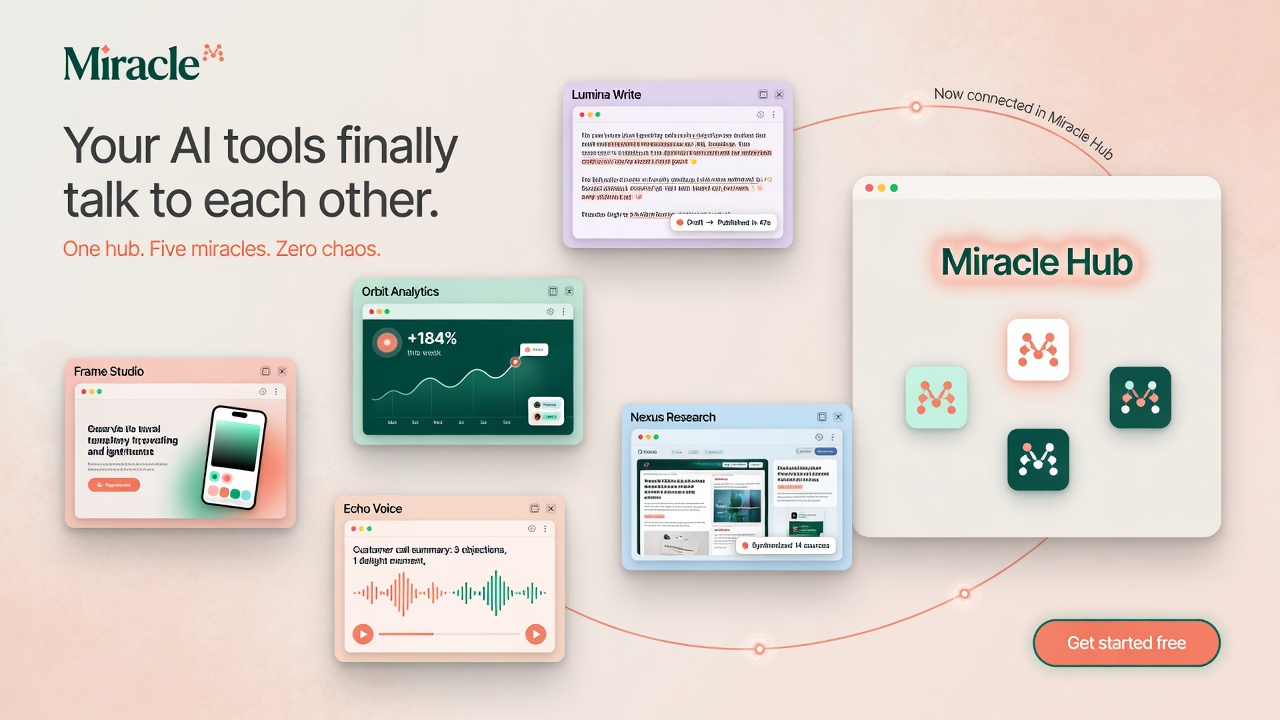
But here is the problem that almost no one is talking about: those tools are not connected. Your content AI does not talk to your Customer Relationship Management (CRM). Your finance automation does not feed your sales insights. Your marketing platform runs in its own silo.
The result is not five tools working for you. It is five islands, each holding a piece of the picture, none of them completing it.
This article is about the next step. Not adding more tools, but connecting what you already have into a single AI Operating System (AIOS) that runs your business.
What an AI Operating System Is (and What It Is Not)
An AI Operating System (AIOS) is a centralized knowledge and execution layer that sits above your individual tools. It knows your business. Your strategy, your customers, your pricing, your standard operating procedures (SOPs), your voice, and your growth targets. It coordinates your tools to act on that knowledge.
It is not a chatbot. A chatbot answers questions. An AIOS runs workflows.
It is not a dashboard. A dashboard shows data. An AIOS acts on it.
It is not another tool to manage. It is the layer that manages your tools.
Think of it this way: your current AI stack is like having five specialist employees who never speak to each other. The marketing person generates leads. The sales person qualifies them. The finance person invoices. The customer service person handles support. Each is excellent at their job, but none of them know what the others are doing. An AIOS is the operating system that makes them a team.
The market data backs this shift. According to Searchlab's 2026 AI tools report, there are now over 14,200 active AI tools, a 68% increase from the previous year. The global AI market hit $184 billion in 2026, growing 42% year over year. The problem is not tool availability. It is integration.
What the AI Operating System Learns About Your Business
An effective AIOS starts with context. Before it can coordinate anything, it needs to understand your business across key dimensions:
- Who you are. Your mission, your positioning, your brand voice, and your competitive differentiation.
- What you sell. Your products, services, pricing, packaging, and bundles.
- How you operate. Your SOPs, workflows, approval chains, and compliance requirements.
- Who your customers are. Your Ideal Customer Profile (ICP), buying patterns, common objections, and lifetime value.
- What your distribution looks like. Your channels, lead sources, ad platforms, and partner relationships.
- How your culture works. Your team structure, communication norms, and decision-making process.
- Where you are heading. Your growth targets, revenue goals, expansion plans, and seasonal patterns.
This context is not stored in a document that gets outdated. It is structured as living reference files. Markdown documents, configuration files, and skill definitions that the AI reads and updates as your business evolves.
ManaTech's 2026 guide to AIOS for SMBs describes the architecture as three layers:
- Intent. Markdown files defining your business strategy, client information, pricing, and SOPs.
- Orchestration. An AI layer (like Claude or Codex) that reads those files and sequences the work.
- Execution. Scripts and APIs that do the repetitive work: sending emails, updating your CRM, deploying marketing campaigns, and generating reports.
When you configure this context once, every automation you build from that point forward already knows your business.
The Architecture: How an AI Operating System Works
At Startup Miracle, we run our own AI Operating System internally. Here is how it works:
Claude (Anthropic) acts as the strategist. It holds the business context, designs workflows, and sequences multi-step operations. When we need to produce a blog article, Claude reads our brand voice guidelines, pulls the latest industry data, defines the structure, and hands off.
OpenAI Codex acts as the executor. It takes Claude's instructions and runs them. Generating images, publishing to our website, creating social posts, logging artifacts. Codex handles the repetitive execution that would otherwise consume a full-time team.
Aitana (our AI Operations Agent) acts as 24/7 operations. She monitors cron jobs, checks output quality, flags blockers, and keeps the pipeline running on schedule. When something breaks, she documents the issue and notifies the team.
This is not theoretical. This is our daily production setup. We publish blog articles, generate leads, run marketing campaigns, and manage client deliverables through this system. The total infrastructure cost is approximately $150 per month.
The results from industry benchmarks confirm the approach works. According to a 2026 McKinsey Global Survey on AI, businesses using integrated AI workflows report 37% average time savings. Forrester's 2026 Total Economic Impact study found 5.2x average Return on Investment (ROI) within 12 months for AIOS-based automation. ManaTech reports that multi-agent systems on a shared AIOS reduce process hand-offs by 45% and improve decision speeds by 3x.
Scale to Team: This Cannot Be a One-Person Tool
A common concern with AI Operating Systems is founder dependency. "If I am the only one who knows how to run this, it does not scale."
That concern is valid, but the answer is in the architecture: an AIOS does not replace team knowledge. It codifies it.
When you define your business context as structured reference files (SOPs, customer profiles, pricing rules, approval workflows), that knowledge is no longer locked in one person's head. It is available to every team member and every AI agent that has permission to access it.
At Startup Miracle, our AIOS is accessible to our entire team. A project manager can trigger a client deliverable without knowing how to code. A salesperson can request a custom proposal without waiting for design. The system handles the orchestration, and the team handles the judgment calls.
The economics support this model. For our clients, an AI Assessment typically identifies 5 to 10 automation opportunities immediately. The first deployment takes two weeks. From there, the system compounds. Each new automation adds to the shared context, making every subsequent build faster and more accurate.
Cost Comparison: AI Operating System vs. Traditional Hiring
Here is the math that matters to an owner.
| Approach | Monthly Cost | Coverage | Scale |
|---|---|---|---|
| AI Operating System | $150/mo | 24/7 operations across marketing, sales, operations, finance | Unlimited. System adds capacity without adding headcount. |
| One full-time marketing coordinator | $4,000-$5,000/mo | 40 hours/week, one department | One person, one function |
| One full-time operations manager | $5,000-$7,000/mo | 40 hours/week, cross-functional | One person, limited span |
| Virtual assistant (part-time) | $1,500-$2,500/mo | Administrative tasks, scheduled hours | Limited to assigned tasks |
The average small business (10-250 employees) spends approximately $460 per month on AI tools, according to Searchlab's 2026 data. An AIOS replaces many of those individual subscriptions by providing the integration layer that makes cheaper, specialized tools work together effectively.
But the real Return on Investment (ROI) is not the cost savings. It is the operating leverage. A business with an AIOS can produce 3x the output without adding headcount. When your tools are connected, a single trigger like "a lead just submitted a form" can cascade into a full response sequence. CRM update. Email response. Calendar invite. SMS confirmation. Follow-up sequence. Analytics log. All without human intervention.
Cost Predictability and Future-Proofing
A fair question: will AI costs keep rising?
In June 2026, Anthropic shifted its credit model for Claude, changing the pricing structure for heavy users. Similar adjustments have happened across the industry as providers refine their business models. This is normal for an emerging technology category, and it should not deter investment for a simple reason: the cost of not integrating is higher than the cost of any pricing change.
AI tools are getting cheaper per unit of capability, not more expensive. The $184 billion market (Searchlab, 2026) is driven by competition, not monopoly pricing. With 14,200+ tools competing for business, the price pressure is downward.
The real risk is not that your AI costs will go up. It is that your competitors will have connected their tools first. The SBE Council reports that 93% of AI-using small businesses plan to continue investing. That means 93% of your competitors are getting better at this every quarter.
An AIOS approach future-proofs your investment because it is tool-agnostic. If one AI provider changes pricing, you switch to another without rebuilding your workflows. The context layer (your business knowledge) stays intact regardless of which engine powers it.
How It Learns Your Business: The Implementation Path
This is not a six-month digital transformation. Here is how it works in practice.
Week 1: Audit. An AI Assessment maps your current tool stack. Every AI tool, every data source, every manual workflow that should be automated. We measure your actual lead response time (most businesses are shocked by the results), your current automation gaps, and your highest-ROI integration opportunities.
Week 2: Foundation. We set up your AIOS workspace. This is your business context layer. Strategy documents, customer profiles, pricing, SOPs, brand voice, and approval workflows. It takes two days to populate and a lifetime to refine.
Weeks 2 to 3: First integration. We connect your highest-priority systems. For most businesses, this is lead capture to CRM to follow-up sequence. Within a week, you have a working system that demonstrates the model.
Month 2 onward: Compound. Each new automation adds to the shared context. By month 3, the system knows your business well enough to propose optimizations you did not ask for. By month 6, it is running processes you would never have considered automating.
The businesses that start this process now will be two years ahead of their competitors by 2028. Not because they have better tools. Because their tools are connected.
Getting Started
You do not need to rip out your existing tools to start. An AIOS works with what you already have. Your CRM, your marketing platform, your finance software, your communication channels. The system integrates through APIs and connects the tools that already hold your data.
Startup Miracle's AI Assessment is the concrete starting point. It includes:
- A full audit of your current AI tool stack.
- Measurement of your actual lead response time and conversion gaps.
- Identification of integration opportunities ranked by Return on Investment (ROI).
- A structured plan to build your AI Operating System in two weeks.
The assessment takes 15 minutes and costs nothing. The output is a roadmap that tells you exactly what to connect and in what order.
Closing Conviction
I run my business on an AI Operating System. Not because I am a technologist. Because I am an operator who realized that five disconnected tools are not leverage. They are overhead.
The difference between a business that experiments with AI and a business that operates on AI is not the number of tools. It is whether those tools work as a system.
By 2028, the businesses that connected their AI tools will look back and wonder why everyone did not do this from the start. That is not a prediction. That is what my current setup looks like every day.
Your AI stack is already five tools deep. Now make them work together.
Frequently Asked Questions (FAQ)
Q: What is an AI Operating System (AIOS) and how is it different from using ChatGPT or Claude?
A: ChatGPT and Claude are language models. They are the engines that understand and generate text. An AI Operating System (AIOS) is the vehicle that connects those engines to your business context. It knows your strategy, your customers, your pricing, and your workflows. It orchestrates your tools to act on that knowledge. Think of the AI model as the brain and the AIOS as the nervous system that connects it to every part of your business.
Q: How much does an AI Operating System cost for a small business?
A: The infrastructure cost for a basic AIOS setup is approximately $150 per month. This covers the AI model subscriptions and API access for your connected tools. The average small business already spends $460 per month on individual AI tools (Searchlab, 2026), so the AIOS often reduces total spend by eliminating redundant subscriptions while increasing the value of the remaining tools.
Q: Do I need to replace my existing tools to use an AI Operating System?
A: No. An AIOS integrates with what you already have. Your Customer Relationship Management (CRM), marketing platform, finance software, and communication channels. It works through Application Programming Interface (API) connections to coordinate your existing tools rather than replacing them. The goal is connection, not migration.
Q: How long does it take to set up an AI Operating System?
A: A structured implementation takes two to three weeks for the first integration. The first week is an audit of your current tool stack and workflows. The second week sets up your business context layer and connects your highest-priority systems. From there, each new automation compounds on the existing setup.
Q: What happens if my AI provider changes pricing?
A: An AI Operating System is tool-agnostic. Your business context layer (strategy documents, customer profiles, pricing rules, workflows) stays intact regardless of which AI model powers it. If one provider changes pricing, you switch to another without rebuilding your automations. This is a key advantage over building your workflows inside any single AI tool.
Q: Can my team use the AI Operating System without knowing how to code?
A: Yes. An AIOS is designed to codify business knowledge so it is accessible to everyone. A project manager can trigger a client deliverable. A salesperson can request a custom proposal. A customer service representative can check order status. All without writing code. The technical orchestration happens in the background.
Want to see what your business would look like with a connected AI stack? Book a 15-minute AI Assessment. We will audit your current tools, identify integration opportunities, and show you the roadmap to an AI Operating System that runs your business.