
Blog
The Speed-to-Lead Data Got Worse: What Every South Florida Business Needs to Know Now
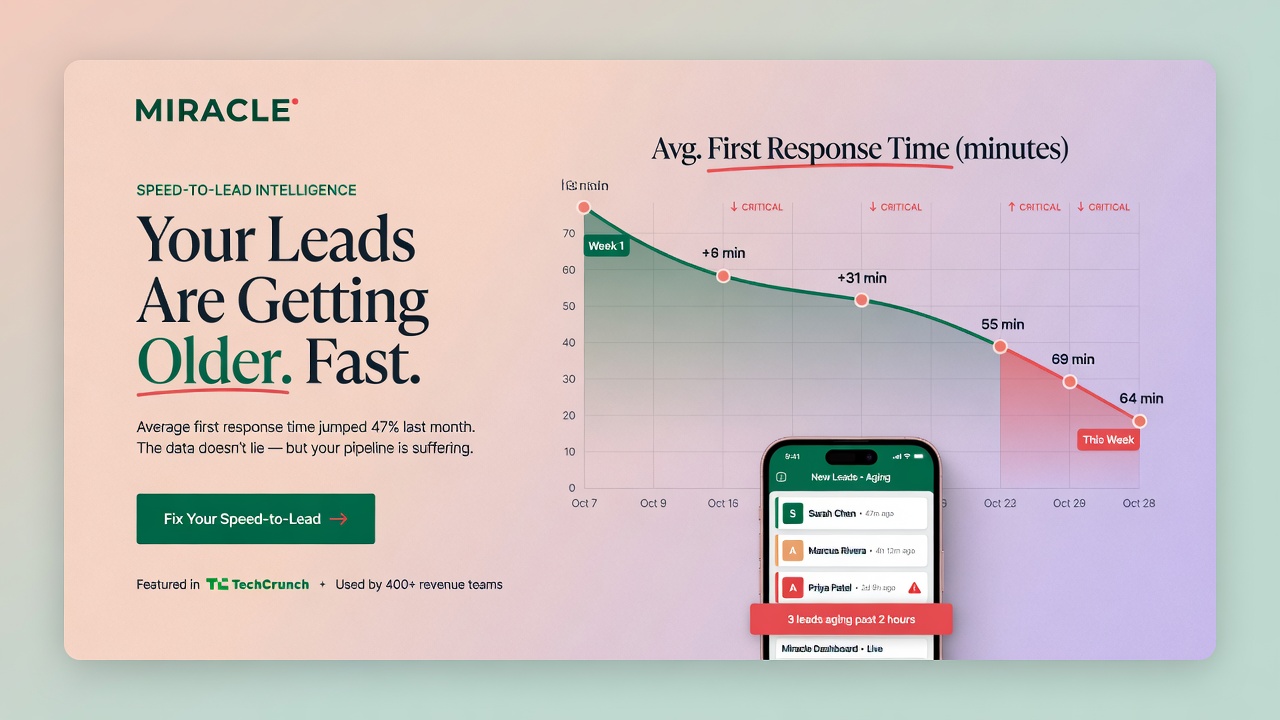
The data keeps getting worse — but most businesses still haven't fixed the leak.
I track speed-to-lead research the way some people track sports scores. Not because I like numbers. Because every data point is a dollar figure that tells me exactly where a business is leaving money on the table.
Here's what the 2026 studies show:
The average business takes 47 hours to respond to a new lead.
That's not a typo. Almost two full days.
Meanwhile, the buyer has already moved on.
What the Research Actually Says
Let's cut through the cherry-picked stats and look at what multiple independent studies have found — consistently, across industries, across years.
The 5-minute window: Leads contacted within 5 minutes are 21 times more likely to be qualified than leads contacted at 30 minutes. The odds of even making contact drop by 100 times after that half-hour mark. (Harvard Business Review / MIT Sloan, replicated across 2,241 companies and 100,000+ leads)
The first-responder wins: 78% of customers buy from the company that responds first. Not the best product. Not the lowest price. The first one to pick up the phone, reply to the email, or send the text. (Lead Connect, 2024)
The 60-second edge: Responding within 1 minute increases conversions by 391% compared to waiting 2 minutes. One minute. The difference between a closed deal and a dead lead is literally sixty seconds. (Velocify)
The industry average is terrible: 55% of companies take five or more days to respond. 63% never respond at all. (Multiple studies, consistent across 2024-2026)
What That Means for South Florida
South Florida runs on speed. Hurricane season doesn't wait. Restaurant rushes don't wait. If a roofing lead calls during a storm and gets voicemail, the next contractor in line gets that job.
Here's what happens locally every single day:
- A Fort Lauderdale law firm gets a call at 6:05 PM. Voicemail. The potential client calls the next firm on Google. That case — worth $5,000 to $50,000 — goes to the firm that answered.
- A Miami car dealership gets an internet lead at 9 PM. No one follows up until 11 AM the next day. By then, the buyer has already put a deposit down at the dealer that sent a text within 10 minutes.
- A Pembroke Pines roofer gets an estimate request through the website. The estimator is on a job site. The request sits for 6 hours. The homeowner booked someone else by hour 3.
These aren't hypotheticals. This is the 78% rule playing out in real time.
What Most Businesses Do Wrong
Two things:
First, they treat lead response as a people problem. "We need to hire another sales rep." "The owner should answer the phone." "We'll train the receptionist to follow up faster."
That's the wrong frame. You cannot hire your way to sub-5-minute response times across nights, weekends, and holidays without going bankrupt.
Second, they think more leads will fix the problem. They spend more on Google Ads, SEO, or referrals — but the leads they already get are leaking out the back door. The conversion rate on a slow-responded lead is already near zero.
Fix the follow-up first. Then buy more demand.
The Math on What Slow Response Costs
Let me give you a conservative number.
If your business gets 50 qualified leads per month — calls, web forms, chats, texts — and your average deal is worth $500:
- At 47-hour response time: you close roughly 5-10% of those leads. That's $1,250 to $2,500/month.
- At sub-5-minute response: you close 20-35%. That's $5,000 to $8,750/month.
The difference: $3,750 to $6,250 per month. For fifty leads.
Scale that up. One hundred leads per month? Two hundred? The number gets ugly fast.
The Fix Doesn't Require a New Hire
This is the part that trips people up. They assume fast response means someone sitting by the phone 24/7.
It doesn't.
An AI system that picks up every call, texts every web lead within 60 seconds, follows up on every missed call, and routes warm conversations to your team — that costs less than one part-time employee. No shifts. No weekends. No "sorry I missed your call."
I run this inside Startup Miracle. So do several of our clients in South Florida. The setup is:
- Voice AI that answers every call, qualifies the lead, and books a time for your sales team to call back.
- SMS/WhatsApp/RCS follow-up that hits every inbound lead within 60 seconds with a personalized message.
- CRM routing that logs every interaction and surfaces only the conversations that need a human.
The result: response time drops from 47 hours to under 60 seconds. The system runs 24/7. Your team only talks to people who are ready to buy.
Implementation Path
Start with one channel. Pick the one where most of your leads come in:
- Phone calls: Set up an AI voice agent to answer after-hours and when your team is busy. Should take one afternoon.
- Web leads: Connect your contact form to automated SMS/email follow-up. Should take a few hours.
- Chat and text: Add AI-powered response that engages immediately and schedules the next step.
Each channel you automate adds 15-25% to your lead conversion rate.
The measurement is simple: track your average response time today, then track it after each change. If it's under 5 minutes, you're winning.
Here's what I'd do right now: Run a 15-minute lead response audit. Send a test lead through every channel your business uses — phone, web form, text, chat — and measure how long it takes to get a response. If any channel takes longer than 5 minutes, that one's leaking revenue.
Then book a call and I'll show you how to close that leak in one afternoon using the same AI systems we run internally.
FAQ
What is speed-to-lead?
Speed-to-lead measures how quickly a business responds to an inbound lead. Research consistently shows that responding within 5 minutes produces dramatically better outcomes than responding after 30 minutes or longer.
Is the 5-minute rule still relevant in 2026?
More relevant than ever. Buyer expectations have accelerated — 64% of consumers now expect real-time responses when they reach out to a business (Salesforce, 2026). The 5-minute window is the ceiling; the goal is sub-60-second response.
Does fast follow-up work for every industry?
Yes, and the data is consistent across B2C and B2B. Home services, automotive, legal, medical, hospitality, construction — every study shows the same pattern: speed wins. The magnitude varies, but the direction never flips.
Can a small business afford AI-powered lead response?
Yes. Systems that handle calls, texts, and follow-up cost $150-300/month — less than one day of a part-time employee's wages. The ROI comes from recovering leads you're already losing.
What's the first step to fixing slow response?
Measure your current response time. Get a stopwatch, submit a test lead through every channel your business uses, and time how long the response takes. If it's over 5 minutes on any channel, that channel is leaking revenue.