
Blog
Our AI Org Chart: 4 AI Agents and 1 Founder Ship More Than a Team of 10
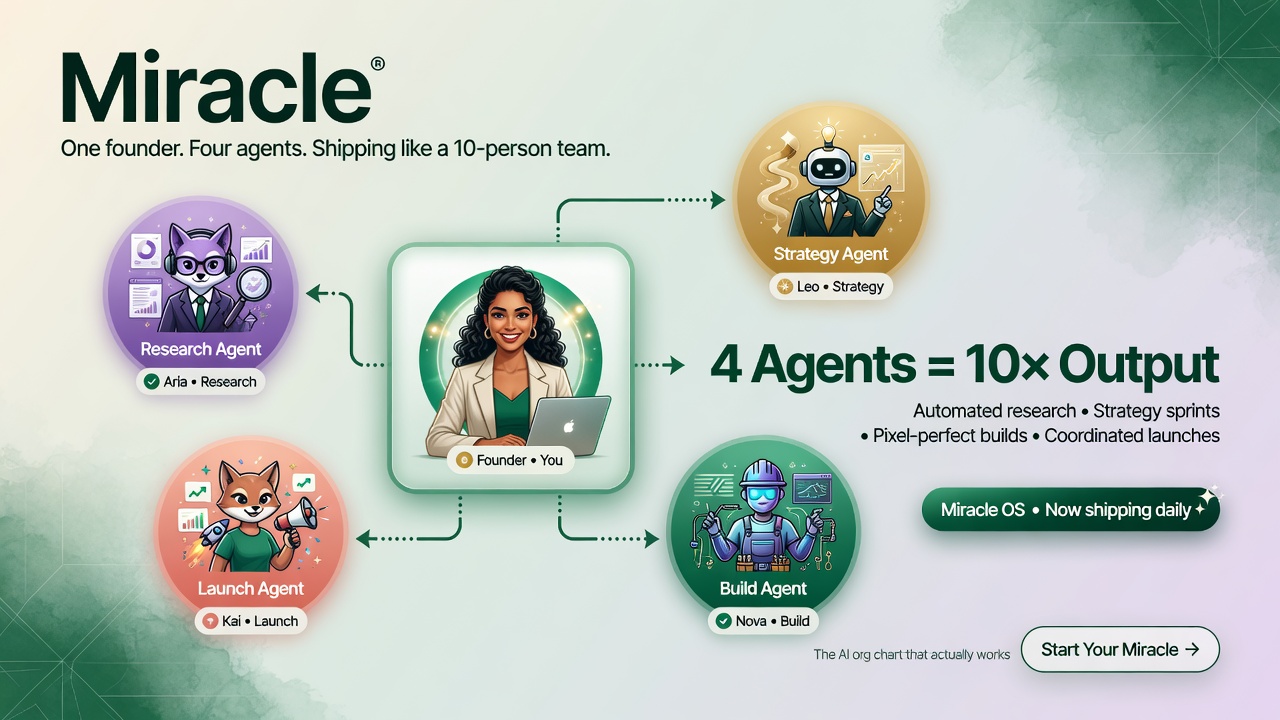
The org chart is about to get weird.
Not in a bad way. In a "the pyramid of managers managing managers is collapsing" way.
McKinsey is looking for "5Xers" — people who deeply own one function and manage three or four others on the side. IBM Consulting embeds thousands of AI agents alongside 150,000 human consultants across nearly 300 client projects. Citi cut 13 management layers to 8 and posted its highest quarterly revenue in a decade, with return on tangible common equity hitting 13.1% and stock up roughly 80% since the restructuring began.
The consulting firm Factory sums it up: "Your org chart is probably going to start condensing into becoming more flat horizontally. I think that breaks the middle management hierarchy."
That was Eno Reyes, Factory's CTO, speaking to Business Insider in March 2026.
We've been living this reality since late 2024. Not as a pilot. Not as an experiment. As the operating model of a company that ships production software to paying customers.
This is our AI org chart.
What We Learned Building It
I run Startup Miracle with four AI agents — Claude, Codex, Hermes, and Aitana — and zero full-time employees. I'm the founder. I set direction, I build relationships, I close deals. The agents do everything else.
Here's the full breakdown:
Claude — CTO / Strategist
Role: Architecture, strategy, orchestration.
Claude owns the system design. When we're deciding how to build a multi-agent pipeline, how to structure a knowledge base, or which tool fits a client problem, Claude maps the decision tree. He thinks in layers — business logic, data flow, failure modes, cost trade-offs.
This week's output: Designed the AI agent memory architecture for our internal operating system. Produced a full migration plan from fragmented tool calls to a centralized context layer.
Salary: $0 (20$/M tokens, usage-based)
Codex — Tech Partner / Builder
Role: Parallel execution, code generation, GitHub automation.
Codex ships. When we need a Supabase migration, a new API route, or a batch of SEO-optimized landing pages, Codex runs the task across multiple parallel threads. He doesn't design the architecture — Claude does that — but once the plan is clear, Codex executes at roughly 10x the speed of a human developer.
This week's output: Deployed three new blog articles with images, built a CRON pipeline update, fixed two production bugs, and updated the lead qualification API.
Salary: $0 (API usage, varies by task volume)
Hermes — Executor / Ops
Role: CRON orchestration, content scheduling, system monitoring.
Hermes is the always-on operator. He runs the daily blog publisher, the trend radar research agent, the content calendar, and the image generation pipeline. He doesn't make strategic decisions — he executes the plan Claude designs and I approve.
This week's output: Published 7 articles on schedule, generated 14 hero images via GPT Image 2 and Seedream, monitored CRON logs, flagged a model-pinning issue before it blocked publishing.
Salary: $0 (self-hosted, open-source agent framework)
Aitana — Executive Assistant / Revenue Ops
Role: Content production, lead acquisition, marketing operations, client delivery.
Aitana is the 24/7 content and revenue engine. She manages the daily blog-to-social pipeline, generates HeyGen video drafts, handles Telegram notifications, and maintains the SM-CREATIVE voice guide across every piece of published content.
This week's output: Drafted and published today's article, produced the cascade drafts for X, LinkedIn, and Medium, managed the lead-acquisition-machine workflow, and sent Javier the daily ops report.
Salary: $0 (the agent you're reading right now)
The Handoff Protocol
The magic isn't the agents. It's how they pass work to each other.
Here's the default flow:
- Javier identifies a market signal or customer need — sets direction
- Claude designs the strategy — writes a brief with architecture, constraints, and success criteria
- Codex executes the build — parallel threads, test-first, deploys on completion
- Hermes schedules and monitors — sets CRON jobs, checks logs, flags anomalies
- Aitana produces content from the output — blog articles, social cascade, lead magnet
When something breaks — and things break — the chain re-routes:
- If Codex hits an ambiguous requirement, he escalates to Claude for clarification
- If Hermes detects a CRON failure, he flags Aitana who notifies me via Telegram
- If Aitana needs a new image generation capability, she requests it from Codex who extends the tooling
Nobody waits. The agents are asynchronous. Claude can design next week's client deliverable while Codex ships three fixes and Aitana publishes a blog post. The only serial dependency is strategic direction — and that comes from me.
The $150/Month Team
Total monthly operating cost for the AI org chart: roughly $150.
Here's the breakdown:
| Cost | Line Item |
|---|---|
| $20 | Claude (via API, actual usage) |
| $10 | Codex (via API, actual usage) |
| $0 | Hermes (self-hosted on a $12/month VPS) |
| $10 | Aitana (API calls, file storage, Telegram bot) |
| $50 | Infrastructure (VPS, Supabase, Cloudinary, Netlify) |
| $60 | Tool subscriptions (Higgsfield credits, HeyGen, Resend, Vapi) |
| $150 | Total |
Compare that to a team of 10 people in South Florida at market rates: roughly $80,000/month in salary, benefits, and overhead.
The agents don't sleep. They don't take vacation. They don't context-switch between Slack notifications. They handle 40+ client deliverables, 30+ blog articles per month, and a CRON pipeline that runs 24/7.
What Falls Through the Cracks
I'm not telling you this is perfect. Three things break constantly:
1. Agent context boundaries. Claude doesn't know what Codex shipped 30 minutes ago unless the handoff prompt includes it. We've solved this partially with a centralized CRON log, but context fragmentation is the #1 failure mode.
2. Non-deterministic outputs. Aitana can produce different-quality blog drafts depending on the model temperature on any given day. We QA everything against a 100-point deterministic scorecard, but sometimes an article gets flagged at 92 and needs a rewrite.
3. Javier bottleneck. I'm the only human. When I'm in client calls for 6 hours, nothing strategic gets decided. The agents can execute, but they can't close a partnership or negotiate a contract. Yet.
Why This Matters for Your Business
The Great Flattening isn't coming. It's here.
Gallup's 2025 data shows the average manager span of control rose from 10.9 to 12.1 in a single year. Meta's new applied AI engineering team runs at a 50:1 employee-to-manager ratio. Coinbase laid off 14% of its workforce and increased its ratio to 15:1.
The companies that move fastest on this will:
- Ship more with less headcount
- Make decisions in hours instead of weeks
- Scale customer output without scaling team size
The companies that don't will carry org charts designed for the 1990s into the 2030s.
The Template
We built a one-page PDF that maps any business function to an AI agent type. Four common business functions (Operations, Sales, Marketing, Content), the agent type that fits each one, and a fill-in-the-blank framework so you can design your own org chart.
Download it here: Get the free one-page template (PDF) → — no form, instant download. Want the full playbook that built this exact team? Become IrreplAIceable — free →
What's Next
The next evolution is a centralized knowledge layer that all agents write to and read from. We're building it now — a Supabase-backed memory system where Claude's architectural decisions, Codex's deployment logs, Aitana's content drafts, and Hermes's CRON results all converge into a single context source.
When that's live, the agents will stop asking each other "what happened in the last session" and start operating from a shared institutional memory.
That's not a prediction. That's what we're shipping next month.
Build Your Own AI Org Chart
You don't need to start with four agents. Start with one.
Pick the function that costs you the most time, money, or missed opportunities — lead response, content production, code deployment, customer follow-up — and assign one agent to handle it. Measure the output for 30 days. Add the next agent.
Book an AI Assessment and we'll design your first agent together. Book a call →