
Blog
New State AI Laws Are Already Here — What Florida Business Owners Need to Know About Texas’s TRAIGA, the Colorado AI Act, and More
If your business uses Artificial Intelligence (AI) tools — a chatbot on your website, an AI phone agent answering calls, an automated hiring screener, or a Customer Relationship Management (CRM) system with AI features — there is a good chance you are already subject to a state AI law you have never heard of.
And the enforcement clock is ticking.
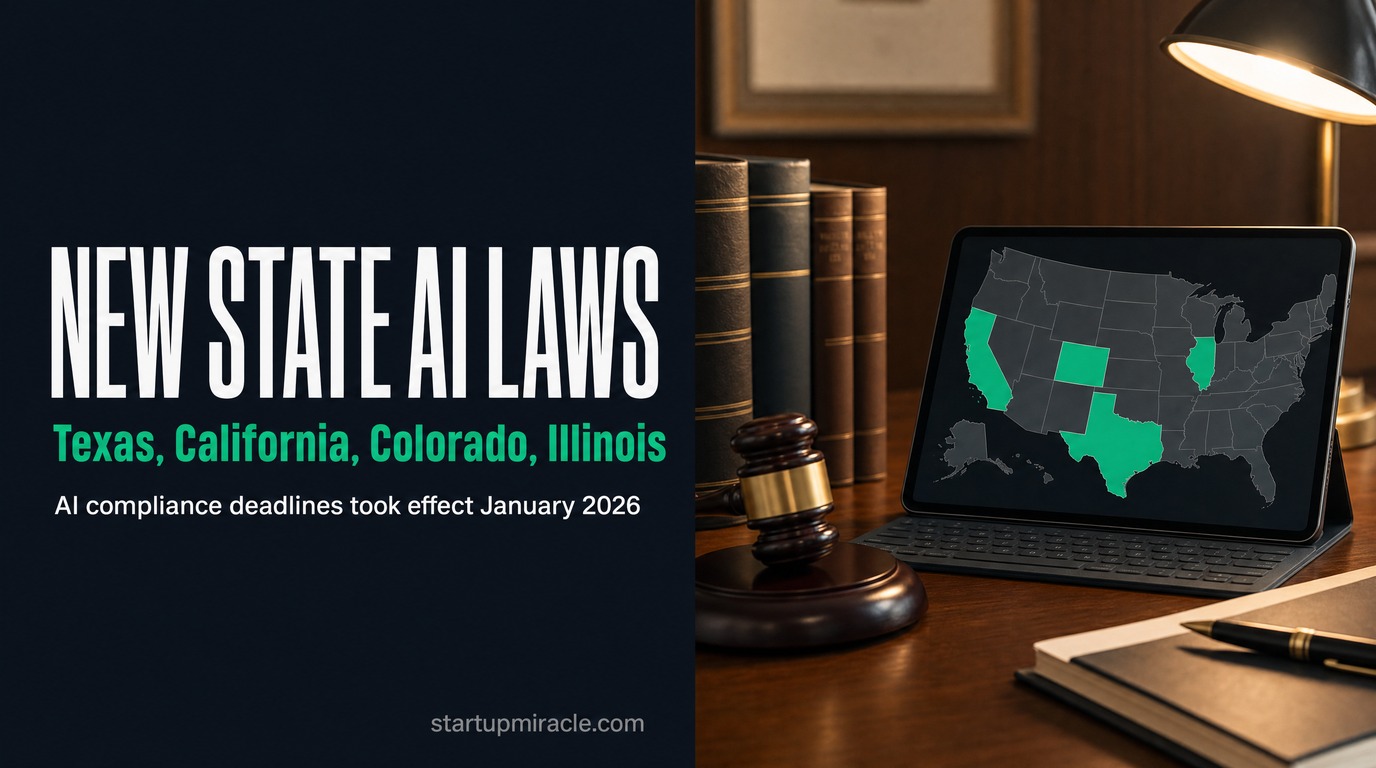
On January 1, 2026, multiple state AI laws quietly took effect across the country. Texas passed the Responsible Artificial Intelligence Governance Act (TRAIGA, sometimes called TRAIGA 2.0). California enacted three separate AI transparency laws. Illinois amended its Human Rights Act to cover AI in hiring. And Colorado — which had been set to begin enforcing its AI Act (SB 24-205) on June 30, 2026 — repealed and replaced that law in May 2026, before it ever took effect.
Most small and medium business owners have no idea any of this happened.
That is the gap I want to close in this article. Not with fear-mongering, but with facts, deadlines, and a clear action plan.
What Changed on January 1, 2026
The regulatory landscape for AI shifted dramatically at the start of 2026. Here is a summary of every major law that went into effect — and why it matters to your business.
Texas: TRAIGA 2.0 (HB 149)
Texas’s Responsible Artificial Intelligence Governance Act, signed by Governor Abbott in June 2025, took effect January 1, 2026. It applies to any person or entity that does business in Texas, sells to Texans, or deploys AI in the state. The definition of an “AI system” is intentionally broad — it covers any machine-based system that generates outputs, decisions, predictions, or recommendations that can influence physical or virtual environments.
Key provisions:
- Discrimination is unlawful if intentional. TRAIGA 2.0 makes it illegal to develop or deploy AI with the intent to discriminate against a protected class (race, color, national origin, sex, age, religion, disability). Unlike some federal laws, unequal outcomes alone — known as disparate impact — do not establish a violation under TRAIGA 2.0. But federal laws like Title VII still apply.
- Enforcement is handled by the Texas Attorney General. There are no private lawsuits or class actions. The Attorney General must provide written notice of violations, and businesses have a 60-day cure period to fix the issue.
- Penalties range from $10,000 to $200,000 per violation. Curable violations: $10,000–$12,000. Uncurable violations: $80,000–$200,000. Ongoing violations: $2,000–$40,000 per day.
- A complaint portal goes live September 1, 2026. This is the date to watch. Once the portal is operational, expect enforcement activity to increase significantly.
According to the Duane Morris LLP client alert on TRAIGA 2.0, businesses should begin by cataloging every AI tool touching their operations and stress-testing vendor relationships — the Attorney General can demand documentation on system purpose, training data, inputs, outputs, and performance metrics.
California: Three Laws, One Deadline
California enacted three AI laws — two effective January 1, 2026, and one (SB 942) effective August 2, 2026:
- SB 53 — Transparency in Frontier AI Act. Applies to developers training large-scale models (10²⁶ FLOP computing power) or companies with $500M+ gross revenue. Obligations include annual public safety disclosures and incident reporting. Penalties: up to $1 million per violation, enforced by the California Attorney General.
- AB 2013 — Training Data Transparency. Requires developers of public generative AI systems to provide a summary of training datasets to Californians, including sources, owners, data categories, and whether data includes protected intellectual property or personal information.
- SB 942 — California AI Transparency Act. Effective August 2, 2026 (delayed from January 1, 2026 to align with the EU AI Act). Applies to entities producing AI-generated content with more than 1 million monthly visitors in California. Requires clear disclosure that content was AI-generated, and a free AI detection tool for users. Penalties: $5,000 per violation, per day.
The Stubbs Alderton & Markiles client alert summarizes the California laws as affecting “companies that develop AI, integrate AI into products/services, use AI in hiring or Human Resources (HR), or distribute AI-generated content.”
Colorado: SB 24-205 Repealed and Replaced by SB 26-189
Colorado was the first state to pass a comprehensive, EU-style AI Act (SB 24-205) — but it never took effect. After an earlier delay pushed the start date to June 30, 2026, Governor Jared Polis signed SB 26-189 on May 14, 2026, repealing SB 24-205 and replacing it with a narrower disclosure-and-rights framework focused on automated decision-making technology (ADMT). The new law takes effect January 1, 2027.
What the rewrite means for SMBs:
- The original law’s affirmative “duty of reasonable care” to avoid algorithmic discrimination is gone — though Colorado’s existing anti-discrimination statutes still apply.
- The mandatory annual impact assessments and risk-management programs of the old law are removed.
- The new framework eliminates the old exemption for businesses with fewer than 50 employees, so some smaller companies that were previously out of scope may now be covered.
- Core obligations shift to transparency: disclosing when ADMT is used, notifying affected consumers, and honoring consumer rights.
Enforcement remains with the Colorado Attorney General as a deceptive trade practice, with implementing rules due by January 1, 2027. The takeaway for businesses: Colorado rewrote its AI law in a matter of weeks — proof that this landscape is volatile, and that a governance framework built to flex matters more than chasing any single statute.
Illinois: HB 3773 — Amendment to the Human Rights Act
Illinois effective January 1, 2026, under HB 3773, employers using AI for recruitment, hiring, promotion, or employment-related decisions must notify employees and job applicants that AI is used. The law prohibits AI use that results in discrimination against a protected class. Enforcement is handled by the Illinois Department of Human Rights, and individuals can file claims or pursue a private right of action in Illinois circuit court.
The Federal Layer Everyone Forgets: TCPA and Your AI Voice Agent
State AI laws are new. But the single biggest legal risk for a business running an AI phone agent is a federal law from 1991 — the Telephone Consumer Protection Act (TCPA) — combined with a 2024 ruling that pulled AI squarely inside it.
AI-generated voices are now legally treated as robocalls. On February 8, 2024, the Federal Communications Commission (FCC) ruled that calls using AI-generated or cloned voices count as an "artificial or prerecorded voice" under the TCPA. In plain terms: the moment your AI voice agent dials a consumer, the same rules that govern a pre-recorded robocall apply to you.
You need consent before the call — and for sales, it must be in writing. The TCPA requires:
- Prior express consent to place AI-voice or pre-recorded calls to a consumer for informational purposes (appointment reminders, account notices, and similar).
- Prior express written consent for any AI-voice call that markets or sells (telemarketing). "Written" can be a digital opt-in — a checked box, a web form, a text keyword — but it must be clear, specific, and tied to your business by name.
The autodialer myth that gets businesses sued. Many founders assume that because their dialer is not a classic "autodialer" — an Automatic Telephone Dialing System (ATDS), narrowed by the U.S. Supreme Court in Facebook v. Duguid (2021) to systems using a random or sequential number generator — they are in the clear. They are not. The artificial/pre-recorded-voice rules, which now include AI voices, apply regardless of how the number was dialed. An AI agent calling a hand-picked list of cell phones still needs consent. The autodialer question is a separate, narrower trap; the voice question is the one that catches AI callers.
The other rules that still bind your AI agent:
- Identification: the call must state who is calling (your business name) and a callback number.
- Calling hours: no telemarketing before 8 a.m. or after 9 p.m. in the recipient's time zone.
- Do-Not-Call: scrub against the National Do-Not-Call Registry and maintain your own internal do-not-call list.
- Easy opt-out: pre-recorded telemarketing must offer an automated opt-out, and as of April 11, 2025, consumers may revoke consent through any reasonable method — and you must honor it within 10 business days.
What it costs when you bend the rules
The TCPA is one of the most expensive consumer statutes in the country precisely because the math is simple and stacks fast:
- $500 per call or text for each violation — and the consumer does not have to prove any actual harm.
- Up to $1,500 per call for willful or knowing violations (a court can triple the damages).
- No cap. Because liability is per-call, a single non-compliant AI campaign to a few thousand numbers becomes a six- or seven-figure class action. The TCPA carries a private right of action, and plaintiffs' firms actively watch for violations.
Trying to bend the rules makes the exposure worse, not better:
- Buying or scraping "consented" lead lists rarely transfers valid consent. Consent must be given to your business — "we bought a list that said they opted in" is not a defense most courts accept.
- Spoofing or faking caller ID to lift pickup rates violates the separate Truth in Caller ID Act, a penalty on top of the TCPA.
- Assuming or manufacturing consent turns ordinary $500 violations into $1,500 willful ones.
The government has already shown it will enforce this against AI voices specifically. After a deepfake AI robocall mimicked President Biden's voice ahead of the 2024 New Hampshire primary, the FCC issued a $6 million fine against the operative who ran the campaign and reached a $1 million settlement with the telecom carrier that transmitted the calls. The technology is new; the willingness to fine it is not.
Florida note: Florida has its own "mini-TCPA," the Florida Telephone Solicitation Act (FTSA), which still requires prior express written consent before sending pre-recorded or artificial-voice messages. A Florida business deploying an AI voice agent faces both the federal TCPA and the state FTSA.
Why Florida Business Owners Should Pay Attention
If your business operates only in Florida, you might be asking: why does Texas or California law matter to me?
Three reasons.
First, if you have customers, employees, or vendors in any of these states, their laws apply to you. A South Florida roofing company that serves snowbirds in Colorado during summer months could be subject to Colorado’s AI rules. A law firm in Fort Lauderdale using an AI hiring tool with candidates from Illinois could trigger HB 3773.
Second, Florida is not standing still. The state has already passed deepfake-related legislation, and a Florida AI law tracker shows pending AI transparency rules. The pattern across all 50 states is clear: once a few states pass AI laws, others follow. Florida will almost certainly introduce its own comprehensive AI regulation in the next legislative session.
Third, preparation is cheap. Violations are not. The cost of an AI compliance audit today is a fraction of what a $200,000 per violation Texas penalty would cost. The same audit that identifies Texas exposure also catches Colorado, California, and Illinois issues. One assessment covers all states.
The Cost of Doing Nothing
The financial risk is real. California’s SB 942 carries $5,000-per-violation, per-day penalties (effective August 2, 2026). Texas caps uncurable violations at $200,000 each. Colorado treats violations as deceptive trade practices, which can carry significant consumer protection penalties.
Beyond fines, there is reputational risk. A compliance failure in one state becomes public record through Attorney General enforcement — and that shows up in Google searches, client due diligence, and partner reviews. For professional services firms — law firms, accounting firms, insurance agencies — a compliance failure erodes the trust that is the core of the business.
There is also a competitive opportunity. According to Law.com’s Legal Tech News, compliance teams are actively hiring for AI governance skills. Businesses that document their AI governance framework now will have a competitive advantage when clients and partners start asking for proof of compliance. The businesses that wait will get the questions first and the answers later.
What Every SMB Should Do Right Now
Here is a four-step action plan. Each step takes less than a day and costs nothing except time.
Step 1: Inventory every AI tool in your business. Go through every department — sales, marketing, operations, finance, HR — and list every tool that uses AI. Chatbots. Voice agents. CRM auto-enrichment. Hiring screeners. Automated email sequences. Content generation tools. If you are not sure whether a tool uses AI, ask your vendor. Write down the tool name, vendor, what it does, and whether it touches residents of Texas, California, Colorado, or Illinois.
Step 2: Check vendor compliance readiness. Under Texas law, the Attorney General can demand documentation on system purpose, training data, inputs, outputs, and performance metrics. Your vendors need to be able to produce this documentation on short notice. If they cannot, that is a compliance gap. Send each vendor an email today asking for their AI compliance documentation.
Step 3: Document your operations governance framework. Write a one-page policy that covers: who owns AI tool decisions in your company, how new AI tools are approved, how you monitor AI system performance, and what happens if an issue is identified. This does not need to be a legal document. It needs to exist.
Step 4: Train your team. The people acting on AI outputs — a salesperson using a lead-scoring recommendation, a hiring manager reviewing an AI-screened candidate, an operator dispatching based on an AI schedule — need to understand legal and practical guardrails. A 30-minute training session covering what the AI does, what to watch for, and how to escalate issues is enough to start.
How Startup Miracle Helps
This may sound like a lot of work. It does not have to be.
Startup Miracle was selected for the ElevenLabs accelerator program to build agents, Voice AI, and GenAI initiatives. We use Claude Code, OpenAI Codex, and Hermes Agents internally — and we have built our own governance framework for deploying AI in compliance-ready ways.
When we conduct an AI Assessment for a client, we do not just look at what AI tools could improve. We audit the current stack for regulatory exposure. We document vendor compliance readiness. We build a governance framework that fits the size and complexity of the business. And we deploy AI systems that are compliant by design — not retrofitted after a problem surfaces.
For professional services firms especially — law firms, accounting firms, insurance agencies, tax firms — we start with compliance and build from there. That is the difference between an agency that deploys AI tools and an operating partner that helps you use AI confidently.
The Bottom Line
The state-level AI regulation wave is not coming. It is here. Texas, California, Colorado, and Illinois have already passed laws that affect how businesses use AI. More states will follow. Florida almost certainly will.
The businesses that act now — inventory their tools, check vendor readiness, document their governance, train their teams — will be compliant when enforcement ramps up. The businesses that wait will scramble, pay penalties, and lose client trust.
The good news: the fix is straightforward. An assessment, a governance document, and a vendor check. Most businesses can complete all three in under a week.
Not sure where your business stands on AI compliance? Book an AI Assessment. We will audit your current AI stack for regulatory risk and build a compliant operating system that keeps you protected as the laws evolve.
Frequently Asked Questions (FAQ)
Do Florida businesses need to comply with Texas’s TRAIGA AI law?
Yes, if you do business in Texas, sell to Texas residents, or deploy AI systems that affect Texans. This includes having Texas customers, Texas employees, or AI tools used to serve Texas-based clients. The law applies based on where the affected person is located, not where your business is headquartered.
What is the difference between TRAIGA 2.0 and the earlier version of the bill?
TRAIGA 2.0 (HB 149) is the enacted, narrower version that replaced a broader earlier draft (informally called “TRAIGA 1.0,” which was never enacted). The enacted version is narrower and more innovation-friendly. Key differences: it requires intent to discriminate (not just disparate impact), provides a 60-day cure period, and gives the Texas Attorney General exclusive enforcement authority with no private lawsuits.
When does Colorado’s AI Act take effect?
Colorado’s original AI Act (SB 24-205) was repealed before it ever took effect. On May 14, 2026, Governor Polis signed SB 26-189, which replaces it with a narrower automated-decision-making (ADMT) disclosure framework effective January 1, 2027. The June 30, 2026 date cited in earlier coverage no longer applies.
What are the penalties for violating the Texas AI law?
Curable violations: $10,000–$12,000 per violation. Uncurable violations: $80,000–$200,000 per violation. Ongoing violations: $2,000–$40,000 per day. The Texas Attorney General can also seek court orders to stop violations and recover attorney’s fees and costs.
Does Florida have its own AI law?
Florida has passed deepfake-related legislation and has pending AI transparency rules, but does not yet have a comprehensive AI governance law similar to Texas or Colorado. However, based on the national trend, Florida is expected to introduce broader AI regulation in the next legislative session.
Do I need consent before my AI voice agent calls a customer?
Yes. Since the FCC's February 2024 ruling, AI-generated voices are treated as an "artificial or prerecorded voice" under the TCPA. You need prior express consent for any AI-voice call, and prior express written consent if the call markets or sells. This applies even if your system is not a classic autodialer — and even if you dial the numbers by hand.
What happens if my AI calling campaign violates the TCPA?
Statutory damages are $500 per call (no proof of harm required) and up to $1,500 per call for willful violations, with no overall cap — which is why TCPA class actions routinely reach six or seven figures. The FCC has already fined AI-voice robocall operators millions of dollars, and Florida layers its own mini-TCPA (the FTSA) on top. Spoofing caller ID or relying on purchased "consent" lists increases the exposure rather than reducing it.
What qualifies as an AI system under these laws?
The definitions are intentionally broad. Texas defines an AI system as any machine-based system generating outputs — including content, decisions, predictions, or recommendations — that can influence physical or virtual environments. Colorado focuses on “high-risk” systems that make consequential decisions. If your tool uses machine learning, natural language processing, or automated decision-making, assume it qualifies.
Last reviewed June 11, 2026 — updated to reflect Colorado’s repeal of SB 24-205 (replaced by SB 26-189, effective January 1, 2027) and the delayed August 2, 2026 effective date of California’s SB 942. It also adds the federal TCPA rules governing AI-generated voice and autodialers.
Disclaimer: This article provides general information and does not constitute legal advice. Laws and regulations vary by jurisdiction and may change. Consult a qualified attorney for specific legal guidance regarding AI compliance.