
Blog
The Real Cost of "Cheap" Voice AI: Why $0.05/Minute Becomes $0.30 (BYOK Breakdown, 2026)
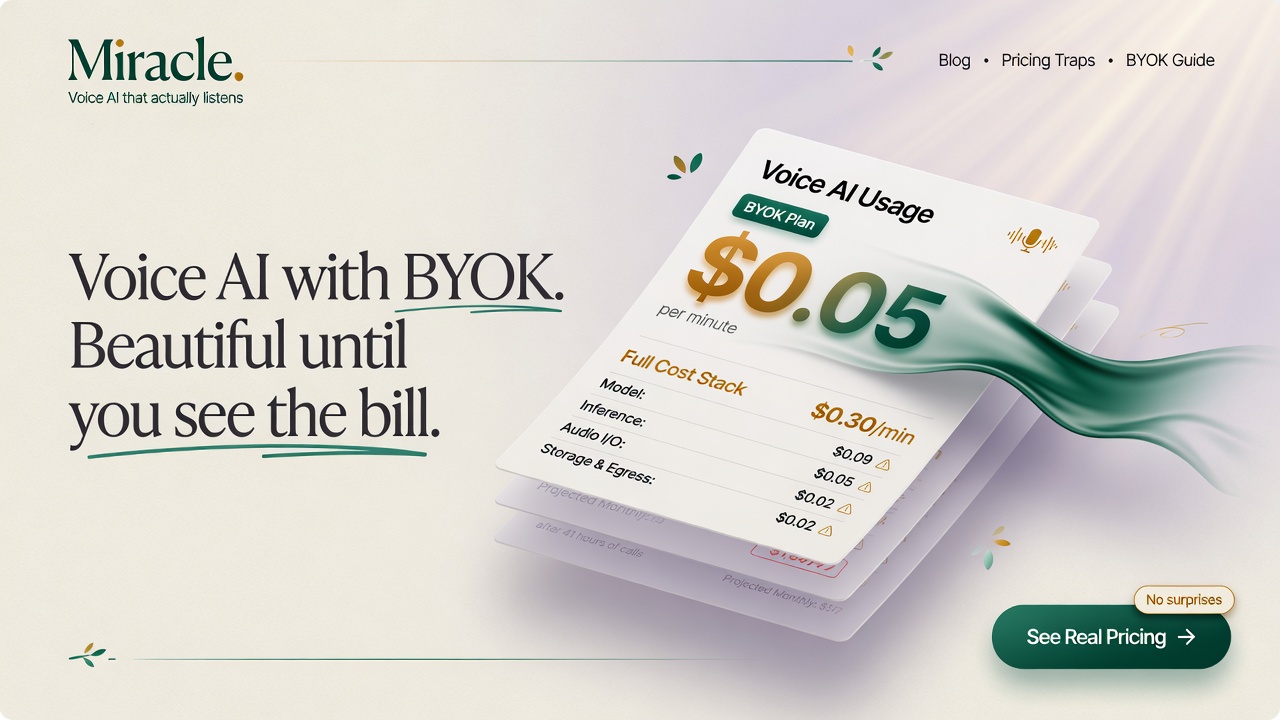
Voice AI pricing looks simple on the surface. A platform says $0.05 a minute. You do the math at 10,000 minutes a month. The number looks good. You sign up.
Then the first invoice arrives. It is three to five times what the homepage promised.
This is not a billing error. It is the Bring Your Own Key (BYOK) model at work. Most Voice AI platforms charge only for their orchestration layer. You still pay separately for every other service that makes the call actually work. Speech-to-Text (STT), the Large Language Model (LLM) brain, Text-to-Speech (TTS) voice generation, and telephony are all billed by the minute on top of that headline rate.
At Startup Miracle, we build Voice AI receptionists for law firms, contractors, medical clinics, and car dealerships across South Florida. We have deployed on Vapi, Retell, and ElevenLabs. We run about 10,000 minutes of Voice AI calls per month across our client deployments. Our invoices tell the real story.
This article breaks down exactly where every penny goes — and how to know the true cost before you commit.
The Headline Number Is the Floor, Not the Bill
Every Voice AI platform publishes an attention-grabbing per-minute rate. Vapi leads with $0.05 per minute. Retell advertises $0.07. The numbers look cheap because they are only a fraction of the total call cost.
Here is what is not included in that headline number:
Speech-to-Text (STT). Every word the caller says needs to be transcribed. Across Deepgram, Whisper, and assembly models, this runs $0.01 to $0.02 per minute of audio processed.
The LLM brain. The core reasoning engine that decides how to respond. GPT-4o and its peers add $0.01 to $0.04 per minute depending on model tier and conversation complexity.
Text-to-Speech (TTS). Converting the response into natural speech. This is often the most expensive layer. ElevenLabs TTS runs $0.03 to $0.10 per minute depending on voice quality tier and generation model.
Telephony. The phone connection itself. A Twilio or Telnyx number costs $0.01 to $0.03 per minute per leg.
Transfer fees. If the call gets routed to a human, many platforms add another per-minute charge on top of the base telephony.
Industry analyst Automation Labs published a pricing model in June 2026 called the "loaded minute" that accounts for all of these layers. At 10,000 minutes per month, the platform that advertises $0.05 finishes near the most expensive option on a total-cost basis.
The headline number is a floor. The loaded minute is the real bill.
What We Actually Pay Across Three Platforms
We run Voice AI agents on Vapi, Retell, and ElevenLabs for different client verticals. Here is what the real per-minute cost looks like at our current volume.
On Vapi, we pay $0.05 per minute for the orchestration layer. Then we add Deepgram STT (about $0.008 per minute), GPT-4o for the LLM (about $0.02 per minute), and ElevenLabs TTS (about $0.06 per minute on the pro tier). With Twilio telephony at $0.013 per minute, the total lands around $0.15 per minute. Three times the advertised rate.
On Retell, the orchestration fee is $0.07 per minute but includes basic STT and TTS in some tiers. Once we add the LLM layer and telephony, the total runs $0.13 to $0.16 per minute. Similar to Vapi at this volume.
On ElevenLabs' conversational AI product, the pricing is all-inclusive for voice. Vapi and Retell are BYOK platforms. You supply and pay for your own keys. ElevenLabs charges a higher headline rate but includes its own TTS, STT, and LLM. The tradeoff is less flexibility in model choice.
The platforms are within pennies of each other on total cost. The gap is not in the per-minute rate. It is in how much engineering time is needed to tune, test, and maintain each stack.
The loaded minute ranges from $0.08 to $0.30 depending on model choices, voice quality settings, call volume, and whether you factor in development overhead.
The Hidden Cost Is Engineering, Not Minutes
The real gap between Voice AI platforms is not the per-minute rate. It is the engineering time required to get a stable, reliable system into production.
A Bring Your Own Key (BYOK) platform like Vapi gives you maximum control. It also requires you to wire together STT, LLM, and TTS providers yourself, build a business logic layer, handle error recovery, monitor call quality, and manage failover between providers. That is not a plug-and-play setup. It is a software build.
A South Florida law firm client of ours wanted a Voice AI receptionist that could screen callers, book consultations, and route urgent legal matters to the on-call attorney. We built it on Vapi because the flexibility to route calls differently based on practice area and urgency justified the engineering effort. The setup took about three weeks to fully tune.
A roofing contractor in Broward needed something simpler: answer after-hours calls during storm season, capture contact info, and dispatch an estimate request. We deployed on a more managed stack in under a week. The engineering cost was lower because the voice logic was straightforward.
Both solutions work. Both cost about the same in per-minute fees at 5,000 minutes per month. The difference was in the engineering overhead. The headline rate told us nothing about that gap.
The global Voice AI market is projected to grow from $2.4 billion in 2024 to $47.5 billion by 2034, according to Market.us. Gartner predicts conversational AI will reduce contact center labor costs by $80 billion in 2026. As the market expands, platforms will compete on headline rates. The real pricing model will remain the same: you pay for each layer separately unless you choose an all-inclusive platform.
How to Calculate Your Real Voice AI Cost
Before you sign up for any Voice AI platform, calculate the loaded minute at your actual volume. Here is the formula:
Loaded Minute = Platform Fee + STT + LLM + TTS + Telephony
                ÷ Minutes Actually Billed
                (at the volume and call length you actually run)
Ask each platform for these specific numbers before committing:
What is your all-in rate at 5,000, 10,000, and 50,000 minutes per month? The per-minute cost changes significantly at different volumes because some platforms offer volume discounts on their orchestration fee but not on BYOK provider costs.
Which layers are included in your headline rate, and which require separate keys? If STT and TTS are not included, those costs need to be quoted separately and added to the total.
What does call routing and transfer cost? If the system transfers to a human, some platforms add a per-minute surcharge for the twinned call leg.
How much engineering time is needed for your specific use case? This is the cost no one quotes upfront, but it is often the largest line item for a first-time deployment.
At Startup Miracle, we include full cost transparency in every client deployment. We quote the loaded minute at the client's expected volume, with their preferred STT/LLM/TTS models, before we build anything. There are no surprises in month one.
The Smart Way to Buy Voice AI
The cheapest headline rate is rarely the cheapest total cost. The most expensive engineering overhead is rarely visible on a pricing page.
For simple use cases — after-hours call answering, basic intake, appointment booking — a more managed platform with higher per-minute rates but lower setup effort is often cheaper overall. The loaded minute might be $0.20 on an all-inclusive platform versus $0.12 on a BYOK platform, but the BYOK platform needs two weeks of engineering time to get there.
For complex use cases — multi-department routing, compliance-aware call flows, bilingual cascading with Spanish-first handling — the flexibility of a BYOK platform justifies the engineering investment. The loaded minute across both options is close enough that the decision should be driven by capability, not pennies.
The Voice AI market is growing fast. Know the real cost before you buy. The $0.05 rate is not the price. It is the invitation.
Frequently Asked Questions
What is the real cost of Voice AI per minute in 2026?
The all-in cost ranges from $0.08 to $0.30 per minute depending on your platform choice, model selections for Speech-to-Text (STT), Large Language Model (LLM), Text-to-Speech (TTS), and telephony provider. At 10,000 minutes per month, most deployments land between $0.12 and $0.20 per minute all-in.
Why is Voice AI cheaper than a human receptionist?
A human in a contact center costs $7 to $12 per call interaction according to industry benchmarks. A Voice AI agent costs $0.30 to $0.50 per call including all layers. That is a 90 to 95 percent reduction per interaction. Gartner predicts conversational AI will reduce contact center labor costs by $80 billion in 2026.
Does the BYOK pricing model save money compared to all-inclusive pricing?
It depends on your engineering capacity and call volume. Bring Your Own Key (BYOK) platforms like Vapi and Retell offer lower headline rates but require you to source and pay for STT, LLM, and TTS providers separately. All-inclusive platforms like ElevenLabs' conversational AI have higher headline rates but include all voice layers. At 5,000 to 10,000 minutes per month, both models land at similar total costs. The biggest variable is engineering time, not per-minute fees.
What is the cheapest Voice AI platform in 2026?
The cheapest by advertised rate is Vapi at $0.05 per minute for the orchestration layer. At full load including STT, LLM, TTS, and telephony, all major platforms converge within a few cents of each other. Do not pick a Voice AI platform by headline rate. Calculate the loaded minute at your actual volume and use case.
How much engineering time does a Voice AI deployment need?
A simple after-hours answering system can be deployed in under a week with a managed platform. A complex multi-department setup with custom routing, compliance logging, and bilingual support can take two to four weeks of engineering work on a Bring Your Own Key (BYOK) platform. The engineering cost often exceeds the first year of platform fees.