
Blog
Westlaw Brief Builder Writes the First Draft
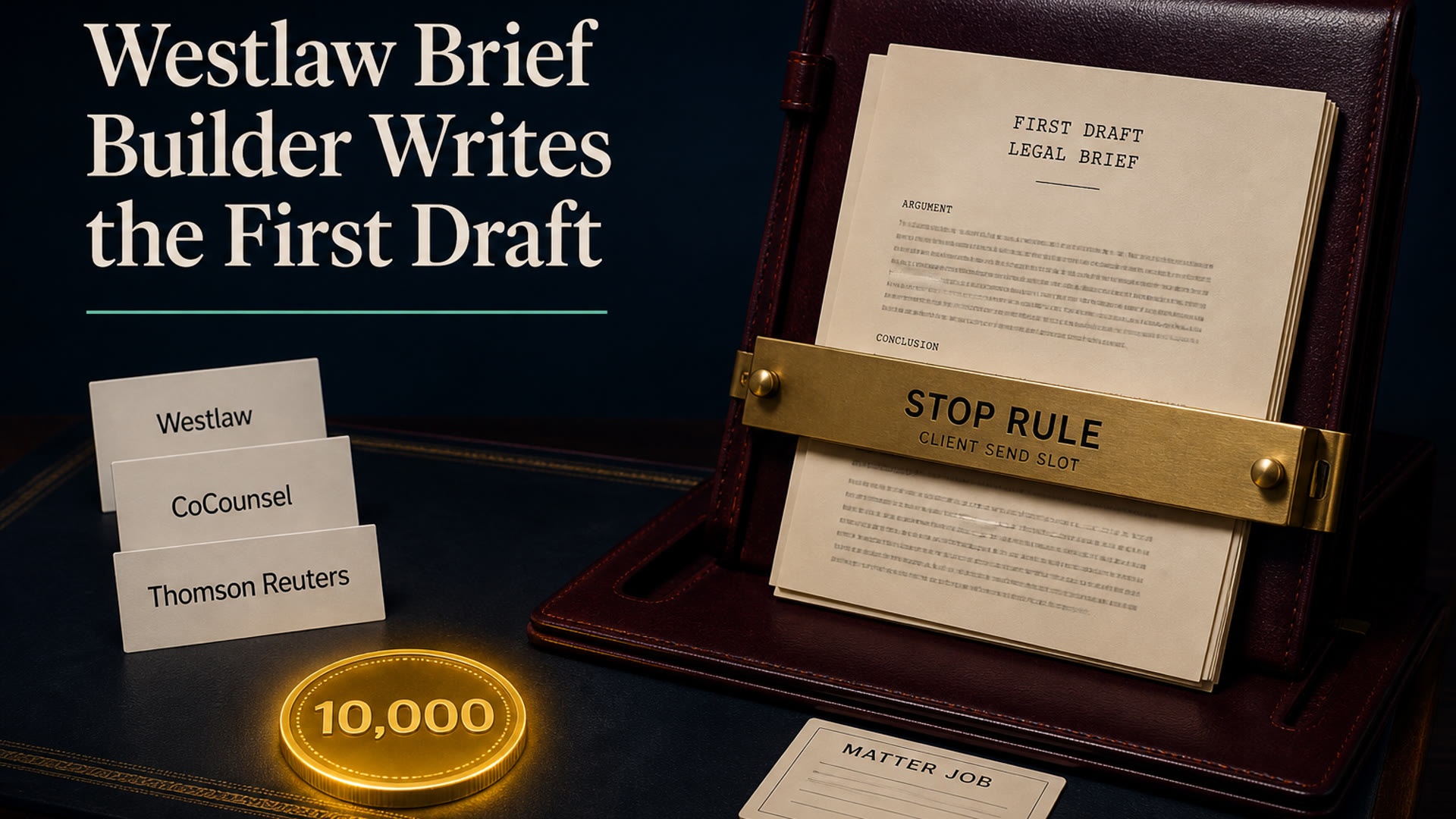
Westlaw Brief Builder Writes the First Draft
On August 20, 2026, Thomson Reuters put the next generation of CoCounsel Legal into general availability in the United States. The new Westlaw Brief Builder takes research and issue analysis into a first-draft brief inside one workflow, and Tabular Analysis can review up to 10,000 documents and ask up to 100 questions in a single pass. If you already research on Westlaw, or you are the plant owner who still reads the vendor pack yourself, that is real help in software the profession already trusts.
Thomson Reuters built something worth turning on. The question is not whether a senior-associate draft can be assembled. It is which matter job you keep, meaning the named work of deciding what the draft may say and when it may leave, before that brief goes to a client under your name. A stop rule, meaning the named line the assistant may not cross without you, has to be written before Brief Builder runs, not after the client already has the file.
Startup Miracle sits with small-firm owners and plant operators who already pay for research software and still write the first draft by hand. We help you name the matter job and write that stop rule so a 10,000-document review does not leave the shop before you have read it.
Brief Builder and Tabular Analysis
Thomson Reuters dated the release August 20, 2026. CoCounsel Legal is built on Westlaw and Practical Law, and Thomson Reuters says it is engineered to reason, plan, and execute at the level of a senior associate. Brief Builder, powered by Westlaw Deep Research, KeyCite, and Practical Law, proposes facts, arguments, and supporting authority. Tabular Analysis, built for high-volume review, returns answers in a filterable table. Deep Research Verify checks whether a cited authority actually supports the assertion.
Those are Thomson Reuters's own words for the product. Treat them as the product, not as a promise that your Tuesday filing will be ready to serve. The company also says one million professionals across 107 countries and territories now rely on CoCounsel. That is a Thomson Reuters claim, not a Startup Miracle count. The new experience is available now in the United States, with Canada, the United Kingdom, and Australia expected later this year.
A first AI hire, meaning the first named job you let software run without you standing over it, can live inside this release. It can be the first-pass table on a 10,000-document pack. It can be the issue list Brief Builder proposes before you pick a theory. It cannot be "Westlaw now speaks for the firm." The lawyer, or the plant owner who signs the pack, still owns the send.
Raghu Ramanathan, president of Legal Professionals at Thomson Reuters, said the challenge is turning insight into action, whether you are at an Am Law 100 firm, a midsize or small practice, or a corporate legal department. Emily Colbert, who leads CoCounsel Litigation there, said Brief Builder was built to support the thinking, not replace it. Both are right about the draft. You still name the job that lets it leave.
When 10,000 pages hit the table
Tabular Analysis caps a review at 10,000 documents and 100 questions. For a small-firm owner who is still the only closer and the only drafter, that number is the reason to turn the tool on, and the reason to write the stop rule first. A pack that size is not something you reread on Sunday. It is also not something you let leave under the firm name because the table looked complete.
The plant owner who is still the only person who reads the vendor pack feels the same weight. Ten thousand pages is a contract-review job, meaning the named work of deciding which terms may be accepted, redlined, or sent back, before anyone signs. If the tool tables the pack and nobody owns that job, you can sign a draft you did not read. Looking careless when a draft goes to a customer is the fear that already lives in that office. The software does not remove it. A named reader does.
Thomson Reuters's one million professionals and 107 countries describe a product that already scales. Your shop does not need scale. It needs one person who decides what the table may change, and what it may not, before the pack is signed or sent.
Grow AI scores the lead, not the brief
The same week, Clio launched Grow AI inside Clio Grow. Grow AI is a set of features that scores incoming inquiries against the cases the firm hired and the cases it declined. Clio data on that page says matters are three times more likely to convert to hired when Grow AI is used. Separate Clio research says the average firm spends 8 percent more on marketing each year than the year before. Those are Clio claims, not a Startup Miracle audit.
A two-person firm owner who still scores every lead by hand can use that scoring. The job is naming which leads the practice software may score, and which consults it may book, before it treats a declined pattern as a win. If Grow AI books a consult the firm would have turned down, you spent the hour and looked available for work you do not want. If marketing spend climbs 8 percent a year for clients you already had, the score did not save you money. It bought you more of the same inbox.
Keep Grow AI next to the draft, not on top of it. Scoring a lead is not the same job as sending a brief. One sits in intake. The other sits on the matter. Mixing them is how a useful week of launches becomes one more login that dies in 30 days.
The shop that still holds the terms
A manufacturing owner who is still the only memory on the real terms has a different version of the same gap. CoCounsel Legal can draft. Tabular Analysis can table. Neither one knows which clause this plant actually lives with, unless someone writes that knowledge down and names the terms job, meaning the named work of deciding which commercial terms may leave the shop.
Another login that dies in 30 days is the fear here, and a first draft that ships the wrong terms is how that fear comes true. The senior-associate framing is Thomson Reuters's claim about the product. It is not a claim that the plant can skip the person who remembers the last fight over freight, warranty, or payment. Write the terms job before Brief Builder or Tabular Analysis runs the file, so the draft cannot invent a position the shop does not take.
The 10,000-document cap and the 100-question cap are useful ceilings. They tell you what the pass can hold. They do not tell you what you will stand behind. That line is the stop rule, and it belongs on a card before the first table runs: no draft to a client without the named reader, no redline that changes price or liability without the owner, no brief that cites a case the closer has not opened.
Before it leaves under your name
Turn Brief Builder on if you already live in Westlaw. Then write three names before the next matter.
First, who owns the matter job. That person decides what the draft may argue and when it may leave. Second, who reads the table. That person, or that job, reviews the 10,000-document pass before anyone signs. Third, who holds the terms. On a plant, that is often the owner. In a two-person firm, it is often the closer. Write the stop rule next to those names so the assistant cannot send, book, or cite past the line.
Startup Miracle's work here is the AI Readiness pass, not another research product. The quiz names which matter job the shop keeps now that Westlaw has offered to draft the brief. The $1,500 assessment, with a $1,000 credit if you continue, is the longer version of that same question. We do not replace CoCounsel or Clio. We sit with you until the draft has a reader, and the stop rule is on the card, before it leaves under your name.
If you already have CoCounsel Legal, write the card this week. If you have not turned Brief Builder on yet, write the card first. The order is the point. A complete first draft with no owner is how a useful release becomes a file you cannot defend.
FAQ
What is Westlaw Brief Builder?
Westlaw Brief Builder is a CoCounsel Legal tool that takes research and issue analysis into a first-draft brief. Thomson Reuters says it proposes facts, arguments, and authority while the lawyer keeps strategy and the final decision.
How do I keep the matter job after CoCounsel drafts?
Name the job before the first draft runs: who decides what the brief may say, who reads the document table, and who holds the terms. Write the stop rule in the same sitting so nothing leaves under the firm name without that reader.
How much review can Tabular Analysis hold?
Thomson Reuters says Tabular Analysis can review up to 10,000 documents and ask up to 100 questions in one pass. Those caps are Thomson Reuters claims about the product, not a promise about your next vendor pack.
CoCounsel can write the brief. You still name the job that lets it leave.
If you want the long version of how we think about readiness, Start with a FREE quiz and Get Your AI Score.