
Blog
Your AI Tools Learn From You. But Can You Learn From Them? The Bidirectional Knowledge Problem and How an AI Operating System Fixes It.
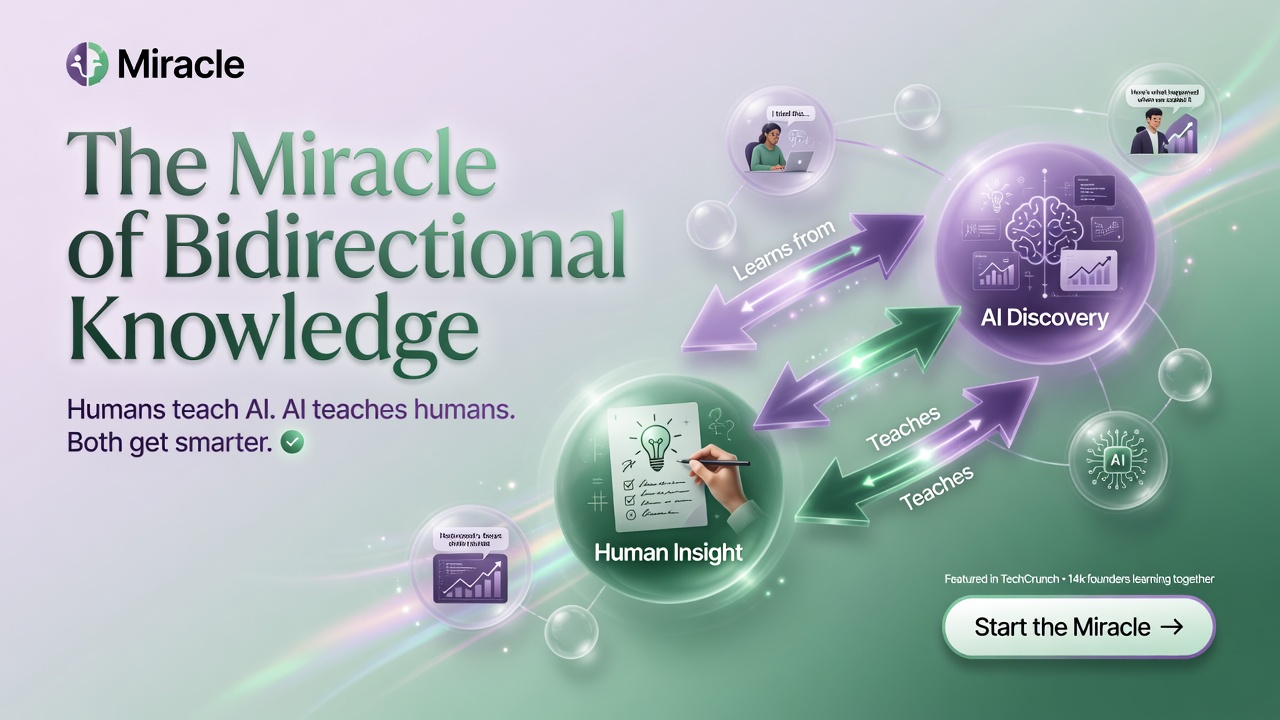
Your AI Tools Learn From You. But Can You Learn From Them?
That is the question most businesses skip when buying AI tools.
You implement a Customer Relationship Management (CRM) agent. It learns your lead pipeline. It surfaces insights. Then the session ends. The agent returns to base state. And the patterns it discovered (the fact that leads from one source convert 3x faster, or that a specific follow-up sequence closes more deals) disappear into a void.
Your AI learned something valuable. But you cannot learn it back from the AI.
This is the bidirectional knowledge problem. And it is the difference between owning an AI tool and building an AI operating system.
What Is Bidirectional Knowledge?
Here is the distinction in one sentence:
Most AI setups are one-way. Data goes in. Answers come out. Session ends. Knowledge stays in the agent's ephemeral context.
A bidirectional setup does the reverse. The agent reads your institutional knowledge. It generates insights, patterns, and decisions. Then it writes those discoveries back into your knowledge base. You review them in your normal editor. Obsidian, Google Docs, Visual Studio Code, whatever you already use. You approve what works. You correct what doesn't. The agent learns from your corrections. And the cycle repeats.
Every interaction compounds. Nothing vanishes.
What Your AI Operating System Learns
A one-way AI tool answers queries. A bidirectional AI operating system learns across eight dimensions:
- Business knowledge: Your products, services, pricing, service areas, standard operating procedures. It reads your documentation and applies it consistently.
- Customer signals: Patterns from lead conversations, intake calls, support tickets. Which objections keep coming up. Which questions predict a close.
- Procedures: Your intake workflow, follow-up cadence, escalation triggers. The AI executes them. When it finds a better pattern, it writes back a proposal.
- Pricing and distribution: How you price, where leads come from, what channels perform. The AI correlates spend to outcome and surfaces the signal.
- Voice and tone: How your team communicates. The AI mirrors your brand voice. When a response pattern works, the AI extracts it and adds it to the style guide.
- Customer treatment: How different segments should be handled. High-value accounts get white-glove. Warm leads get speed. The AI knows the difference because it documents the rules.
- Growth targets: Revenue goals, capacity constraints, hiring timelines. The AI factors these into every recommendation.
- Organizational culture: The unwritten rules. Who approves what. When to escalate. The AI learns these by observing decisions and writing back patterns.
Each dimension compounds. A one-way tool learns nothing between sessions. A bidirectional system gets smarter every single day.
The Architecture: How Knowledge Flows Both Ways
The setup is simpler than you expect.
The vault. A folder of plain markdown files. One per topic. Structured like a wiki but living in a normal file system. No database. No proprietary format. Just text files that any human can open, edit, and version control.
The agent. An AI system that reads the vault at query time. It searches semantically, finds the relevant context, and generates a response. But unlike a standard chatbot, it also has write access to the vault.
The review layer. When the agent discovers a new pattern, like a customer objection trend or a more efficient workflow step, it drafts an update to the relevant vault file. A human reviews the draft in their normal text editor. Approve, edit, or reject. The approved content enriches the vault.
The search layer. Semantic, keyword, and entity matching runs in parallel. Results are fused and ranked by relevance. The agent sees the full picture.
That is the entire architecture. No multi-million dollar data lake. No dedicated team. Files plus an agent that reads and writes them.
Why Most AI Setups Stop at Read-Only
The dominant AI deployment pattern in 2026 is Retrieval-Augmented Generation (RAG). Upload documents to a vector store. The agent queries them at inference time. It reads and answers.
This works for simple question-answering. A support bot that reads your product manual. An internal wiki search. A code assistant that references your repository.
It fails when the agent needs to learn over time. Because the knowledge base is static. The agent never adds what it learns. Every session starts from scratch.
The Fountain City team documented this problem in their 2026 comparison of agent memory systems. They called it the "human-agent merge" problem. The question is not how much the agent remembers. It is how the human team participates in the same knowledge base, using normal tools, while the agent adds discoveries without overwriting things humans have not reviewed.
Most memory systems skip this step. They assume the agent can write directly to memory with no human review. That is fine for personalization. It is dangerous for business knowledge.
Scale to Team: This Cannot Be One Person
A common concern when founders hear about this system: "So I become the knowledge librarian on top of everything else?"
Fair question. The answer is no.
A bidirectional knowledge base does not require one person to maintain it. It requires a convention.
Anyone on the team can write to the vault. The sales rep documents a new objection they keep hearing. The operations lead adds a process update. The customer success manager notes a support pattern. The agent reads all of it, surfaces conflicts, and proposes consolidations.
The knowledge base becomes a team asset, not a founder dependency. When the founder is unavailable, the knowledge base is still current. When a new hire joins, they read the vault instead of shadowing someone for three weeks.
The Cost Comparison
A bidirectional AI operating system costs roughly $150 per month in tooling. That covers the agent infrastructure, the search layer, and the file storage.
Compare that to:
- One full-time operations person managing institutional knowledge: $45,000 to $65,000 per year
- A knowledge management platform like Guru or Notion with AI: $30 to $60 per user per month. Limited write-back capability.
- Doing nothing and losing institutional knowledge every time someone leaves: incalculable
The $150 per month number is not aspirational. It is what Startup Miracle pays for the stack we run internally. Hermes Agents orchestrate the cron chain. Claude Code and OpenAI Codex handle the reasoning. Plain markdown files store the knowledge. Supabase manages structured data. The total infrastructure cost for the knowledge layer is under $200 monthly.
How It Learns Your Business: The Process
Step one: create a folder. One directory on your computer or your team's shared drive. Inside it, start with a few markdown files. One for products and services. One for standard operating procedures. One for customer personas and objections. One for pricing.
Step two: connect your agent to the folder. Configure it to search the vault before answering any question. Configure it to draft additions when it detects a new pattern.
Step three: set a review cadence. Five minutes at the end of each day. Open the vault. Check the agent's proposed additions. Approve, edit, or delete. The act of reviewing teaches the agent what "good" looks like.
Step four: repeat. Every cycle adds density. After one month, the vault contains your entire operating playbook. After three months, it contains patterns you did not consciously document. The agent found them in your data and wrote them back.
Getting Started
You do not need a specialized platform to start. Any folder of markdown files with a semantic search tool works. Obsidian is a popular editor because it is built for this workflow. Visual Studio Code with a markdown extension works just as well.
If you want the full bidirectional loop where the agent reads, generates, and learns from human review, you need an agent that supports both read and write access to the vault. The frameworks listed in the Fountain City comparison all support this pattern to varying degrees. The markdown vault approach gives you the strongest human-editor workflow because you are using tools you already know.
At Startup Miracle, we run this setup across three teams: content production (this blog pipeline), client delivery (knowledge base per client), and internal operations (SOPs, pricing, workflows). It took one afternoon to set up the initial vault. The compounding happens automatically.
Why This Matters Right Now
The AI market is moving from query tools to autonomous agents. The difference between a tool that helps you answer questions and a system that grows your institutional knowledge is bidirectional sync.
The Fountain City analysis compared eight memory systems. Only one approach rated "strong" on the bidirectional sync criterion: plain markdown files with human-editable content. Not because the technology is advanced. Because the workflow is natural. Humans edit text files. Agents read and write them. The two sides meet in a format that both understand.
Your AI tools should learn from you. But you should also learn from them. A system that only works one way is not an operating system. It is a search engine with a chat interface.
That is not a prediction. That is my current setup.
Ready to Build Your Knowledge Layer?
Stop letting your AI's insights disappear between sessions. Book a 15-minute AI Assessment and we will build a bidirectional knowledge system for your business that learns forever.
Frequently Asked Questions
What is the bidirectional knowledge problem?
The bidirectional knowledge problem is the gap in most AI systems where the agent reads your data and generates insights, but those insights vanish when the session ends. A true AI operating system writes discoveries back into your knowledge base so they compound over time.
Do I need a technical team to set this up?
No. The core infrastructure is a folder of markdown files and an AI agent that has read and write access to that folder. If your team already uses documents, spreadsheets, or notes, you can implement this with minimal technical overhead.
What is Retrieval-Augmented Generation (RAG)?
RAG is the standard pattern for giving AI agents access to your documents. The agent searches your knowledge base at query time, finds relevant context, and generates a response. Standard RAG is read-only. Bidirectional knowledge adds write-back capability so the agent can contribute new information.
Which AI agents support bidirectional knowledge workflows?
Frameworks like Mem0, Zep, and Letta support partial bidirectional sync through APIs. The strongest human-editor workflow comes from a plain markdown vault combined with any agent framework that supports file read and write. This avoids vendor lock-in and lets humans use their normal text editors.
How long does it take for the knowledge base to become valuable?
The first week builds the baseline. After one month, the vault contains enough density to answer most routine questions. After three months, the agent starts surfacing patterns you did not explicitly document. Correlations your team observed but never wrote down.