
Blog
The Agent Forgets Everything Between Sessions. That’s the Real Problem With Disconnected AI Tools — and How an AI Operating System Fixes It
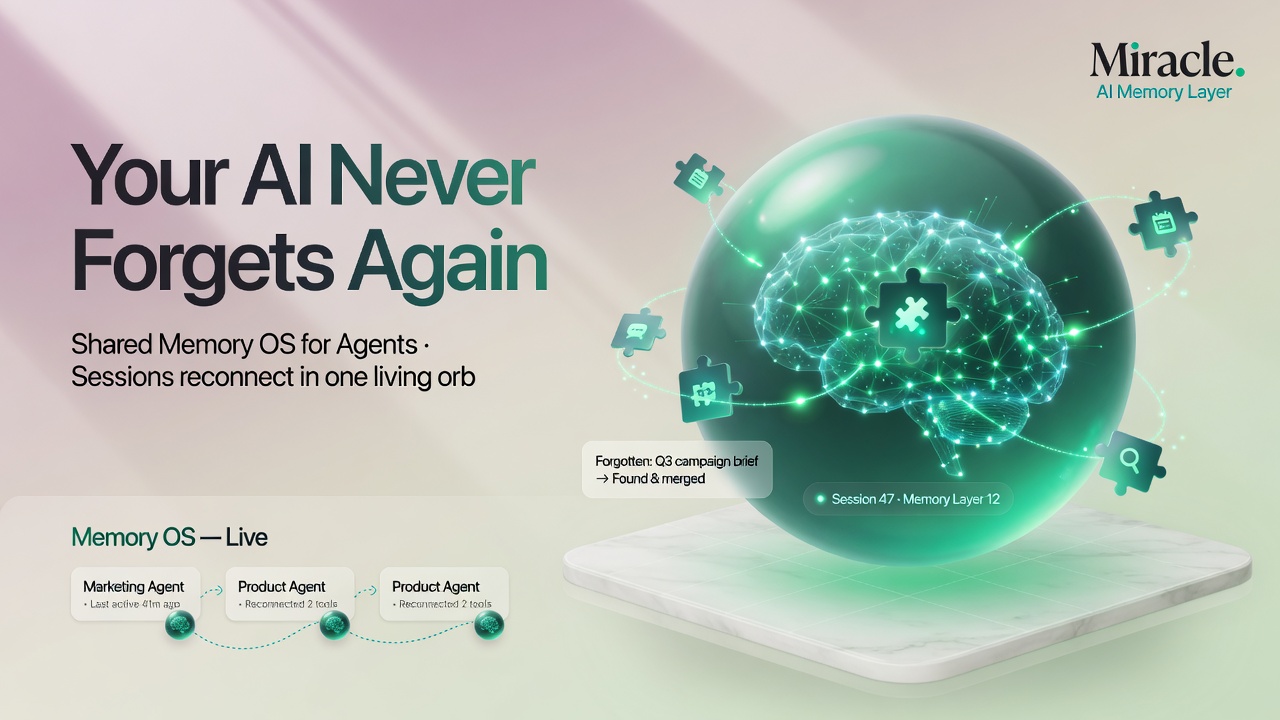
Your business invested in AI. Maybe five tools — a core assistant for writing, Canva for design, HubSpot for Customer Relationship Management (CRM), QuickBooks for finance, Zapier for automation. You stack them, you pay for them, you train your team on them.
And none of them remember what you told the others.
This is not a small annoyance. It is the reason most AI agent projects stall before reaching production. In 2025, 71% of AI pilots failed to scale — not because the models weren't powerful enough, but because the tools had no shared memory, no persistent context, and no way to learn across sessions. Codingscape reports the pattern.
The context window is RAM, not storage. Treating it like a hard drive is the most expensive mistake you can make with AI.
What Your AI Stack Actually Does (and Doesn't Do)
The SBE Council's 2026 Small Business Tech Use Survey found that 82% of small business employers have invested in AI tools, and the median business runs five different tools. The SBE Council documented the full data. The stack usually looks like this:
- ChatGPT or Claude for drafting copy, proposals, emails
- Canva for design and social media
- HubSpot for CRM and marketing automation
- QuickBooks or Xero for bookkeeping and invoicing
- Zapier for connecting apps and automating workflows
Each tool is capable. Each one learns something about your business. But they do not share that knowledge. The context your operations team built in one session evaporates by the next. The model that drafted your proposal last week cannot reference the pricing structure it generated. The chatbot that handled a refund request yesterday has no record of the resolution today.
The SBE Council survey also found that 93% of small business owners plan to continue investing in AI, and 62% will increase spending. They are pouring more money into a stack with no central nervous system.
The Five Failure Modes of Stateless AI
Fountain City's 2026 practitioner playbook on agent memory identifies four failure modes that emerge when you treat the context window as persistent storage. I will add a fifth from direct experience running these systems at Startup Miracle.
1. Token bloat. Unmanaged conversation history grows from 2,000 to 25,000+ tokens per session. Model attention degrades. Responses drift. The system gets slower and dumber at the same time.
2. Preference dilution. BEAM benchmark research shows agent compliance drops from 73% at turn 5 to 33% by turn 16. Instructions given early in a session are buried under later content. The agent forgets how you want things done.
3. Mid-session contradictions. When retrieved memories compete with fresh context, the model picks whichever is stronger in the moment. One response follows your pricing guidelines; the next one does not.
4. Instruction decay. System prompt constraints lose weight as context grows. The guardrails you set at the beginning effectively dissolve after a few dozen exchanges.
5. The cross-session reset (the one nobody talks about). Every new session starts from zero. The business owner who spent 40 minutes training a voice agent on their product catalog finds that agent remembers nothing the next day. In a voice interaction, the user cannot scroll back, copy-paste context from a previous session, or manually remind the agent of past conversations. Mem0's 2026 benchmark report frames this as the hardest open problem in the agent memory space. The friction is immediate and obvious.
The root cause is structural: these tools were not built to share a memory layer. They were built to solve one function each, and the architecture stops there.
What an AI Operating System Actually Is
An AI Operating System is not a chatbot. It is not a tool. It is a persistent knowledge layer that connects every AI interaction across your business.
The distinction matters. Most companies build five disconnected AI pilots and call it a strategy. The result is five tools with independent context windows — each one forgetting everything the others learned.
An AI Operating System — what we run at Startup Miracle, with Claude as strategist, Codex as executor, and Hermes as always-on operator — does three things that no single AI tool can:
1. Externalize memory to a persistent layer. Instead of stuffing everything into a context window (which has hard limits), the system writes structured memory to a vector store and retrieves only what each interaction needs. Mem0's 2026 benchmarks show this approach scoring 92.5 on LoCoMo (the standard long-term conversational memory benchmark) at roughly 6,900 tokens per query — versus full-context approaches that score lower while consuming 26,000+ tokens. We use Granola to feed structured meeting notes into this memory layer — no bot joining calls, no awkward recording notices.
2. Maintain two tiers of memory. Tier 1 (working memory) holds recent turns, current context, and 5-10 retrieved facts per interaction. Tier 2 (persistent storage) uses a structured index — SQL for facts, vector embeddings for semantic recall, and graph connections for relationships. The system pulls from Tier 2 into Tier 1 only when needed, keeping response speed high and token costs low. Fountain City's architecture guide details this two-tier pattern.
3. Learn across sessions, not just within them. Every interaction — whether through chat, voice, email, or CRM — feeds the same memory layer. The preferences a client states on a phone call are available to the agent that drafts their follow-up proposal. The pricing adjustment made in one system is reflected in every subsequent quote.
The Architecture That Makes Memory Stick
The two-tier memory architecture is not theoretical. It is running in production right now across the South Florida businesses we serve at Startup Miracle.
Tier 1: Working Memory (episodic)
This is the agent's short-term context. It holds:
- The current conversation turns (last 10-15 exchanges)
- The active task or goal
- 5 to 10 retrieved facts from persistent memory that are relevant to this moment
- A scratchpad for intermediate reasoning
Think of it like your desk. You keep the papers you are working on right now within reach. You do not pile every document you have ever touched onto the same surface.
Tier 2: Persistent Memory (semantic + procedural)
This is the institutional knowledge that survives session boundaries:
- Client profiles, preferences, history
- Product catalogs, pricing structures, policies
- Past decisions, commitments, outcomes
- Learned playbooks and routing rules
Fountain City's research shows that keeping retrieval namespaces explicit and separate is critical. Mixing casual preferences with authoritative specs causes retrieval collision — a one-off comment can compete with a documented policy. The fix is to segment memory categories and instruct the model to prefer retrieved content over internal guesses.
The result is a system that improves over time instead of falling apart at six months.
Why This Matters for Family Offices and Professional Service Firms
If you run a family office managing investments, real estate, and wealth across multiple entities, the fragmented AI problem is not an inconvenience. It is a structural risk.
A family office typically operates across private equity, real estate, fixed income, and direct investments — each with its own team, software, and workflow. AI tools adopted piecemeal by different teams create a knowledge architecture where the left hand has no idea what the right hand is doing. A portfolio company valuation discussed in the PE team's meeting never reaches the tax team's planning model.
The same dynamic plays out in law firms, accounting firms, and insurance agencies. Each department picks its own tools. Each tool builds its own context. None of them share a memory layer. The result is an organization that generates more information than it can integrate. We recently wrote about how 65% of family offices still run on spreadsheets — the same fragmentation problem, different industry.
An AI Operating System fixes this by making institutional knowledge a centralized utility — always available, always current, never siloed by tool or team.
The Cost of Staying Fragmented
The SBE Council survey shows small businesses are increasing AI spending. The money is not the problem. The allocation is.
Running five disconnected AI tools means:
- Paying for redundant context. Each tool builds its own understanding of your business from scratch. You pay for the same training data five times.
- Lost institutional knowledge. When a team member leaves, their AI tools' context leaves with them. The system does not retain what it learned from their interactions.
- Slower decisions. Every answer requires re-establishing context. "As I mentioned last week" has no meaning in a stateless system.
- No compounding learning. Good AI systems improve with use. Fragmented tools forget what they learned. They plateau at the level of their last conversation.
The Fountain City playbook puts it bluntly: "Memory architecture is what separates an agent that improves over time from one that falls apart at six months."
How We Built Ours
At Startup Miracle, we run a three-agent AI Operating System internally. It is how we ship 30+ blog posts per month, manage client workflows across South Florida, and run our Speed to Lead infrastructure. We were selected for the ElevenLabs accelerator program to build agents and Voice AI initiatives.
- Claude acts as strategist. It holds the high-level business context, client playbooks, and long-term memory.
- Codex executes. It handles code generation, Supabase operations, and automated publishing.
- Hermes operates always-on. It manages cron jobs, monitors systems, and runs the daily publishing pipeline.
All three share a persistent memory layer. The client requirement documented in a Granola meeting note is available to the blog publisher six hours later. The pricing decision made in a consultation call is reflected in the next proposal draft.
This is not a prediction about what AI could do. It is the system we run right now.
The Cost Question: $150/Month vs. $78,000/Year
A permanent headcount in South Florida — admin, ops, or junior analyst — costs approximately $40,000 to $78,000 per year including taxes and benefits. An AI Operating System with persistent memory costs roughly $150 to $300 per month depending on usage.
The comparison is not theoretical. For the price of one part-time employee, a business can run a memory-persistent AI system that never forgets, never takes vacation, and processes information across every channel simultaneously: voice, SMS, email, WhatsApp, and CRM.
The real question is not whether you can afford an AI Operating System. It is whether you can afford to keep running five disconnected tools that forget everything between sessions.
Getting Started: The Three-Step Path
An AI Operating System does not require replacing your existing tools. It requires adding a memory layer that connects them.
Step 1: Audit your current stack. List every AI tool you use. Classify each one by function (generation, CRM, automation, finance, design). Ask: does this tool share context with the others?
Step 2: Identify your highest-signal interaction point. For most businesses, this is customer conversations — phone calls, chat, email, SMS. This is where memory persistence creates the most immediate Return on Investment (ROI). If every customer interaction fed the same knowledge layer, your sales team would respond faster and your marketing would build on complete customer context.
Step 3: Add the memory layer, not another tool. Start with a persistent memory architecture that connects your highest-signal channel. The rest of your stack connects from there.
FAQ
What is the difference between an AI Operating System and a chatbot?
A chatbot handles one conversation at a time, in isolation. An AI Operating System maintains persistent memory across all conversations, channels, and sessions. The chatbot forgets everything after you close the window. The OS remembers.
Do I need to replace my existing AI tools to implement an AI Operating System?
No. The OS layer sits above your existing tools. It connects them through a shared memory architecture. Your team keeps using the tools they know. The difference is those tools now share context.
How does an AI Operating System handle sensitive or confidential information?
Memory architectures can segment data by user, team, or permission level. Persistent memory stores facts in structured categories with access controls. Sensitive information stays within its authorized scope. Retrieval only surfaces what the current context is permitted to access.
What happens when the AI remembers something incorrectly?
Memory systems use a three-stage pipeline: extraction, update, and delete. The extraction stage uses add-only writes — it writes new candidate facts on first pass. A separate follow-on pass compares against existing entries to resolve conflicts. Fountain City's research shows that adding a self-check gate (the model reviews its own extraction output before writing) improved extraction yield by 8x.
Book an AI Assessment and let's build your Operating System.
Sources: Codingscape — 71% AI pilot failure rate, SBE Council — 82% SMB AI adoption, median 5 tools, Fountain City — Agent memory architecture playbook, Mem0 — AI Agent Memory 2026 benchmark report