
Blog
EventsAir AI Survey: Know-How Tops Budget for Event Pros
EventsAir AI Survey: Know-How Tops Budget for Event Pros
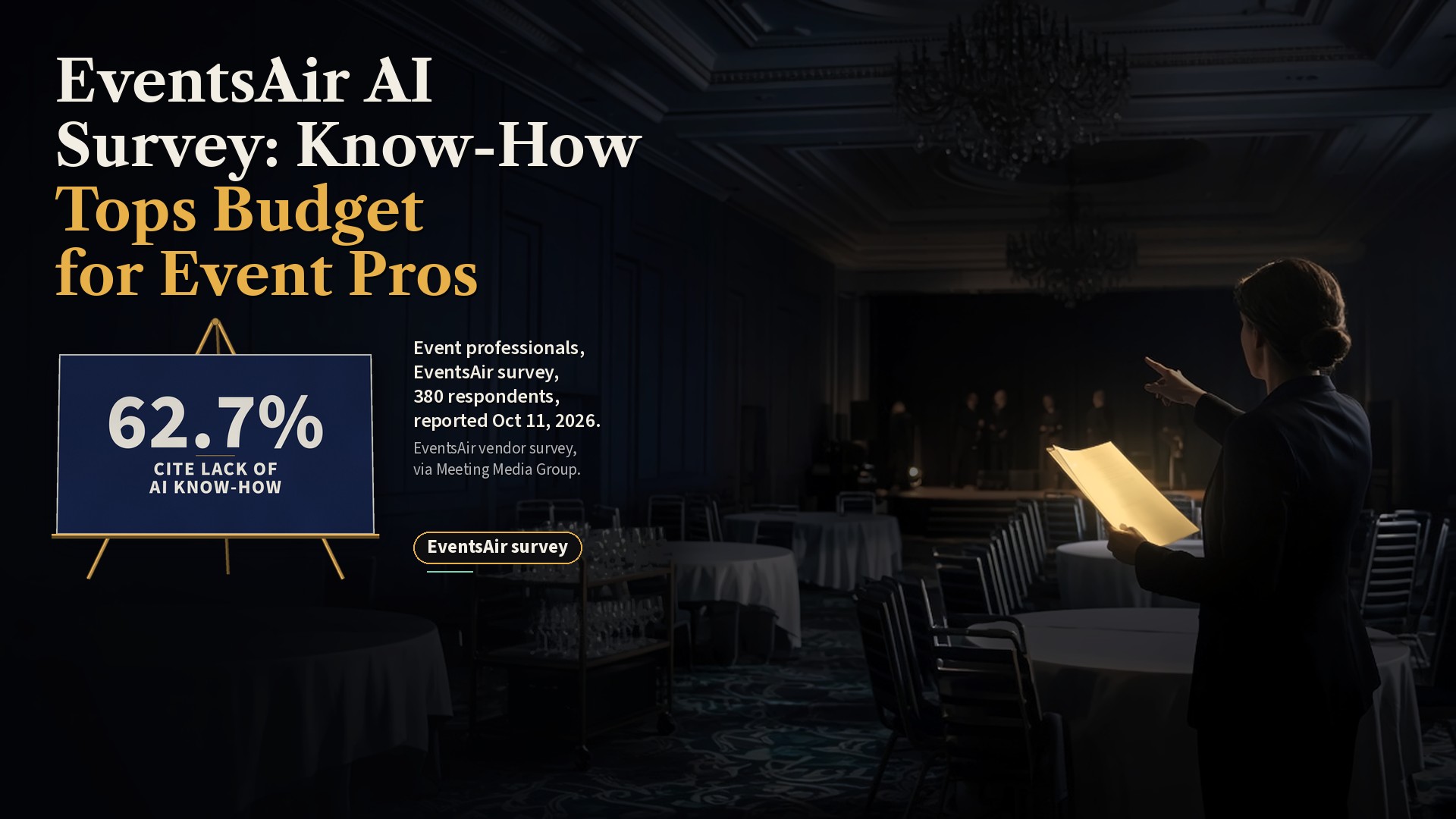
Event software vendor EventsAir surveyed 380 event professionals about AI, and the biggest barrier wasn't money. According to Meeting Media Group's report on the survey, 62.7% named a lack of knowledge or expertise as a barrier, making it the top obstacle. Cost or budget was named by 31.4%, so know-how came up about twice as often as cost.
That's a vendor's survey, with respondents across Europe, the Middle East and Africa, Australia and New Zealand, and North America. It isn't limited to small firms. Still, if you own an independent event planning firm or a venue, the finding probably sounds familiar. Cost is still a barrier for some, but the larger one is knowing what to do with AI once you have it. Our read is that the most practical place to build that know-how is the operations side of an event, where few AI users point it today.
Know-how named twice as often as budget
EventsAir deserves credit for asking about barriers directly instead of only about enthusiasm. Its numbers give an owner a clearer picture of what's in the way.
The headline split is 62.7% for lack of knowledge or expertise against 31.4% for cost or budget, both shares of the 380 respondents. That doesn't mean cost doesn't matter. Nearly a third named it. It means more of these professionals said they don't know how to use AI well than said they can't afford it.
For a small firm, that's useful to hear. Know-how is something you can build on purpose, one job at a time, while a budget often depends on things outside your control.
Valuable on paper, unused in practice
The same survey found 72% of respondents consider AI valuable or essential. Separately, 26% are not using it at all.
We'll keep those two figures apart rather than doing math with them, since the report presents them as separate findings. Even so, they describe an industry where many people believe in the tool more than they use it.
If that describes your firm, you're not behind in some unusual way. The survey suggests plenty of event professionals sit in the same spot, convinced AI matters but unsure where it fits in the work they actually do each week.
Privacy is the other worry on the list
Data privacy and security came up too, cited as a barrier by 52.9% of respondents. That makes sense in a business that can handle attendee names, contact details, and sometimes payment or travel information.
We wouldn't dismiss that concern. Any first step with AI should start with a plain decision about what information it may see. Attendee data you'd never email to a stranger shouldn't go into a tool you haven't set rules for.
Getting that rule written down early also helps with the know-how gap. A team that knows what's off limits is more willing to try AI on everything else.
The rule doesn't need to be long. List the kinds of information AI may use, such as event timelines, vendor names, or room layouts. Then list what stays out, such as payment details or anything a client asked you to keep private. Put one person in charge of answering questions about it, so nobody has to guess.
Where AI users point it today
Among respondents who use AI, 62.4% use it for marketing, while 37.8% use it for data analysis and reporting. Only 15% use it for logistics and operations, meaning the work of actually running an event. Think schedules, vendor coordination, room setups, or attendee communications.
Those shares come from AI users only, not from all 380 respondents. The pattern is still clear. Most of the use sits in marketing, with operations a distant third.
Marketing is a reasonable starting point, and there's nothing wrong with it. If your team already uses AI there, keep going. The point is that operations barely shows up on the list, even among people who already use AI.
Why we'd look at operations first
Here's our read, and it's ours rather than the survey's. The operations side of an event is where repeat work piles up for a small team. Every event has run sheets, vendor confirmations, and timeline updates. The same attendee questions also get answered again and again.
That repetition is exactly what makes operations a good place to build know-how. When a task repeats, you can write down how your best coordinator does it, then check whether AI follows those steps. Each event gives you another round of practice on the same job.
The task will look different depending on your business. A planning firm might start with turning a client's change requests into an updated timeline for every vendor. A venue might start with the setup sheet that tells staff how each room should look for the next event. Both are repeat work with a clear right answer, which makes the AI's output easy to check.
EventsAir also has its own AI product, Planner Assistant. We haven't tested it, so treat it as a vendor example rather than a result. Whatever tool you look at, judge it on your own events.
Building know-how one event at a time
The fix for a knowledge gap isn't a course everyone forgets. It's one job done well, then the next. We'd give that first job to an AI employee. As we use the term, an AI employee is a single recurring task handed to AI, with your firm's own written steps and a named person who reviews the result before it reaches a client or vendor.
Pick one operations task that repeats on every event, such as drafting vendor confirmation emails from the run sheet or turning a client's changes into an updated timeline. Write the steps down. Decide what data the AI may see, given the privacy concern above, then have your coordinator review every output for the first few events.
After two or three events, look at what changed. Did the coordinator spend less time on that task? Did fewer details get missed? If yes, the team has learned something real, which is the know-how the survey says is missing. If not, the written steps can show where the gap is, whether that's missing information or an unclear step.
Here's the short version we'd give any event firm owner. The biggest AI barrier in EventsAir's survey was knowledge, not cost, so build knowledge by giving AI one repeating operations task with written steps and a reviewer. Once that job runs well, the next one gets easier.
We've written before about an AI coordinator for overnight group inquiries at hotels and venues, which is one example of AI on the operations side. It's also worth knowing why AI spend now belongs on the budget as its own line, since cost was still named by nearly a third of respondents.
Event firm owner FAQ
What is the EventsAir AI survey?
It's a survey by event software vendor EventsAir of 380 event professionals across Europe, the Middle East and Africa, Australia and New Zealand, and North America, reported by Meeting Media Group. It found 62.7% named lack of knowledge or expertise as a barrier to AI, compared with 31.4% who named cost or budget.
How to close the AI knowledge gap at a small event firm?
Pick one operations task that repeats on every event, write down how your best coordinator does it, and have AI follow those steps with a person reviewing each output. Set a clear rule for what attendee data the AI may see before you start.
How much do event professionals use AI for operations?
Among AI users in EventsAir's survey, only 15% use it for logistics and operations, compared with 62.4% for marketing. That leaves operations as the least common of the three uses the survey reported.
If you want the long version of how we think about readiness, Start with a FREE quiz and Get Your AI Score.