
Blog
Lighthouse Says Hotel AI Is 10% Build, 90% Upkeep
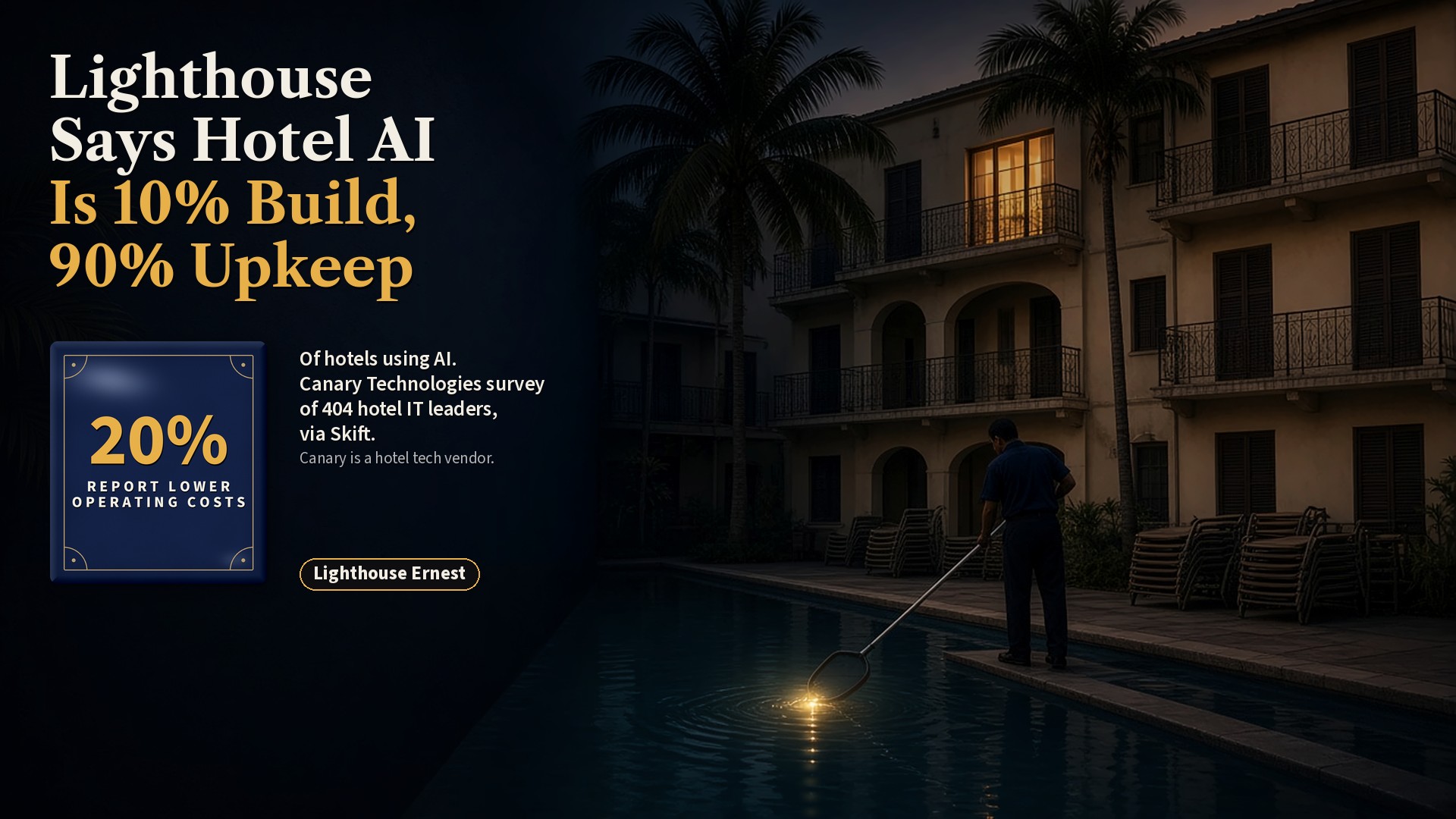
Lighthouse Says Hotel AI Is 10% Build, 90% Upkeep
On October 7, 2026, Lighthouse made Ernest generally available to every group, chain, and management company, according to Lighthouse's Ernest release. Generally available, or GA, means it's out of limited rollout and open to that whole set of customers. Lighthouse calls Ernest an AI teammate for hotel commercial teams. An AI teammate, in plain terms, is AI that carries a share of a team's recurring work, and a commercial team is the group that owns revenue at a hotel, such as sales, marketing, and revenue management.
Lighthouse deserves credit for what it built, and for saying the quiet part out loud. It says wiring generic models into hotel systems is about 10% of the effort, and the other 90% is keeping connections, definitions, and security intact. That's Lighthouse's own framing, not a measured study, but it lands on a real worry for an independent or small-group owner: AI costs climbing on the P&L with no matching gain. The answer we'd give is to start with one job you can keep running, not five you can't.
What lands on the desk before the morning meeting
Here's what Lighthouse says Ernest does. It reasons over more than 3 billion hotel data points monitored daily across more than 80,000 hotels, and it prepares competitive analysis, forecasts, and reports overnight. The GA follows four months of live deployments at Viceroy, Stonebridge, and Maine Course.
Competitive analysis is where the comp set comes in. Your comp set is the short list of competing hotels you measure your rates and performance against. Revenue management is the work of setting room rates and availability based on the demand you expect. Both depend on someone pulling numbers together before anyone can make a decision.
In other words, Ernest is aimed at prep work, the kind a revenue manager might otherwise build by hand before the day's decisions get made. For a commercial team, having that work ready in the morning is the appeal.
One thing to keep straight. The release covers groups, chains, and management companies. It doesn't say Ernest is available to, or built for, a single independent property. If you own one hotel, the lesson in the release still applies to you, even if the product may not.
Where the other 90% of the work goes
The 10/90 line is the most useful sentence in the release for an owner who isn't buying Ernest at all. Lighthouse's point is that connecting a model to your systems is the small part. The large part is everything that has to stay true afterward.
Lighthouse names three things: connections, definitions, and security. Our reading of those, in a small hotel's terms, goes like this. Connections are the links between the AI and the systems it reads from, and they have to keep working when a system changes. Definitions are the agreed meaning of each number the AI reports, so a forecast means the same thing on Friday as it did on Monday. Security is who and what the AI is allowed to see.
None of that is a one-time setup. It's upkeep, and upkeep takes somebody's time every month. That's why we'd rather an owner hand AI one job with a clear owner on the team than spread it across every department and maintain all of it at once.
What hotels are reporting so far
The industry numbers point in the same direction, though each one comes from a different source and they shouldn't be blended. Skift's October 1 report on hotel AI costs and gains pulls several of them together.
Canary Technologies, a hotel tech vendor, surveyed 404 hotel IT decision-makers and presented the results at Destination AI. Among hotels using AI, 37% reported more room revenue and 20% reported lower operating costs. Separately, most respondents expect IT budgets to rise at least 10% next year, with more than 5% going to AI.
Read on its own, that budget line matters to an owner. Spending on AI is expected to keep growing, and the gains reported by AI-using hotels in that same survey are real but far from universal.
A second survey adds texture. Josiah Mackenzie's StateOfHotelAI survey of Destination AI attendees, also reported by Skift, found marketing was the only function where a majority reported results, and just 12% called those results strong. That's one attendee survey, and the 12% describes marketing results only. Our read is that it fits the 10/90 lesson: within marketing, reporting a result was common, and calling it strong was rare.
Hours saved aren't a line item
Labor is over 40% of a typical hotel's cost base, according to CBRE, as cited by Skift. That's why hours saved sound so attractive in a hotel pitch. If people are the biggest cost, saving their time should matter.
Hyatt SVP Pat Nestor made the sharper point, as Skift reported it. Early AI was measured in hours saved, and he asked where those hours actually show up on a P&L. It's a fair question at any size and a sharp one for an independent owner, because your P&L has no line called hours saved.
Our read is that saved hours only count when they move into something the P&L does track. That might be a rate decision made earlier in the day, a group lead worked instead of a report rebuilt, or a shift you no longer have to cover. If the time just dissolves into the week, the AI bill is real and the gain isn't.
Picking the job for a small hotel
An AI employee, as we use the term, is one recurring job handed to AI, with written rules for how it gets done and a named person who answers for the result. That's narrower than a teammate across the whole commercial function, and for a small hotel the narrowness is the point.
We'd pick the job by three tests. It repeats every day or every week, so the upkeep is worth paying for. Its output feeds a decision that touches revenue or cost, so the gain has somewhere to land on the P&L. And someone on your team already owns it, so there's a person to check the work and notice when a connection breaks.
For a revenue manager who rebuilds the comp set view in a spreadsheet every morning, that prep work passes all three tests. For another property, it might be the weekly forecast or a recurring owner's report. The job differs by hotel. The tests don't.
Here's the short version. Start hotel AI with one recurring job whose output feeds a revenue or cost decision, and name the person who owns it. The build is the easy part, so pick the job you can afford to keep running.
Keeping the job running after launch
Once the job is live, the 90% starts. Someone has to notice when a source system changes, confirm the numbers still mean what they meant at launch, and review who can see what. We'd put that on the same named person, with a short monthly check rather than a project every time something breaks.
We'd also measure the one job before and after. Write down how long the work takes today and which decision it feeds, then look again after a month. If the decision moves earlier or the hours land somewhere the P&L tracks, you've got a result you can defend. If not, you've learned that on one job instead of five.
We've made the case before that AI spend belongs on the budget like any other line. The 10/90 framing adds a piece that's easy to leave off that line: the upkeep is part of the cost.
Short answers for hotel owners
What is Lighthouse Ernest?
Lighthouse Ernest is an AI teammate for hotel commercial teams that Lighthouse made generally available on October 7, 2026, to every group, chain, and management company. Lighthouse says it prepares competitive analysis, forecasts, and reports overnight, reasoning over more than 3 billion hotel data points across more than 80,000 hotels.
How to start with AI at a small hotel?
Pick one recurring job whose output feeds a revenue or cost decision, and name the person on your team who owns it. Keep the connections, definitions, and access for that one job maintained before you add a second.
How much return does Lighthouse report for Ernest?
Lighthouse's release doesn't put a number on ROI; its CEO says the return is demonstrable without giving a figure. Your own before and after measurement on one job is the number to trust.
If you want the long version of how we think about readiness, Start with a FREE quiz and Get Your AI Score.