Blog
68% of SMBs Now Use AI. 91% Report Revenue. Only 25% Use It Daily. That’s the Gap We Fill.
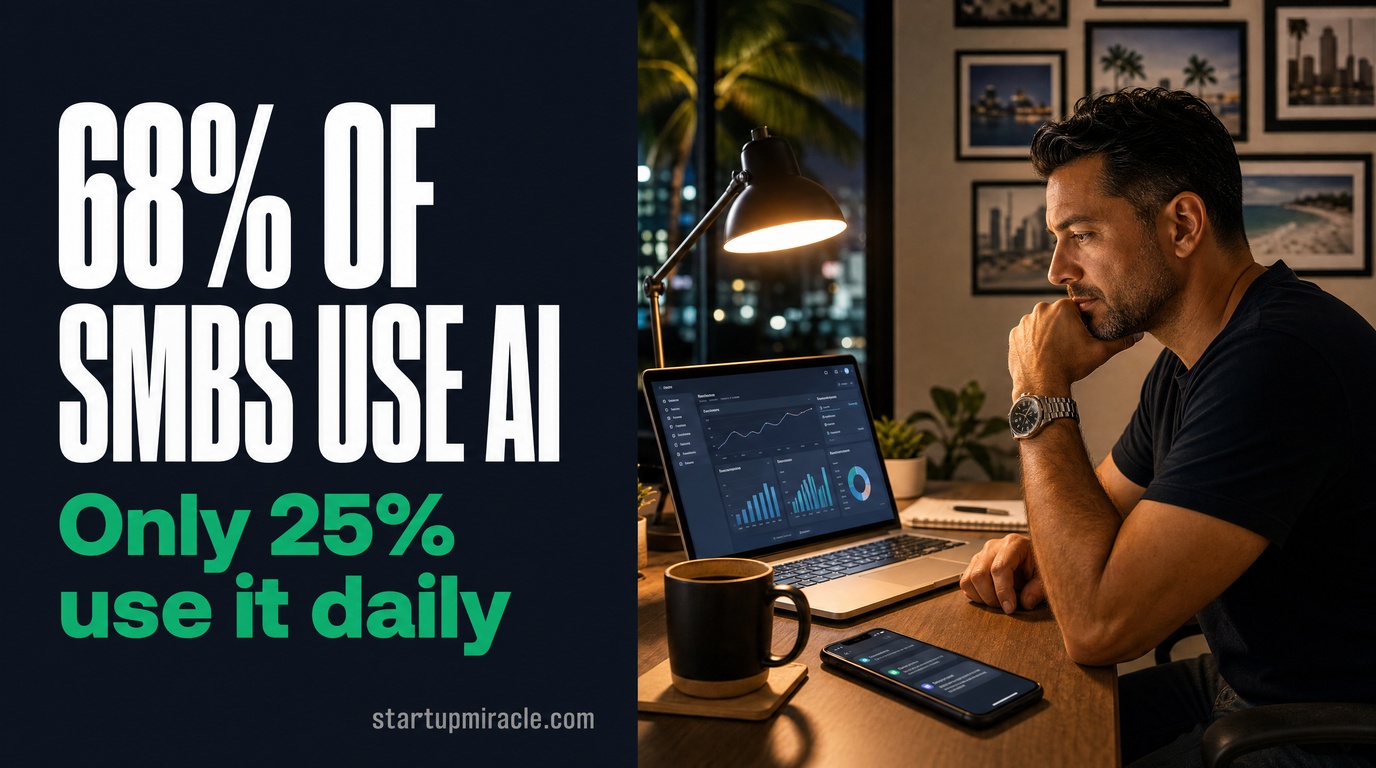
You already use Artificial Intelligence (AI). You have ChatGPT open in a browser tab. Maybe you pay for Claude, Midjourney, or a dozen other tools. You read the headlines -- 68% of small businesses now use AI, and 91% of them report revenue increases.
That first headline is real. According to the Small Business Administration (SBA), 68% of small and medium businesses with 10--100 employees now use AI in some capacity. More telling, the AI Economy Institute at Microsoft documented that the adoption gap between small businesses and large enterprises closed from 1.8x to just 1.2x in a single year -- the fastest diffusion of a general-purpose technology in modern history.
But the second number is what keeps me up at night: only 25% of those businesses use AI in their daily operations.
That gap -- between ownership and operation -- is where the real story lives.
What You Already Have is the Starting Point
If you are reading this, you have already invested in AI. You bought the tools. You experimented. You found some wins.
That is not the problem. The problem is that those tools do not connect. ChatGPT handles one thing. Your voice agent handles another. Your Customer Relationship Management (CRM) system sits in its own world. Your email sequences run on a separate platform. Your marketing tools, your scheduling, your follow-up -- each is a silo.
You have tools, not a system.
This is not a failure of effort. It is a structural gap. Most small businesses are running a collection of point solutions when what they actually need is an AI Operating System -- a single knowledge layer that connects every tool, learns every part of the business, and runs continuously.
What an AI Operating System Actually Learns
The difference between a tool and an operating system is what it knows. A chatbot knows how to answer a question. An operating system learns your entire business:
- Your business model: How you make money, who pays you, what margins look like
- Your customers: Who they are, what they ask for, how they buy, what makes them leave
- Your procedures: Every workflow, approval chain, handoff, and exception
- Your pricing: What you charge, why, when to discount, when to hold firm
- Your distribution: Where leads come from, what channels perform, what is drying up
- Your culture: How your team communicates, what good service looks like
- Your voice and tone: How your brand sounds in English, Spanish, or both
- Your growth targets: What matters this quarter, this year, and three years from now
A single knowledge layer that holds all of this. Every tool you use reads from and writes to it. New hires get up to speed in days, not months. Every customer interaction is informed by everything the business knows.
That is what “AI Operating System” means. Not a chatbot. Not a dashboard. A learning system that understands your business the way you do -- and runs it the way you would, 24 hours a day.
How the Architecture Works
At Startup Miracle, we run on a three-layer architecture that we built for ourselves before we ever recommended it to clients:
Claude (Anthropic) acts as strategist. It holds the business knowledge, designs the workflows, makes the high-level decisions about what should happen when a lead calls at 9 PM versus when a customer sends a follow-up email.
Codex (OpenAI) acts as executor. It handles the code, the API integrations, the automation scripts. It makes sure the strategy Claude designed actually runs in the real world.
Hermes acts as the operations layer. It sits between strategy and execution -- scheduling, monitoring, logging, recovering from failure, connecting to Telegram, managing cron jobs, delivering output.
This is not theoretical. This is how we run Startup Miracle. I built it because I got tired of managing 15 disconnected tools and still missing leads. Startup Miracle was selected for the ElevenLabs accelerator specifically to build and test this architecture before reselling it to clients.
Scale to Team, Not Just Founder
The first concern I hear from every business owner: “This sounds like it only works if I am the one running it.”
Fair point. A system that depends on one person is not a system. It is a dependency.
The AI Operating System is designed to scale to your team. The knowledge layer captures what your best people know and makes it available to everyone. When a new salesperson joins, they do not spend three months learning the business -- the system teaches them. When your operations manager takes a vacation, the workflows do not pause. When a customer calls at 10 PM, the system handles it the same way your best employee would.
The system learns once and runs forever. It does not take vacation. It does not forget what it learned. Every improvement one team member makes is instantly available to the whole business.
The Cost Math
Let me be direct about cost because this matters.
A full-time sales development representative in South Florida costs $3,500--$5,000 per month including benefits and overhead. A Customer Relationship Management (CRM) administrator adds another $3,000--$4,000. A marketing operations person runs $4,000--$6,000.
An AI Operating System at Startup Miracle starts at $300 per month for the Speed to Lead stack, or $150 per month for the core operating system.
That is not theoretical math. That is my actual cost. I run a three-agent AI team (Claude, Codex, Hermes) on under $200 per month. For $300 per month, I get a voice agent that answers every call, a follow-up system that never drops a lead, a CRM that updates itself, and a content machine that publishes daily.
The cost comparison is not close. And it gets better over time because the system learns -- it does not need raises, benefits, or time off.
Cost Predictability and Future-Proofing
I want to be candid about something. In June 2026, Claude shifted to a credit-based pricing model. Some of my costs went up. This is a real concern for businesses that are budgeting.
Here is how I think about it: the system saves me more money every month than it costs. Even if AI pricing doubles, I am still ahead. And the trend in AI pricing is down, not up -- the cost of inference has dropped roughly 10x in two years.
The right approach is to build the system so it works with any provider. If Claude gets expensive, swap in a different model. If one automation platform raises prices, move to another. The knowledge layer is yours. The operating system is provider-agnostic by design.
How It Learns Your Business
This is the part most people find surprising: teaching the system takes less time than you think.
- Knowledge audit (one session, 90 minutes). We map everything your business knows -- products, customers, competitors, procedures, exceptions, pricing, culture.
- Workflow documentation (one session, 60 minutes per major workflow). We write down exactly what happens when a lead comes in, when a customer calls, when a follow-up is due, when an appointment is set.
- Voice training (one session, 45 minutes). We record how your best people talk to customers. Tone, phrasing, language switching (English/Spanish), objection handling.
- Integration setup (one session, 60 minutes). Connect your CRM, phone system, email, calendar, and any other tools you already use.
- Deployment and monitoring (first week). The system runs live. We watch every interaction, catch every edge case, and refine the workflows.
Five sessions. Then the system runs. It learns from every interaction after that. What worked gets reinforced. What did not work gets adjusted. You never build it again.
Getting Started
If this clicks, the next step is not an upsell. It is an AI Assessment. We spend 45 minutes looking at your current setup -- what tools you have, what workflows are manual, where leads are leaking, where your team is spending time they should not spend.
You leave that session with a map. Not a pitch. A concrete list of the first three things to automate, the expected timeline, and the cost.
And if you are in South Florida, come by Area Centre in Miami. We run weekly workshops where business owners bring one real workflow and leave with one working automation. No slides. No sales pitch. Just a laptop and a problem to solve.
Closing
I run my business on an AI Operating System. Three agents. Under $200 per month. Publishing, answering, scheduling, following up, learning. It does not ask for time off. It does not forget. It gets better every week.
That is not a prediction about the future of small business. That is my current setup.
The gap between having AI tools and running your business on AI is the biggest opportunity in small business right now. 68% of business owners have already made the first investment. The question is whether that investment pays off as a collection of disconnected tools -- or as a system that runs your business the way you would, 24/7.
Frequently Asked Questions
Is this just another tool I have to learn?
No. The operating system connects the tools you already use. You keep your CRM, your phone system, your email. The OS sits underneath and makes them work together. You do not need to change what you use. You need a layer that connects what you have.
What happens if I change my mind after the first month?
You keep the knowledge layer. It is a document set, a workflow map, and a voice profile. Those are yours. If you want to run the operating system yourself, you can. If you want to pause, the workflows are documented -- nothing is locked in.
Does this work for Spanish-language businesses?
Yes. This is exactly what we build for. Our system handles English and Spanish naturally, switches between them mid-conversation, and adapts to Cuban American, Venezuelan, and Colombian business contexts. The knowledge layer stores both languages. The voice agents respond in whichever language the customer prefers.
How is this different from a chatbot or voice agent?
A chatbot answers questions. A voice agent takes calls. An operating system runs your business. The distinction is the knowledge layer -- the OS knows your products, your pricing, your customers, your procedures, and your culture. It does not just respond. It operates.
Can this replace my team?
No. It replaces the repetitive work that burns out your team -- answering the same questions, sending the same follow-ups, entering the same data. Your team focuses on the work that needs human judgment, relationship building, and creativity. The system handles the rest.