
Blog
71% of AI Pilots Stalled in 2025. The Reason Wasn’t the Technology — It Was the Missing Operating System.
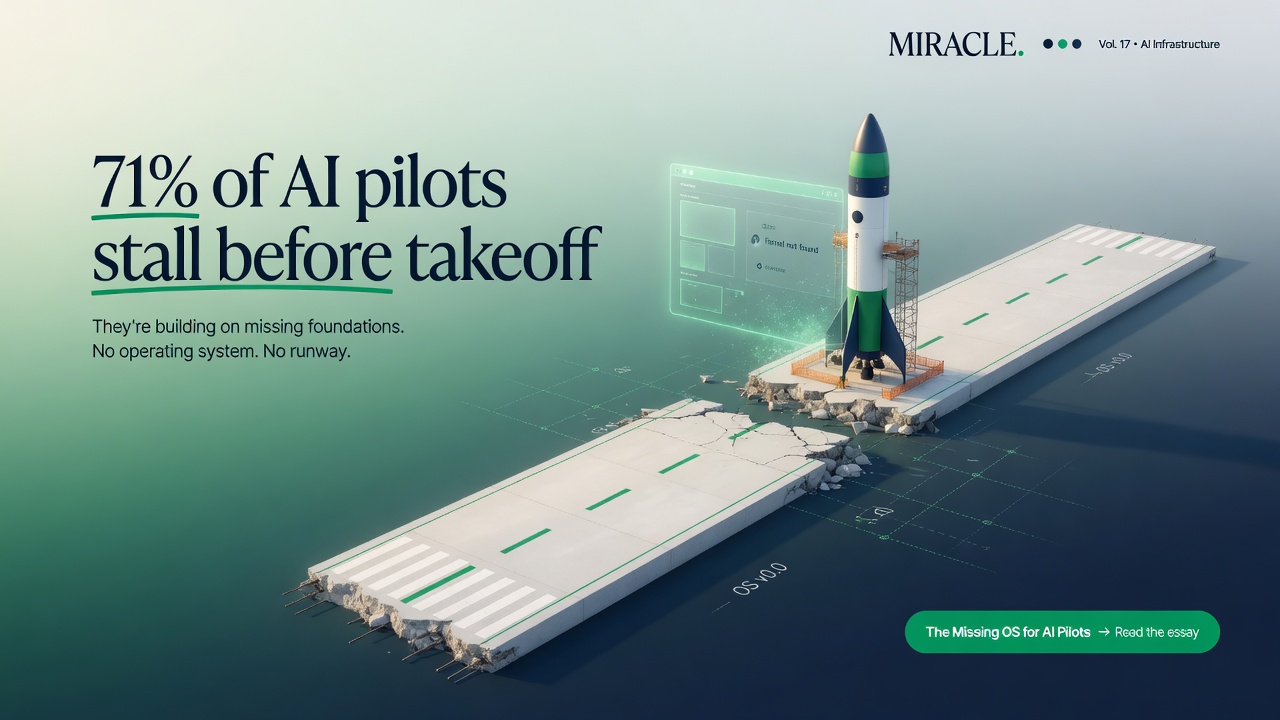
Here is what $2.52 trillion buys you in 2026: a lot of pilots that never reach production.
According to Gartner, global AI spending hits that number this year — a 44% increase year-over-year. The money is flowing. The tools are better than ever. And yet the MIT 2025 study found 95% of generative AI pilots fail to deliver rapid revenue acceleration.
S&P Global tracked the same pattern: 42% of companies abandoned most of their AI initiatives in 2025, up from 17% the year before. A March 2026 survey of 650 tech leaders found 78% are running AI agent pilots — but only 14% have anything in production.
The pattern is clear: money in, pilots started, results stalled.
Andrej Karpathy named the problem: "We have a powerful new kernel (the LLM) but no Operating System to run it." That line stuck with me because it maps exactly to what I see running Startup Miracle’s AI stack every day. The model is not the bottleneck. The layer around the model is.
This article is about why AI deployments stall — and what the architecture looks like when they do not.
The Three Traps That Kill AI Deployments
Composio’s 2025 AI Agent Report identified three universal failure patterns. I have seen all three in production.
Trap 1: Dumb RAG.
Most teams dump every document, Slack thread, and Salesforce record into a vector database and hope the LLM figures it out. The result is context flooding — the agent gets overwhelmed by irrelevant data and produces worse answers than if you gave it nothing.
The fix is context precision: give the agent only the five-page briefing it needs, not the entire company archive. Treat context like memory management in an operating system (OS). You do not load your entire hard drive into RAM and expect the CPU to find one byte.
Trap 2: Brittle connectors.
Pointing agents at raw APIs with undocumented rate limits, custom fields, and legacy middleware is a recipe for silent failure. Agents are naive to enterprise API realities. They do not know that a 200-field dropdown will break their reasoning loop.
The fix is a managed tooling interface that normalizes schemas, handles authentication and retry logic, and batches requests. The agent should not know whether it is calling Salesforce, HubSpot, or a custom database.
Trap 3: Polling tax.
Agents that constantly poll for updates burn 95% of their API calls on empty checks. You cannot build autonomous agents on request-response infrastructure.
The fix is event-driven architecture: webhooks, not polling. The system tells the agent when something happens instead of the agent asking every few seconds.
What the 5% Do Differently
According to Olakai’s analysis of the MIT data, the organizations that scale AI successfully share one pattern: they treat measurement as infrastructure, not an afterthought.
JPMorgan Chase deployed LLM Suite to 200,000 employees within 8 months without a mandate — because they tracked adoption rates, time savings, and productivity gains from week one. Walmart cut 30 million unnecessary delivery miles using AI route optimization because they established baselines before deployment.
The gap between these organizations and everyone else is not technology, talent, or budget. It is whether they built the infrastructure to prove the AI is working.
As Gartner notes, "AI is in the Trough of Disillusionment throughout 2026." The improved predictability of ROI must occur before AI can scale.
The OS That Your AI Stack Needs
At Startup Miracle, we run four AI agents every day — Claude on strategy and architecture, OpenAI Codex on execution and GitHub automation, Hermes on orchestration and cron workflows, and Aitana on content operations and revenue ops.
We do not run these agents as disconnected tools. They share a knowledge layer that holds our business context: our procedures, our pricing, our customer data, our voice, our deployment playbooks. When an agent needs to make a decision, it queries the knowledge layer.
This is the missing operating system. It handles memory management, I/O, permissions and governance, and observability — the full trace of every decision, every API call, every piece of context that led to a bad output.
Gartner projects that more than 40% of agentic AI projects will be canceled by end of 2027 due to escalating costs, unclear business value, and inadequate risk controls. That prediction comes true for organizations that buy AI tools without building the OS layer.
It does not come true for organizations that build the OS first.
How an Operating System Changes the Economics
For 33 prototypes built, only 4 reach production. That is an 88% failure rate at the scaling stage.
The prototypes that die do not die because the model failed. They die because nobody built the infrastructure around the model.
An AI operating system changes this by providing four things that disconnected tools cannot:
- Shared context across every agent. The sales agent knows what the support agent resolved yesterday because they share the same knowledge layer.
- Event-driven triggers, not polling loops. When a deal closes, the system fires a webhook. The operations agent, marketing agent, and sales agent all respond without polling.
- Policy enforcement baked in, not bolted on. High-risk actions pause for human approval. This is the OS-level "sudo" prompt that prevents an agent from acting without authorization.
- Full observability for debugging. Every decision trace is captured. When an agent produces a bad output, you do not guess why. You read the stack trace.
The Cost of Not Having an OS
Startup Miracle runs its entire content machine, client delivery pipeline, and sales operations on roughly $150 per month in AI costs across 50+ client workflows. The operating model is what makes that leverage possible.
Gartner says average enterprise AI spend will hit $11.6 million in 2026. For small and medium businesses, the ratio is the same. You can spend $5,000 a month on AI tools that do not share context, or you can spend $500 a month on an AI operating system that connects them.
The question is not whether to use AI. It is whether you are buying point tools that work in isolation, or building an operating system that works as a whole.
Getting Started
An AI operating system is a layer you build as you go:
- Start with one high-value workflow — the one where disconnected tools cause the most pain. For most service businesses, that is lead response.
- Build a shared context document — a single source of truth that every agent can query. A markdown file in a repository is better than nothing.
- Add an orchestration layer — a tool that routes tasks to the right agent, controls permissions, and logs every decision.
- Iterate on observability — capture traces from day one. You need to know what the agent did, why it did it, and what context it used.
The organizations that scale AI successfully do not start with more models. They start with the layer that connects them.
Why This Matters for Your Business
The Forbes analysis of the S&P Global data frames it directly: 42% of AI projects fail because of missing orchestration. The technology works. The deployment fails.
Every business I talk to in South Florida has the same pattern. They bought a chatbot. They signed up for a voice agent. They are using ChatGPT for content. None of these tools share context. The voice agent does not know the lead already submitted a web form. The content tool does not know what the sales team is hearing from prospects.
The fix is not a better chatbot. It is the operating system that connects them.
That is what we build at Startup Miracle. Not chatbots. Not voice agents in isolation. An AI operating system for your business — a knowledge layer that learns your operations, your customers, your procedures, and your voice, and makes every agent you run smarter because of it.
Frequently Asked Questions
What is an AI operating system?
An AI operating system is the layer that connects your AI tools to your business data, your procedures, and each other. It handles memory management, permissions, event-driven triggers, and observability.
How is an AI operating system different from a chatbot or voice agent?
A chatbot or voice agent is a single tool. An AI operating system connects multiple agents across channels, shares context between them, and manages permissions for all of them.
How much does an AI operating system cost for a small business?
Startup Miracle’s operating system costs roughly $150 per month in AI tooling for a business running 50+ workflows. Coordination cost drops dramatically when tools share a knowledge layer.
Do I need an AI operating system if I only use one AI tool?
Not immediately. The need arises when you add a second tool, then a third. Most South Florida businesses I talk to are already at three to five tools.
What is the first step?
Pick one workflow — typically lead response — and build a shared context document that every tool involved can query.
Does Gartner really predict $2.5 trillion in AI spending in 2026?
Yes. Gartner’s January 2026 forecast projects $2.52 trillion in worldwide AI spending, a 44% increase year-over-year.
Most AI pilots fail because they are tools without an operating system. Book an AI Assessment and let us build the layer that connects everything.