
Blog
Arzana's $4.3M Bet on Plant Office Order Entry
Arzana's $4.3M Bet on Plant Office Order Entry
In October 2026, Arzana announced a $4.3 million seed round led by Sunshine Lake VC, with Y Combinator and others, per Arzana's announcement. The round backs AI agents, software that works a multi-step task on its own and hands the result to a person, and Arzana says they automate quoting, order entry, and invoicing on top of existing ERPs such as Epicor, NetSuite, and Dynamics 365. Order entry is the job of reading a customer's order and typing it into the ERP, the enterprise resource planning system where your orders, inventory, and invoices live.
That's a serious bet on the least glamorous room in a plant, and Arzana deserves credit for aiming at it. If you run a paper, plastics, packaging, mold and tool, or metals plant whose office lives on PDFs and the ERP, the win is the boring part: purchase orders come in, the backlog clears, and the ERP stays. That last part is our reading of "on top of existing ERPs," meaning no rip-out. The fear to answer first is an agent keying a wrong order into your system.
A Monday in the plant office
A purchase order, or PO, is the document a customer sends saying what they want, how many, at what price, and by when. Each one has to be entered as a sales order before your floor can build against it.
Picture a packaging plant on a Monday morning. The weekend's POs are sitting in a shared inbox as PDFs, each customer with its own layout, its own part numbers, and its own way of writing a ship date. A customer service rep opens the first one, reads it line by line, and retypes it into the ERP. Then the next one, and the one after that.
Nothing about that work is hard, and that's the trouble with it. It takes a careful person's whole morning, and while it waits, the order isn't really in the building yet. Production can't plan against it, purchasing can't buy for it, and the invoice that eventually follows the shipment starts its life late too.
You may already know which desk this is in your building. The open question is whether that desk is the right first job to hand to software, and what has to be true before you trust it.
Five claims from one announcement
Every figure below comes from Arzana itself, not from an outside audit. So we'll take them one at a time and keep them apart.
First, Arzana says it has processed more than 100,000 purchase orders at 99.9% accuracy. That's a meaningful volume, and accuracy is the right thing to lead with, because accuracy is the fear. It's still Arzana's own count, and it's the figure to test first on your own paperwork.
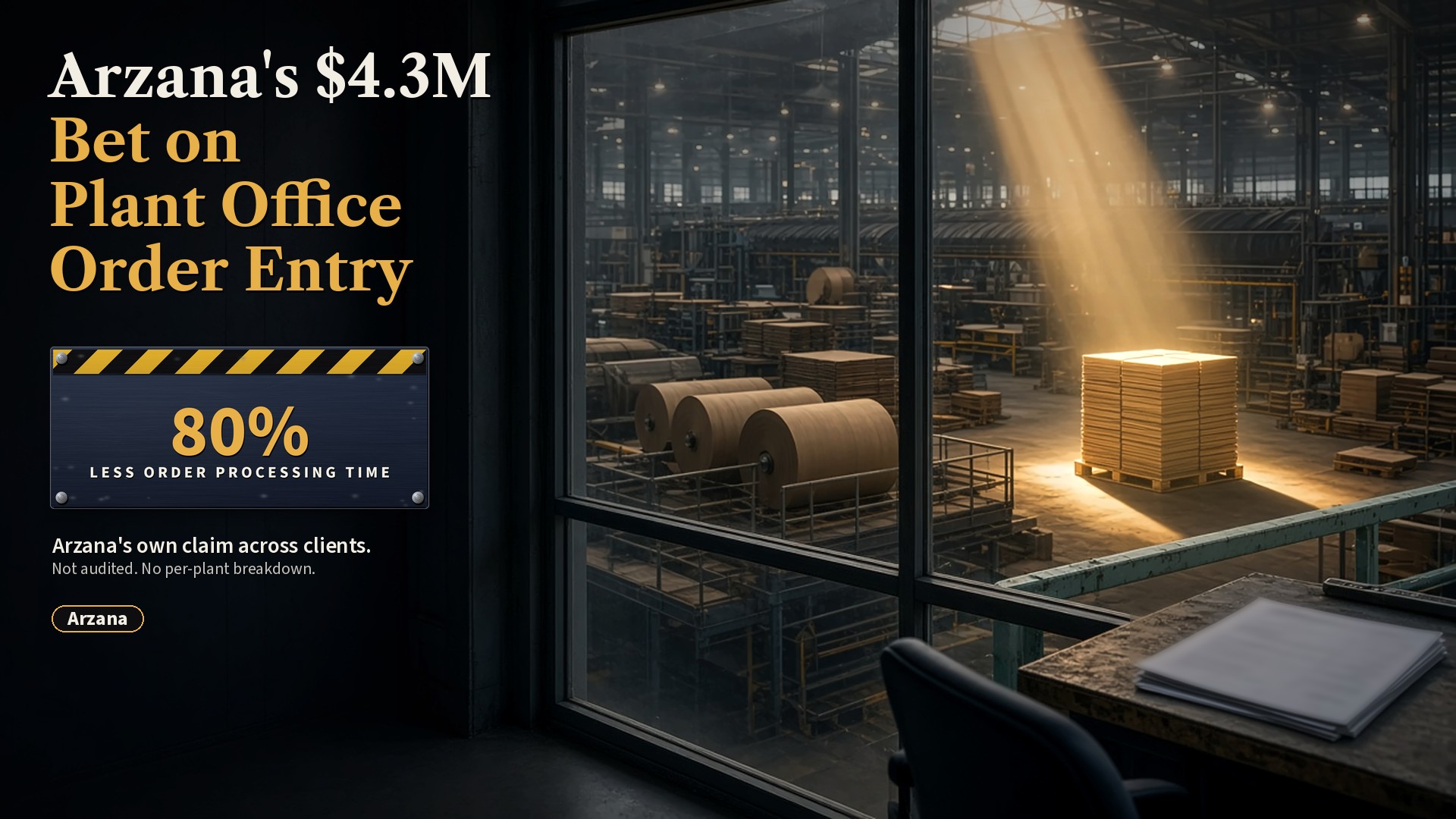
Second, Arzana says clients see an 80% reduction in order processing time. That figure is across clients, and the announcement doesn't break it down by plant, so it tells you the direction Arzana reports rather than what your office would see.
Third, Arzana says its clients have realized more than $1 million in time savings this year. That's an aggregate across all of its clients, and the announcement doesn't explain how the figure was calculated. We won't split it per client or stretch it forward, because nothing in the announcement supports either move.
Arzana also says clients get custom quotes in under three minutes. For the plant office owner reading this, though, order entry is the desk worth looking at first, and that's where we'll stay.
The $4.3 million seed is the company's own statement too. It tells you investors are backing the approach. It doesn't tell you anything about how the agents will handle your customers' paperwork.
Testing it against your own paperwork
Credit where it's due: a vendor that leads with accuracy on purchase orders is pointing at the right risk. The next step is to check that claim against the POs your plant actually receives, because a strong average across someone else's clients isn't the same as a strong result on your customers' layouts.
We'd ask for a trial on a sample of your own recent POs, including the ugly ones. That means the scanned fax, the customer who writes part numbers their own way, the PO with a revised price on page two, and the blanket order, a standing order the customer draws down in releases through the month. If the agent reads those correctly, the 99.9% starts to mean something for your shop.
We'd also want to see the result side by side with what your rep entered, line by line. That comparison is the closest thing you'll have to your own accuracy number, and it's built on your paperwork rather than an announcement.
When a PO doesn't fit the pattern
The real test of any order entry agent is the exception. An exception is any order that doesn't match what the system expects, such as a part number the ERP doesn't recognize, a price that differs from the quote, or a ship date your floor can't hit.
How an agent handles exceptions is a question to put to Arzana directly. Does the agent stop and flag the order, does it guess, or does it post the line and leave a note? Who gets told, and how quickly? Those answers matter more than the headline accuracy, because exceptions are where a wrong order slips into the ERP and onto the floor.
The other question is who reviews an order before it posts. Early on, we'd want a named person on your team looking at every agent-entered order before it becomes real in the ERP. That review can loosen later, once your own numbers justify it.
How we'd hand over the PO desk
We'd treat this as giving the order desk an AI employee, which for us means an agent assigned one desk's recurring work, held to written rules, with a named person reviewing what it produces. The point isn't to replace the rep. It's to move the rep from typing orders to checking them.
We'd start with order entry alone, not quoting and invoicing at the same time. We'd pick the customers whose POs arrive cleanly and often, write down what counts as an exception, and decide who approves before anything posts. Invoicing comes after order entry has a track record, since an invoice built on a wrong order only repeats the mistake.
Here's the short version. The first plant office job to hand to an agent is the one your team retypes all day, as long as a named person reviews every order before it posts. Prove it on your own POs first, then widen what the agent handles one customer at a time.
We've looked at this same handoff before, when we wrote about turning a messy PO into an order and naming who approves the exception. And if quoting is the job eating your week instead, our post on CloudNC and the quoting desk at precision machine shops covers that side.
Measuring the backlog instead of the demo
Arzana's $1 million figure is an aggregate across its clients, and it can't tell you what your plant would save. The way to find out is to measure your own office before and after.
Before the trial, write down how many POs are waiting at the start of each day, how long an order sits before it's entered, and how many entered orders need a correction later. After a month, look at the same three things. If the backlog is smaller and corrections haven't gone up, the agent is doing the job. If corrections climb, the review step is earning its keep, and you've learned that before a wrong order reached a customer.
That's a measurement an owner can trust, because it comes from your own desk.
Common questions about Arzana
What is Arzana?
Arzana is a company building AI agents that automate quoting, order entry, and invoicing on top of existing ERPs such as Epicor, NetSuite, and Dynamics 365. In October 2026 it announced a $4.3 million seed round led by Sunshine Lake VC, with Y Combinator and others.
How to tell whether order entry should go to an agent first
Look for the desk where someone retypes customer POs into the ERP all day, and test the agent on a sample of your own POs, including the messy ones. If it reads them accurately and sends exceptions to a named reviewer before anything posts, order entry is a strong place to start.
How much time does Arzana say it saves?
Arzana says clients see an 80% reduction in order processing time, and separately that its clients have realized more than $1 million in time savings this year in total. The announcement doesn't break the 80% down by plant or explain how the $1 million was calculated, so your own before and after numbers are the ones to trust.
If you want the long version of how we think about readiness, Start with a FREE quiz and Get Your AI Score.