
Blog
ChatGPT and a Franchise Owner's Back-Office Week
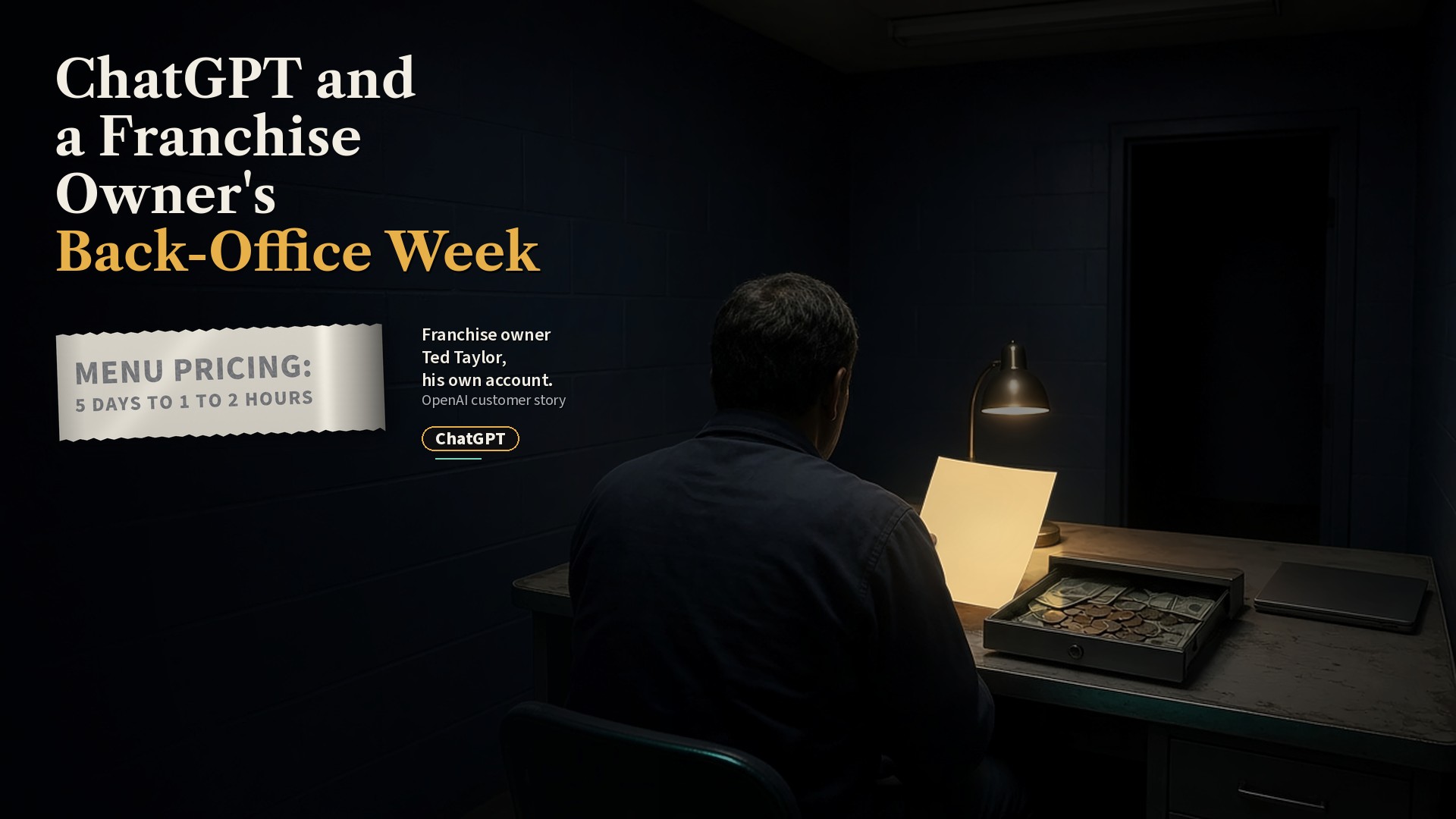
ChatGPT and a Franchise Owner's Back-Office Week
OpenAI has published a customer story about Ted Taylor, who owns three Schlotzsky's and Cinnabon units in New Mexico. Taylor is a franchisee, meaning he owns and runs restaurants under brands that belong to a larger company. A unit is one restaurant location. According to OpenAI's customer story on Ted Taylor, he uses ChatGPT Work for back-office jobs he used to do by hand, and he reports large time savings on several of them.
Here's our honest take. Taylor's numbers are one owner's account, published by the company that sells the tool. Even so, the jobs he describes will sound familiar to anyone running a few restaurants, and that's why we think the story is worth your time. If you do your own books, the useful question it raises is a simple one: where is your back-office week going?
Five days of menu pricing, by his account
The biggest number in the story is about menu pricing analysis. That's the work of checking what each item costs to make against what it sells for, then deciding which prices to change. Done by hand, it means pulling food costs, sales, and current prices into one place. Then someone works through them line by line.
According to OpenAI's customer story, that analysis used to take Taylor five days. With ChatGPT Work, he says it takes one to two hours, which the story describes as a 95% cut.
That's one owner, three units, and his own measurement. We'd read it as an example of what's possible for someone in his position, not as a promise for every operator.
Payroll and the monthly cash count
Taylor reports savings on two more routine jobs. The first is payroll. A payroll run is the regular cycle of totaling hours, checking them, and paying staff. According to the story, he saves four hours of manual work every payroll.
The second is monthly cash reconciliation. Cash reconciliation is matching the cash and card totals each store reports against what actually landed in the bank, then tracking down any gap. Taylor says he now spends 94% less time on his monthly cash reconciliation.
We won't turn the four hours per payroll into a weekly or yearly figure, because the story's numbers don't support that math. Both figures come from him, through OpenAI.
A projection about the schedule, not a result
The story also includes a number about scheduling, and it needs careful handling. Taylor estimates that better AI-drafted schedules could cut his hourly labor by one to two points of sales. Labor percentage is what you pay hourly staff as a share of sales, and a point of sales is one percent of sales. As a made-up example of our own, not Taylor's numbers, labor going from 30% of sales to 29% would be one point.
He projects that change could add $50,000 to $100,000 a year in free cash flow across his three restaurants. Free cash flow is the money left after the business pays its bills and costs.
That's a projection, in his own words a "could." It isn't a result, and it isn't a saving he has banked. We include it because it shows where he thinks the next gain might be, not because it's proven.
Why doing it by hand made sense
None of this means Taylor was doing his back office wrong before. Hand work on pricing, payroll, and cash has a real advantage. The owner sees every number, so problems get caught by someone who knows the stores.
For an owner who does the back office personally, as Taylor did, that work has to fit around running the stores. It's careful work, and it's slow.
The cost of that approach is time, and that's what Taylor's story puts a number on. Five days on pricing is five days not spent with managers, guests, or the stores themselves.
Counting your own back-office hours
Here's what we'd take from the story if we owned a few restaurants. Before thinking about any tool, find out where your back-office time actually goes. A rough sense isn't enough, so write it down.
For one month, keep a simple log. Note each back-office job, how long it took, and how often it comes around. Include pricing reviews, each payroll run, cash reconciliation, scheduling, and ordering.
At the end of the month, sort the list by hours. The jobs at the top are your candidates. Taylor's biggest reported win came from pricing analysis, a job that took him days each time. Your list may look different.
Picking the first job to hand off
Once you have the list, we'd pick one job, not five. Choose something that repeats, follows steps you can write down, and has a clear right answer you can check. Cash reconciliation fits that well, since the totals either match or they don't.
Write down how you do it today, step by step. That written method is what you'd give an AI tool, whether it's ChatGPT Work or something else. It's also what you'd give a new manager, so the effort pays off either way.
Then run the AI version alongside your own for a few cycles. Compare the results. Keep checking the output yourself until you trust it, the same way you'd check a new employee's work.
Keeping the owner's eyes on the numbers
The story describes time saved, not judgment handed over. We think that's the right way to read it. An AI tool can pull numbers together faster, but the owner still decides which menu prices change and whether a cash gap needs a closer look.
That matters even more for a franchisee. If your brand has rules about menus, suppliers, or reporting, any change an AI suggests still has to fit them.
We'd treat the tool as a fast assistant on the prep work. The decisions, and the responsibility for them, stay with the owner.
Checking your month against his
If you try this, measure. Use the hours from your monthly log as the starting point. After a month with the new approach, log the same jobs again and compare.
Taylor's numbers are useful because they're specific: five days to one to two hours, four hours per payroll, 94% less time on monthly reconciliation. Your own numbers will be more useful still, because they'll be about your stores.
If a job doesn't get faster, that's worth knowing too. Write down why, adjust how you set it up, or move on to the next job on your list.
It also helps to share the log with your managers. Do any of them handle parts of the back office, such as counting drawers or approving hours? If so, their time belongs on the same list, because a job that moves off your desk shouldn't quietly land on theirs. Counting everyone's hours gives you the honest picture of where the week goes.
Taylor points to labor as his next possible gain, and we've covered labor before in a look at AI drafting restaurant labor schedules. For bookkeeping work owners often carry themselves, see an AI agent chasing invoices in QuickBooks.
Restaurant back-office questions owners ask
What is ChatGPT Work?
ChatGPT Work is the OpenAI product Ted Taylor uses for back-office jobs at his three restaurants, according to OpenAI's customer story. He reports using it for menu pricing analysis, payroll, and monthly cash reconciliation.
How do I cut back-office time at my restaurant?
Log every back-office job for a month, then pick the one that takes the most hours and follows clear steps. Write down how you do it, test an AI tool alongside your own work, and keep checking the output until you trust it.
How much time did Ted Taylor save with AI?
According to OpenAI's customer story, Taylor says menu pricing analysis went from five days to one to two hours, and his monthly cash reconciliation takes 94% less time. He also reports saving four hours of manual work every payroll, all by his own account.
If you want the long version of how we think about readiness, Start with a FREE quiz and Get Your AI Score.