
Blog
Toast IQ Team Puts an AI Agent on Your Labor Schedule
Toast IQ Team Puts an AI Agent on Your Labor Schedule
On October 6, 2026, Toast launched Toast IQ Team, a labor product for restaurants that pairs sales forecasting with a Scheduling Agent, according to Toast's fall 2026 release. An agent, in plain terms, is AI you hand a whole task and get finished work back from, and this one builds a full schedule in seconds. Toast labels it beta, the software word for an early version that's still being tested and refined.
That's a real tool aimed at a real headache, and Toast deserves credit for going after the weekly schedule. For an independent restaurant, the schedule is one of the first places margin can slip, through overtime that creeps in or a rush you staffed too thin. Toast's own survey says 86% of surveyed operators with 16 or fewer locations are already experimenting with AI for business purposes. Experimenting isn't the same as knowing which back-office job should go first, whether that's scheduling, payroll, or tips, and that choice is still yours to make.
A schedule built in seconds
Toast says the Scheduling Agent builds a full schedule from staff availability, expected sales, and overtime risk. Overtime risk is the chance that a given shift pushes someone past the point where overtime pay starts, so it's the input that speaks most directly to labor cost.
Getting a full draft in seconds changes what the manager's part looks like. The schedule becomes something you review and adjust instead of something you assemble cell by cell.
IQ Team covers more than the schedule. Toast also describes sales forecasting and menu-item contests, and one Toast customer describes using it across payroll, scheduling, contests, and tip management. So the question for an owner isn't whether the product does enough. It's which of those jobs you trust it with first.
That 86% comes from Toast's 2026 Voice of the Restaurant Survey, a blind survey of 676 U.S. restaurant decision-makers with 16 or fewer locations, fielded April 3 to 20, 2026, with a margin of error of plus or minus 4 points. It tells you experimenting is common among those operators. It doesn't tell you which job paid back for them.
Where overtime hides in a normal week
Picture an independent restaurant with a strong weekend and a thin bench. A server picks up a double because someone called out, a line cook stays late after a slammed Friday, and the manager approves both because the alternative is a short floor. None of that feels like a decision about margin in the moment. It shows up later, when payroll lands and the overtime line is bigger than the week's sales can comfortably carry.
The opposite mistake costs you too. Cut the schedule lean to dodge overtime, and the rush lands on fewer people, tickets back up, and service slips on the kind of night guests remember. That's the squeeze a weekly schedule sits inside, with overtime on one side and an understaffed rush on the other.
That's also why we think the schedule is a sensible place for an agent to start. It gets built every week, its inputs are things you already know, and a manager can check the draft before anyone on staff sees it.
The 41% comes with a footnote
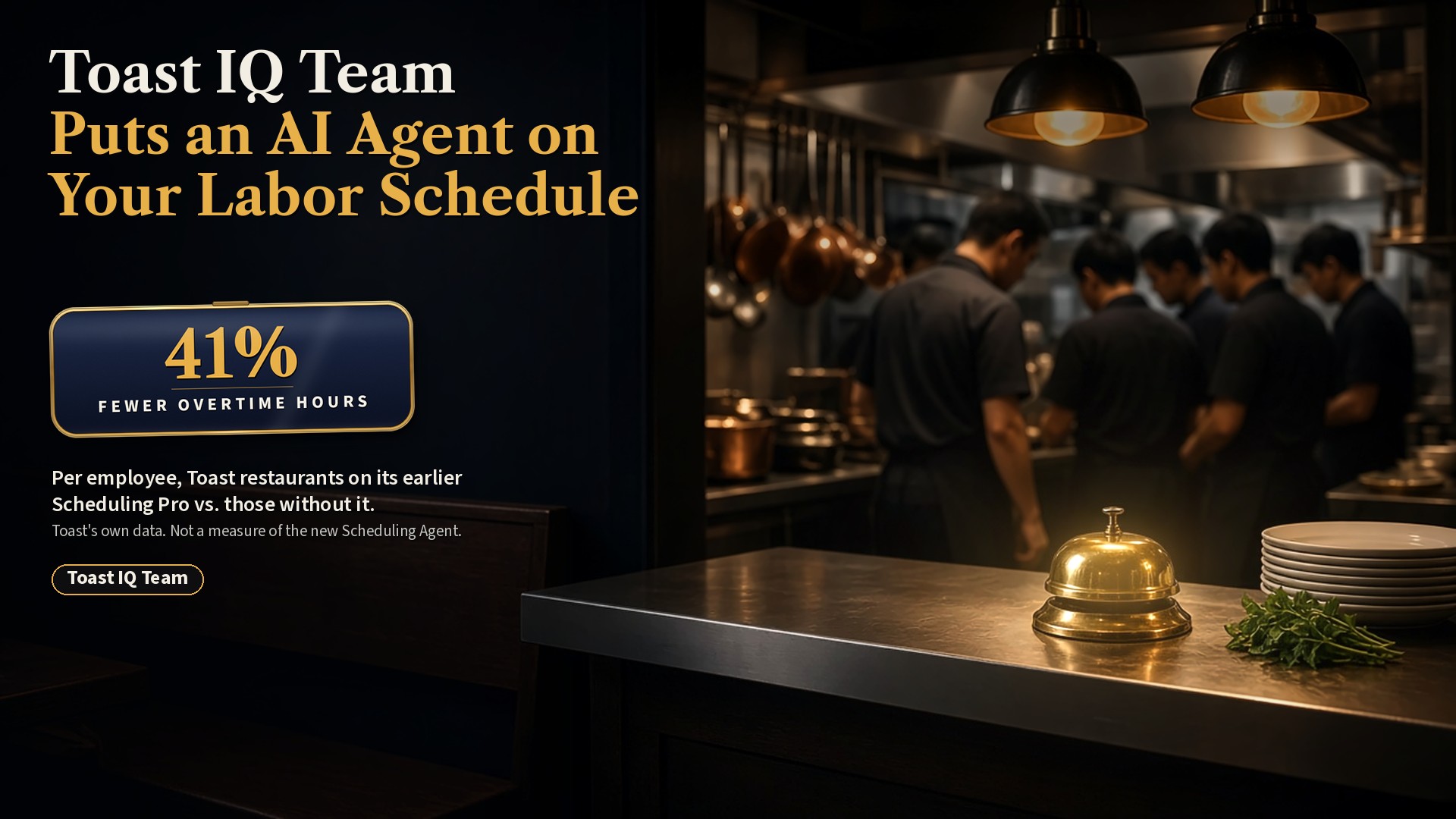
Toast reports that its restaurants using its scheduling tool averaged 41% fewer overtime hours per employee than Toast restaurants not using it. That's a number worth paying attention to, and it's the kind of figure an owner feels on every payroll run.
Read the footnote before you lean on it. The comparison covers July 2025 to 2026 and looks at restaurants using Scheduling Pro, the tool Toast offered before it was bundled into IQ Team, against restaurants that weren't using it. It's a comparison, not a controlled test, so it doesn't prove the tool produced the difference. And because it measured Scheduling Pro, it doesn't cover the new Scheduling Agent, which is still in beta.
So the honest takeaway is narrow. Toast restaurants on its earlier scheduling tool logged fewer overtime hours per employee over that stretch than those without it. Whether the new agent does anything similar in your restaurant is something you'd learn by watching your own overtime line, not by borrowing the 41%.
The back office has more than one job
Scheduling is the headline, but it isn't the only back-office job IQ Team touches. Tricia Rowley, Director of Operations at Madi Group, a business with more than 150 employees, told Toast that IQ Team saves her about 10 to 15 hours a week across payroll, scheduling, contests, and tip management, compared with the separate systems she used before. That's her own estimate for one business, so read it as one operator's experience rather than a number to expect in yours.
Then there's the sales side. A menu-item contest is a staff competition to sell more of a chosen item. Toast reports that restaurants running these contests through IQ Team saw an average 10% sales lift on featured items, a weighted average across 96 contests from February to June 2026. In one four-day contest at MugShots Bar & Grill, June 4 to 7, 2026, alcohol sales rose 14% against the prior week.
Both of those figures measure the featured items, not a restaurant's total sales. Still, they're a useful reminder that labor isn't only a cost line. The crew on your schedule is also the crew selling the items with the best margin, and the same tool is pointed at both.
Our order of operations for the back office
A launch can't decide this part for you. Scheduling, payroll, tips, and contests are different jobs with different stakes, and we'd hand them over one at a time. When we talk about an AI employee, we mean an AI tool given one standing back-office duty, with a named manager who checks its work before it touches anyone's paycheck or shift.
We'd usually look at the schedule first. It repeats every week, the draft is easy to check against what you know about your staff and your nights, and a bad draft costs you an edit rather than someone's pay. The manager reviews the agent's schedule, adjusts the shifts they don't trust it with yet, and only then publishes it.
Payroll and tips come later for us, and not because they matter less. A mistake there lands in somebody's pay, so those jobs need a longer track record and tighter review before an AI employee drafts them. Contests are a different kind of job altogether, a sales call about which item to push, so they stay with whoever knows the margins.
Which job comes first in your restaurant depends on where your week breaks. If overtime is the leak, start with the schedule. If your operations lead loses a day to payroll and tip pooling, start there, carefully. If labor is under control but the featured items aren't moving, a contest may matter more.
Here's the short version we'd give any independent operator. The first back-office job to hand an AI agent is one that repeats every week and that a manager can check before it touches anyone's pay. In a restaurant, the weekly schedule fits that test more easily than payroll or tips do.
We made a similar case about handing over one slice of the books at a time when QuickBooks added its own bookkeeping help. The principle carries over to the restaurant office.
The price, and what it doesn't tell you
Nation's Restaurant News reports that Toast IQ Team starts at $60 a month plus $9 per employee per month. A published starting price at least gives you something concrete to weigh.
What a price can't tell you is the return. We won't run that math, because the figures around this launch measure different things in different restaurants, and none of them stack into a payback for yours. The 41% compares earlier tool users with non-users, the 10 to 15 hours belong to one operator, and the contest lifts cover featured items only.
The way to know is to pick one job, write down how it runs today, such as overtime hours per employee or the time it takes to build the schedule, and look again after a month. If you've already started treating AI spend as a budget line, this is the same habit applied to labor.
Toast IQ Team questions, answered
What is Toast IQ Team?
Toast IQ Team is a restaurant labor product Toast launched on October 6, 2026, pairing sales forecasting with a Scheduling Agent that's still in beta. The agent builds a full schedule in seconds from staff availability, expected sales, and overtime risk.
How do you choose which back-office job to give AI first?
Pick the job that repeats every week and that a manager can check before it touches anyone's pay or shift, which in a restaurant often points to the schedule. Hand over that one job, keep a manager reviewing the drafts, and measure it before you add payroll or tips.
How much does Toast IQ Team cost?
Nation's Restaurant News reports that Toast IQ Team starts at $60 a month plus $9 per employee per month. What it returns in your restaurant depends on which job you use it for, so measure that job before and after rather than borrowing anyone else's numbers.
If you want the long version of how we think about readiness, Start with a FREE quiz and Get Your AI Score.