
Blog
Forgepoint's Frank Drafts the Quote, a Person Approves It
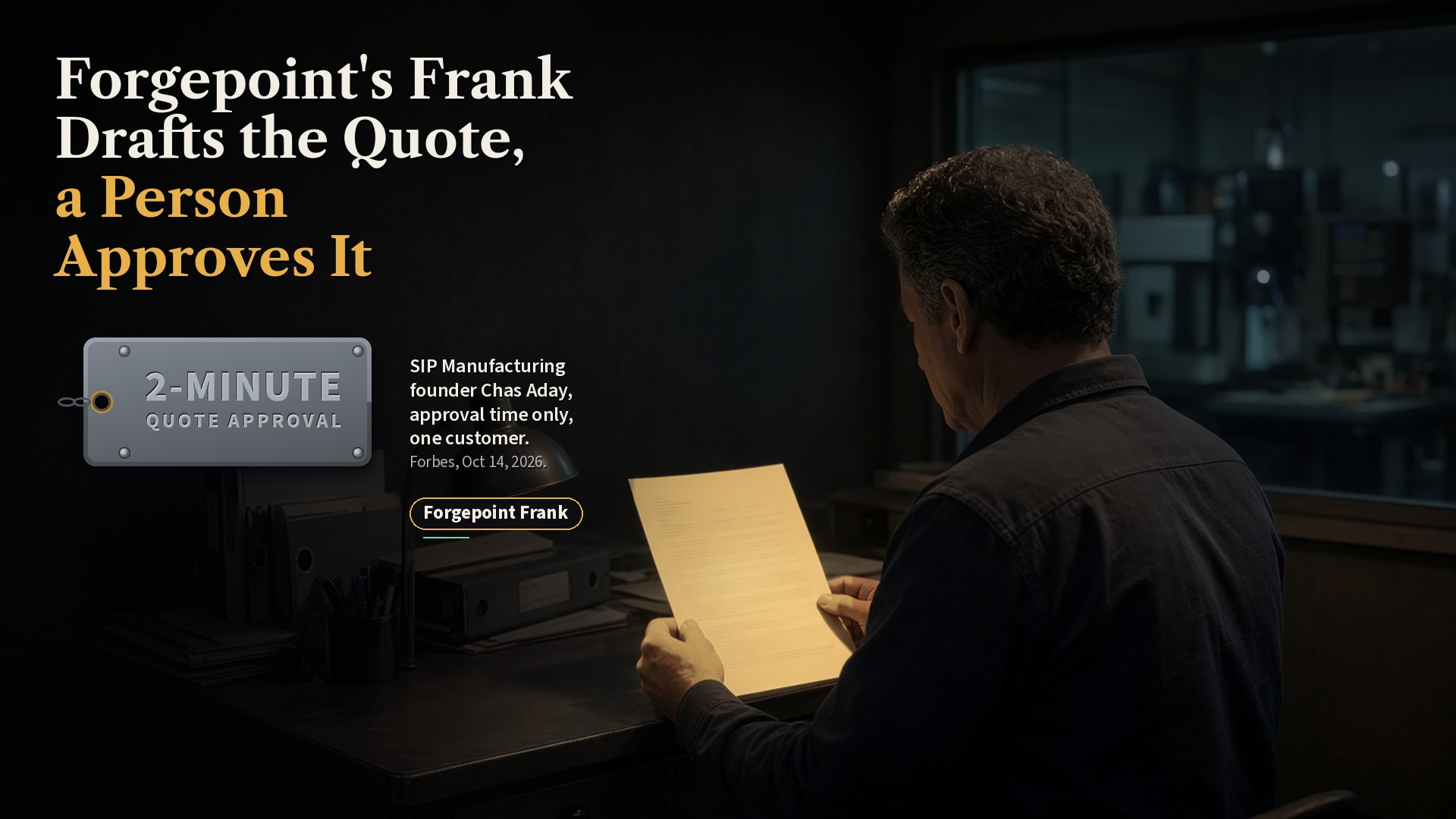
Forgepoint's Frank Drafts the Quote, a Person Approves It
On October 14, 2026, Forbes reported that Forgepoint raised a $9.8 million seed round led by investors Primary Venture Partners and a16z speedrun, according to Forbes' story on the start-up. Forgepoint builds Frank, an AI agent that drafts quotes for manufacturers. An AI agent here is software that works through a multi-step task on its own, in this case turning a customer's RFQ into a draft quote. An RFQ, or request for quote, is the document a buyer sends asking what a part or job will cost.
That's worth a look, and so is the plainest result in the story. Chas Aday is founder and chief revenue officer (CRO) of SIP Manufacturing. He told Forbes his team used to build quotes by hand and barely kept up. Now Frank drafts the quote, and he can approve it in two minutes. If you own a custom shop or a mid-size manufacturer still quoting by hand, our read is that your bottleneck may sit at the quote desk, not on the shop floor.
What changed for Chas Aday at SIP Manufacturing
Aday's account is the most concrete part of the Forbes piece, so it's worth reading carefully. Before Forgepoint, his team built quotes by hand and was barely keeping up. Now Frank drafts each quote, and Aday approves it in two minutes.
That's one customer, and the two minutes describe approval time only. The story doesn't say how long the whole quote cycle takes now, from RFQ in to quote out. So we read it as a change in where Aday spends his time, not as a total turnaround figure.
Still, the shift itself matters. The person who used to build each quote now reviews a draft instead. For an owner who is also the quoting bottleneck, that's the change worth paying attention to.
What Forgepoint reports across its customers
Forgepoint also makes broader claims, and they should be read as the company's own. Forgepoint says its average customer has cut typical time-to-quote by more than 55%, meaning the time from receiving an RFQ to sending a quote. It also says quoting goes from taking days or weeks to a few hours.
Forbes reports those as Forgepoint's claims. No sample size or baseline is given, so we can't tell how many customers that average covers or what they started from.
Forgepoint also says it has processed more than $4 billion worth of RFQs. That's the dollar value of the quote requests that passed through its system. It isn't money customers saved or won, so we treat it as a measure of volume rather than proof of results.
The 24-hour clock your customers are on
The Forbes piece also cites a Gartner study from last year, which found nearly 50% of manufacturers' customers expect a vendor response within 24 hours. That's Gartner's finding as Forbes reported it, and we haven't seen the original report.
Even read secondhand, it gives an owner something to think about. If close to half of customers expect an answer within a day, a quote that takes several days to build may arrive after the buyer has moved on. The figure doesn't say what happens to slower quotes, so we won't put a number on that.
What it does show is that response time is part of what buyers are judging. A shop can make excellent parts and still lose ground if the quote shows up late.
Where the RFQ pile forms
Hand quoting deserves respect. A good estimator, the person who prices incoming work, knows which materials run long, which machines are booked, and which customers always change the drawing. That judgment is why many shops trust hand quotes.
The trouble, in our read, is that the same judgment often lives in one or two people. When those people are also running production or meeting customers, RFQs wait in a pile. The floor might have open capacity, but no quote has gone out to fill it.
That's why we'd look at the quote desk before the floor. The quote desk is the person or team that turns RFQs into priced quotes. If it's the narrowest point in your business, faster machines won't help until quotes move faster too.
Keeping an engineer on every quote
Forgepoint says a human engineer still checks Frank's work. We think that's the right design. It lines up with how Aday describes his role: Frank drafts, then he approves.
A draft quote can be wrong in ways that cost a shop. A tolerance gets misread, a material is priced at last quarter's rate, or a secondary operation gets left off. A person who knows the shop catches those before the quote reaches the buyer.
So the goal isn't to remove the estimator. It's to move the estimator from building every quote line by line to reviewing drafts and handling the hard ones. That keeps the judgment in the loop while letting more RFQs get a timely answer.
It also changes what the estimator's day looks like. Instead of starting each quote from a blank sheet, they open a draft and check it against what they know about the job. When a draft is off, they fix it and note why. Over time, those notes become part of the written method, which makes the next draft closer to right.
Getting your quote desk ready for an agent
Here's how we'd approach it, whether you look at Frank or another tool. We'd treat quoting as a job for an AI employee. As we use the term, an AI employee is one recurring job handed to AI, working from your shop's own rules, with a named person who approves its work before it goes out.
Start by writing down how your best estimator builds a quote. List the inputs they check, such as material, quantity, tolerances, and finishing. Note where they look up rates and which jobs they always price by hand. That written method is what any AI drafting quotes needs to follow.
Next, sort incoming RFQs. Some are repeat parts or simple jobs, while others are complex one-offs. We'd start the agent on the repeat and simple ones, keeping the complex ones with your estimator until the drafts prove reliable.
Then measure. Before you change anything, note how long RFQs wait before a quote goes out. After a month, check the same number. If quotes leave faster while the estimator still approves each one, the desk is no longer the bottleneck.
Here's the short version we'd give any shop owner. If RFQs pile up while the floor has capacity, the quote desk is likely your bottleneck, so have AI draft the simple quotes and keep a person approving each one. Measure how long RFQs wait before and after to see whether it worked.
We've written about nearby jobs before, including AI on a precision machine shop's quoting desk and AI agents taking on plant office order entry. Quoting sits right before order entry, so the two are worth thinking about together.
Job shop quoting FAQ
What is Forgepoint's Frank?
Frank is Forgepoint's AI agent that drafts quotes for manufacturers from incoming requests for quote. Forgepoint says a human engineer still checks Frank's work, and SIP Manufacturing's Chas Aday told Forbes he now approves Frank's drafts in two minutes.
How to speed up manufacturing quotes without losing accuracy?
Write down how your best estimator builds a quote, then have AI draft the simple and repeat RFQs from that method. Keep a person approving every quote before it goes out. Then measure how long RFQs wait before and after.
How much faster can AI make quoting?
Forgepoint claims its average customer cut typical time-to-quote by more than 55%, from days or weeks to a few hours. That's the company's own claim as reported by Forbes, with no sample size or baseline given.
If you want the long version of how we think about readiness, Start with a FREE quiz and Get Your AI Score.