
Blog
IPA 2026 IT Survey: CPA Firms Bought AI, Few Integrated It
IPA 2026 IT Survey: CPA Firms Bought AI, Few Integrated It
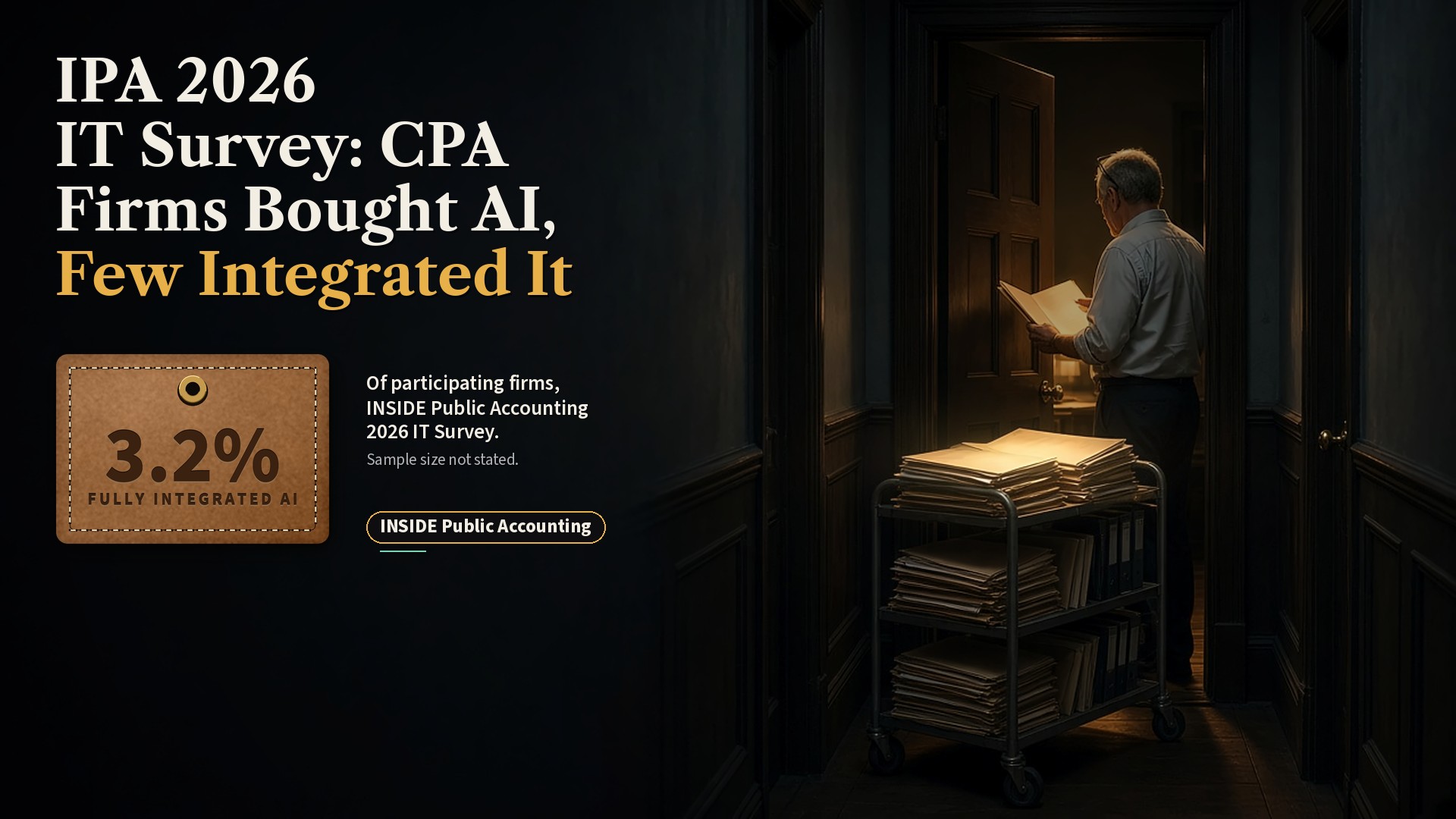
On October 1, 2026, INSIDE Public Accounting published results from its 2026 IT Survey, and the headline is about buying rather than using. Nearly three-quarters of participating firms bought software or modules for AI functionality, according to IPA's recap of the survey. A module here is an add-on to software the firm already runs. Yet only 3.2% of participating firms say AI is fully integrated into how the firm operates, while nearly 43% have seen no measurable impact from their AI tools.
If you're a managing partner who signed for those add-ons, that gap may feel familiar: the license is paid, but busy season, the crunch around tax deadlines, looks the same as last year. Our read is that the tools aren't the weak point. What's missing is the process around them, meaning who uses the AI on which work, who reviews what it produces, and where the freed hours go. No survey in this piece states that cause. It's our interpretation of the distance between bought and integrated.
Bought versus built into the firm
Credit where it's due. Firms that bought AI modules made a reasonable bet on tools their staff can put to work. Buying was never the hard part.
Being fully integrated, in plain terms, means AI is part of how work moves through the firm every day, with defined steps and a known reviewer. It's not a tool a few people open when they remember it exists. By that standard, IPA's 3.2% is a small share of participating firms, even though nearly three-quarters of them bought software or modules.
The staffing line tells the same story from another angle. Almost 8 in 10 participating firms report no noticeable staffing impact from AI. IPA's recap doesn't give a sample size for the survey, so read these as the share of participating firms rather than a count you can project.
Where tax season swallows the saved time
There's an older number that adds context on where saved time goes, though it comes with clear limits. The CPA.com 2025 AI in Accounting Report cites a 2024 Gartner survey finding that AI delivers an average of 5.4 hours per week in gross time savings across finance teams. Yet 69% of that gain is lost to rework, training, or new non-value-added tasks, which are tasks that take time without moving client work forward.
That figure is secondhand, two years old, and drawn from finance teams broadly rather than CPA firms alone. We use it as context, not as a measure of your firm.
Still, picture what it would look like in a tax practice. A preparer uses AI to draft a client memo in minutes. The reviewer, who wasn't told which parts came from the AI, checks every line twice. A question comes back to the preparer, the draft gets reworked, and the minutes saved upfront are spent again during review. Nobody wasted time on purpose. The firm simply had no agreed step for how AI output gets checked.
Review, for any reader outside the profession, is the step where a senior person checks a staff member's work before it reaches the client. In our view, review is already a tight spot during tax season, so any extra checking lands there first.
Two vendor surveys, read on their own
Two more surveys add detail, and both come from vendors, so each one stands alone. Financial Cents, a practice management vendor, ran its own State of AI in Accounting and Bookkeeping 2026 survey of 486 North American professionals from July 15 to August 7, 2026. Practice management software is the system a firm uses to track clients, deadlines, and work in progress.
In that survey, 95% of respondents have adopted AI in some capacity, but only 11% are running with it. Among AI users, more than half save 3 hours a week or less, while only 15% save 7 hours or more. Those are Financial Cents' own bases and numbers, so we wouldn't stack them on top of IPA's.
The second is a joint survey from Blue J, a tax research vendor, and CPA.com of more than 1,000 U.S. tax professionals, released June 8, 2026, as CPA.com reported. It found 60% of those tax professionals use AI for tax research at least weekly, up from 33% in 2025. That's a sign peers are moving, but it measures use rather than results.
Review is where rework piles up
Read separately, without merging them, these findings suggest a pattern to us. Firms are buying AI while people inside them try it out, yet few describe it as part of how they operate. Meanwhile, the time it saves can leak away in rework.
Our read is that the leak happens at handoffs. When a staff member uses AI and passes the result along, the next person has to decide how far to trust it. Without a shared rule, the safe choice is to recheck everything, and in a CPA firm the safe choice is usually the right one. The result is a tool that speeds up the first draft while slowing down the review that follows it.
That's why we'd look at review before we look at any new tool. If your reviewers can't tell what the AI did, where it got its answer, or what it wasn't allowed to touch, the hours it saves will keep landing back on the partner's desk in March.
Building the process around the tool
Here's how we'd approach it, using the tools you've already paid for. We'd give one recurring piece of work to an AI employee. In our language, an AI employee is an AI set up to handle one defined task the same way every time, following the firm's own checklist, with a named reviewer who signs off on the output.
First, pick work with a clear finish line, such as drafting a standard client request list or summarizing documents a client sent in. Second, write the checklist the AI follows, using the same steps your best staff member would. Third, mark the output so the reviewer knows exactly which parts the AI produced and what to check.
That last step is the one that protects review time. A reviewer who knows what to check spends less time rechecking what doesn't need it. It also gives the firm a record of where the AI gets things wrong, which is how the checklist improves before next season.
Here's the short version we'd give any managing partner. Buying AI modules gets the tool into the firm, but it doesn't change how work moves. Integration happens when one defined task has a checklist, a marked output, and a named reviewer. Then the next task gets the same treatment.
We've made a similar case about handing over one slice of the monthly close at a time when QuickBooks added its bookkeeping service. And if the AI add-ons are already showing up as their own cost, our earlier post on AI spend growing with every job you run through it explains why that line deserves the same scrutiny as staff time.
Measuring it before the next busy season
The 43% in IPA's survey describes firms with no measurable impact, and part of the fix is simply measuring. Before you change anything, write down how long the chosen task takes today, including review. Then note how many items come back from review for a second pass.
After a few weeks with the checklist in place, look at the same two numbers. If the task is faster but review returns are up, the rework has just moved down the line. If both improve, you've got the start of a result you can show your partners before tax season arrives.
CPA firm AI in plain terms
What is AI integration in a CPA firm?
AI integration means AI is part of how work moves through the firm every day, with defined steps and a named reviewer, rather than a tool people open occasionally. In INSIDE Public Accounting's 2026 IT Survey, only 3.2% of participating firms said AI is fully integrated into how they operate.
How to stop AI time savings from turning into rework?
Give the AI one defined task with a written checklist, and mark its output so the reviewer knows exactly what to check. Measure task time plus review returns before and after, so you can see whether the saved time actually stays saved.
How much time does AI save accounting professionals?
In Financial Cents' 2026 survey, more than half of AI users said they save 3 hours a week or less, and 15% said they save 7 hours or more. A 2024 Gartner survey cited by CPA.com found finance teams lose 69% of gross AI time savings to rework, training, or new non-value-added tasks.
If you want the long version of how we think about readiness, Start with a FREE quiz and Get Your AI Score.