
Blog
Litify ACE and the First Safe Step on a PI File
Litify ACE and the First Safe Step on a PI File
Litify ACE, Agentic Case Expert, shipped its largest update on September 15, 2026, so a personal-injury firm on Litify can carry a file from missing records to a demand draft. Document Assistant ingests and classifies records, Damages Assistant builds a source-linked medical chronology, ACE sends the medical provider a request for missing documents with a signed HIPAA form attached, Policy Agent tallies damages against the policy, and Instant Demands drafts the packet once damages cross the threshold. Litify's September 15, 2026 newsroom note describes that sequence. You can't turn it on today outside Litify.
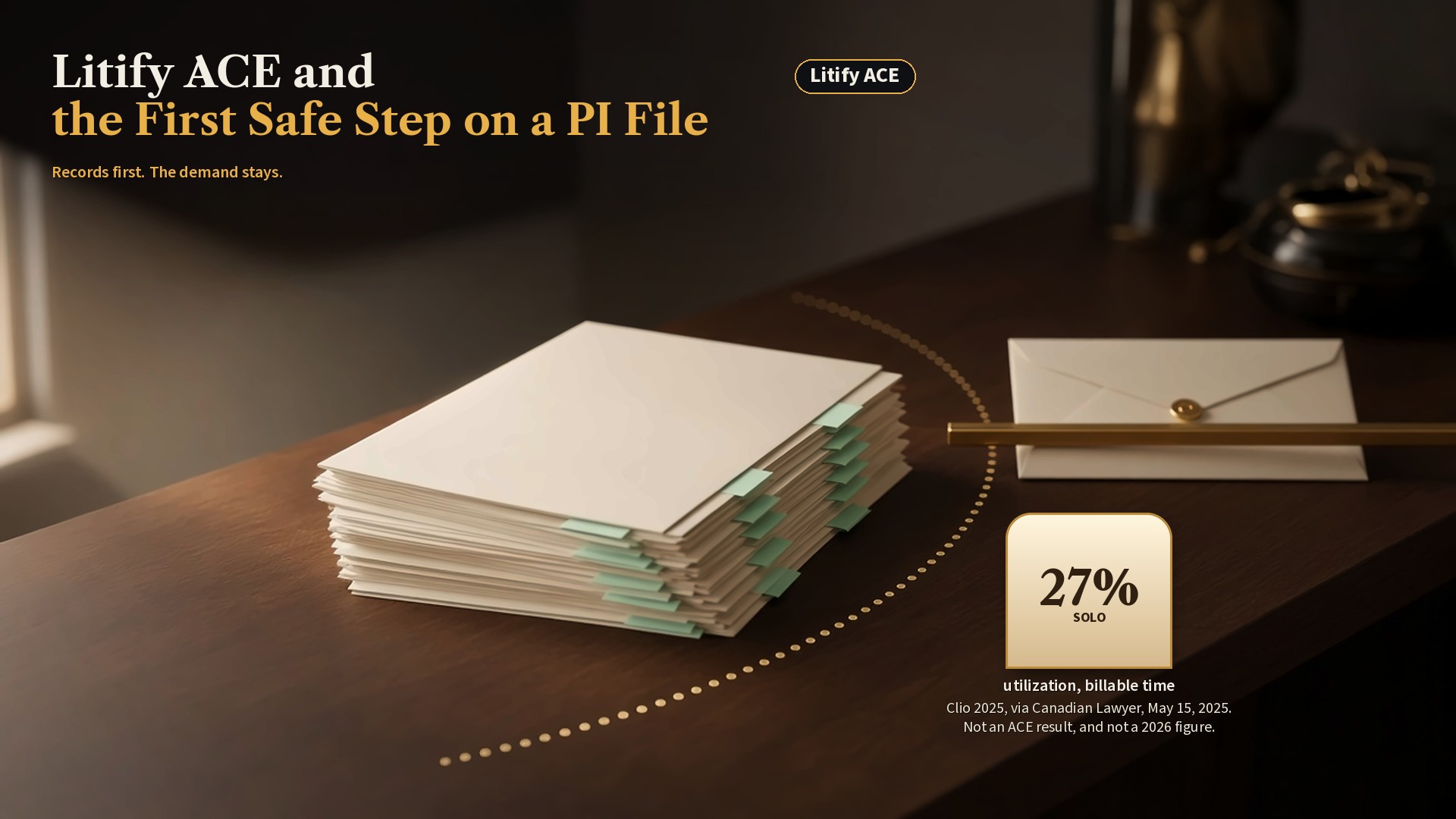
The tool is good, and the real question is which step is safe to hand off first, the records chase or the demand draft. Clio's 2025 figures, as Canadian Lawyer reported on May 15, 2025, put solo utilization at 27% and small-firm utilization at 32%, against about 50% at mid-sized firms. Clio defines a small firm here as five or fewer full-time employees. If you're still the person chasing records, that 27% or 32% means the week is already spoken for before a demand exists.
The week the file stalls
Joshua Lenon of Clio said these owners spend the least time on billable work because they wear many hats, including business development, client intake, and admin. You feel that as a solo or small plaintiff lawyer who still lives in the file. A demand can look sloppy, or the case stalls because the records chase ate the week. Time is the inventory you sell, and the license on the door is what a referral source remembers.
The job is to move a matter from new records to a demand packet without retyping the file, and to keep you on the strategy. Pages sit with the provider, and the file waits because you're the only person who knows which pages are still out.
A first AI hire, in our language, is the first named job you hand the software, not a blank box you hope the staff will use wisely. On this file that job is the records chase or the demand draft. A stop rule, in our language, is the line it may not cross without you, and here that line is a demand or a record request that leaves the firm. Sorting what came in can sit on your side of that line. A provider letter with a signed HIPAA form on it cannot.
Where the chain leaves the building
Document Assistant takes the records in and classifies them. Damages Assistant builds a source-linked medical chronology, which means a treatment date stays attached to the page it came from. If someone later asks where a date came from, you want that page.
ACE then sends the medical provider a request for missing documents with a signed HIPAA form attached. That's useful, and it's the first moment something leaves under the firm's name. Policy Agent tallies damages against the policy, which is the comparison you already make before you call a case ready. Instant Demands drafts the packet once damages cross the threshold, so you get a draft rather than a letter that has already gone to the carrier.
If the matter doesn't live in Litify, none of that chain is yours to switch on. ACE isn't a separate tool a firm turns on in some other system. Hand off a step the file already passes through inside Litify, or wait until the matter is actually there.
What the 2025 survey counted
Litify's 2025 State of AI in Legal is a commissioned nationwide survey. Adoption rose from 23% in 2023 to 78% in 2025, while less than 15% of organizations report business impact. The same survey says 67% of organizations increased AI investment in the past year. Those shares are in Litify's 2025 State of AI in Legal report, which Litify commissioned. They aren't a measured return for firms running ACE, and they don't show that buying ACE raises utilization or that spending more caused the impact.
Most respondents use general-purpose tools: ChatGPT at 66%, Microsoft Copilot at 42%, and Google Gemini at 24%. Less than 50% say they get enough AI training, and even fewer work somewhere with an AI policy. Usage is still mostly research, summarizing a matter, or drafting. That's a count of tools people open, not proof those tools recover fees. It also isn't a reason to drop a client's records into a chat box with no firm rule behind it.
Flat fees, larger firms, and referrals
Canadian Lawyer's May 15, 2025 article is the Clio 2025 coverage behind those utilization rates, and it isn't a 2026 refresh. The same piece says solo and small firms are more likely than mid-sized firms to offer flat-fee services, 15% versus 9%. That is who offers a flat fee, not a share of revenue. Around 80% of solo firms that use flat fees apply them to the entire matter.
On a matter priced as a whole, time the records chase gives back is room for another client, not a shorter invoice. An hourly practice can fear that faster drafting shrinks the bill. A flat-fee practice can save the time and then leave it on the table.
In that Clio coverage, 59% of larger firms have adopted AI more widely, and 11% report full implementation. Lenon said smaller firms have barely dipped in, mostly experimenting with ChatGPT. That 59% is about larger firms. It isn't a small-firm score, and it isn't an ACE result.
Referrals are the other 59%, on a different desk. They're the top lead source for 59% of solo and small firms. When referrals bring the work in, a sloppy demand and a stalled records chase are the two risks you can name without guessing.
A chatbot doesn't choose the step
Opening ChatGPT, Copilot, or Gemini, at the shares above, still doesn't give you a first AI hire on the matter. The fear that fits is staff using a general chatbot on client facts, with no policy, while the bill goes up anyway. A chatbot with no training isn't how you pick the records chase or the demand draft. A summary can be handy, and it still isn't a chronology tied to the page or a packet set against the policy.
We already wrote those jobs up, in the Westlaw post and the NetSuite post. This file is a different job.
Three checks, then the quiz
- Name the step. Choose the records chase or the demand draft, not both in the same week. We'd name the records chase first, because that's the stall while you still live in the file, and we'd leave the demand draft with you until you've read it.
- Point it at this firm's real files. A sample chronology won't show whether Document Assistant can classify the records you actually receive, or whether Damages Assistant stays tied to your pages.
- Put a stop rule on anything that sends a demand or a record request out. Litify's update says ACE sends the provider request with a signed HIPAA form attached, so that send is a real product step. Your rule can still hold it until you've seen it. The same rule covers a demand if a later step would send one. A draft in the matter isn't a letter that already left.
Then stop there. The only next step is to find out whether that named job is ready on your files.
The step we'd name first
Start with the records chase, not the demand draft, because the chase is what eats the week while you're still the person living in the file. Keep the demand draft in your hands until you've read it, and don't let a record request leave the firm until your stop rule says it can.
What to settle before you hand a file off
What is Litify ACE?
Litify ACE is Agentic Case Expert, and the September 15, 2026 update lets a personal-injury firm on Litify move a file from missing records through a demand draft. It runs inside Litify, so it isn't a tool any firm can turn on if the matter sits in another system.
How do you choose the first step on a PI file?
Name either the records chase or the demand draft, point that one step at files this firm already has, and keep your stop rule on any demand or record request that would leave. The quiz is the only next step after those checks, so you aren't guessing from a product tour.
How much is a stuck utilization rate?
Clio's 2025 figures, as Canadian Lawyer reported on May 15, 2025, put solo utilization at 27%, which is a rate of billable work and not a price. That 27% isn't Litify's fee, isn't an hour count, isn't a dollar total, and isn't an ACE customer result.
If you want the long version of how we think about readiness, Start with a FREE quiz and Get Your AI Score.